


Article 1 – Complete Care Model
3.1.2 Scope of Patient Care Services
-
Procedure Overview
-
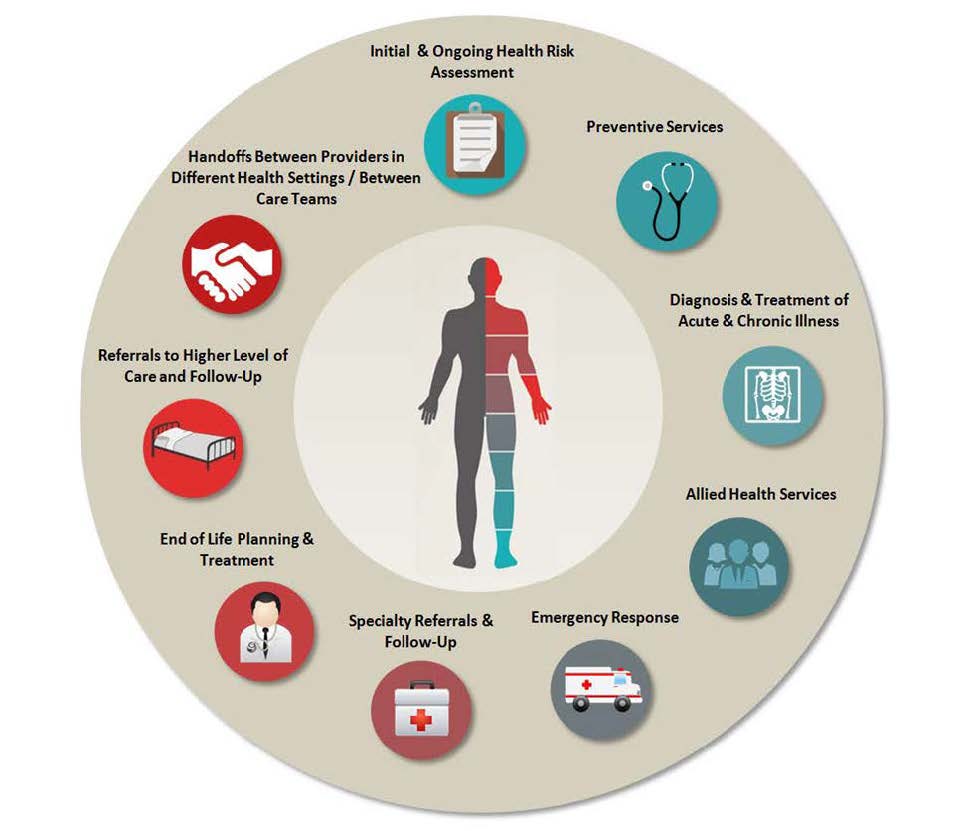
Under the Complete Care Model (CCM), an assigned Primary Care Team (PCT) serves as the center of each patient’s Health Home, directly delivering the majority of dental, medical, mental health, and nursing services and coordinating all care that falls outside the team’s scope of services (refer to the figure below). Applicable standards for the delivery and coordination of the services outlined in this procedure can be found in existing California Correctional Health Care Services (CCHCS) and Division of Health Care Services policies and procedures. PCTs remain responsible for adhering to these standards under the CCM (refer to Appendix 1, Services and/or Coordinated by the Primary Care Team and Associated Standards in the Health Care Department Operations Manual).
-
Complete Care Model Patient Care Services
-
-
This procedure incorporates existing policies and procedures that describe the scope of primary care services provided and coordinated by the PCTs to fulfill their role as the center of each patient’s Health Home by following the CCM. Refer to the Health Care Department Operations Manual and the Mental Health Services Delivery System Program Guide. In addition, the PCTs shall utilize existing decision support tools such as Care Guides, Nursing Protocols, Order Sets, Standing Orders, etc., when providing services.
-
-
Responsibility
-
Statewide
-
California Department of Corrections and Rehabilitation and CCHCS departmental leadership at all levels of the organization, within the scope of their authority, shall ensure administrative, custodial, and clinical systems are in place and appropriate tools, training, technical assistance, and levels of resources are available so that Care Teams can successfully implement the Scope of Patient Care Services Procedure.
-
-
Regional
-
Regional Health Care Executives are responsible for implementation of this procedure at the subset of institutions within an assigned region.
-
-
Institutional
-
The Chief Executive Officer (CEO) has overall responsibility for implementation and ongoing oversight of a system to provide management of the Scope of Patient Care Services. The CEO delegates decision-making authority to designated Institutional Health Care Executives for daily operations of the Scope of Patient Care Services Procedure and ensures adequate resources are deployed to support the system.
-
The CEO and all members of the institution leadership team are responsible for ensuring all necessary resources are in place to support the successful implementation of this procedure at all levels including, but not limited to, the following:
-
Institution level
-
Patient panel level
-
Patient level
-
-
The CEO and all members of the institution leadership team shall ensure access to and utilization of equipment, supplies, health information systems, patient registries and summaries, and evidence-based guidelines.
-
The CEO and all members of the institution leadership team as a part of the Quality Management process on an ongoing basis shall:
-
Review and compare institutions’ PCT performance, including the overall quality of services, health outcomes, assignment of consistent and adequate resources, utilization of Dashboards, Master Registries, Patient Summaries, decision support tools and address issues pertaining to delivery of the Scope of Patient Care Services.
-
Provide PCT members with adequate resources, including protected time, staffing, physical plant, information technology, and equipment/supplies to accomplish daily tasks.
-
Work with custody staff to minimize unnecessary patient movement and ensure appropriate escort and transport.
-
-
The Chief Nurse Executive is responsible for the overall daily clinic operations and ensuring that the institution has designated supervisors to monitor clinic operations including, but not limited to:
-
Efficiency.
-
Coordination.
-
Supplies.
-
Equipment.
-
Physical plant issues.
-
Scheduling and access to care on a daily basis.
-
Identifying and addressing or elevating concerns regarding barriers.
-
-
-
-
Procedure
-
Services Delivered and/or Coordinated by the Primary Care Team
-
The PCT is responsible for coordinating care for patients within the assigned panel and pulling in other health care staff as necessary to meet the needs of the patient. The PCT identifies services that are outside of the team’s purview, coordinates patients’ access to necessary services, and ensures appropriate follow up after services have been provided by other providers in other health care settings.
-
The PCT provides the full scope of primary care services to patients within an assigned patient panel including, but not limited to:
-
Care coordination.
-
Initial and ongoing health risk assessment.
-
Preventive services, such as health screenings, health promotion, and health maintenance services.
-
Diagnosis and treatment of acute and chronic illness.
-
Allied Health Services required for diagnosis and treatment of acute and chronic illness such as diagnostic testing, medication administration, nutritional services, and health care equipment and supplies.
-
Emergency response.
-
Planning for end-of-life care such as advance directives, Physicians’ Orders for Life-Sustaining Treatment, and palliative care.
-
Specialty referrals and follow up.
-
Referrals to higher levels of care and follow up.
-
Facilitating handoffs between providers in different health care settings or between Care Teams to ensure the best possible care for the patient and continuity of planned care, pending appointments or services, medications, medical equipment and supplies, and all other necessary treatment.
-
-
-
Appendices
-
Appendix 1: Services Delivered and/or Coordinated by the Primary Care Team and Associated Standards in the Health Care Department Operations Manual
-
-
References
-
Health Care Department Operations Manual, Chapter 3, Article 1, Section 3.1.1, Complete Care Model
-
Health Care Department Operations Manual, Chapter 3, Article 3, Dental Care
-
California Department of Corrections and Rehabilitation, Mental Health Services Delivery System Program Guide, 2009 Revision
-
National Committee for Quality Assurance – Patient-Centered Medical Home Recognition http://www.ncqa.org/Programs/Recognition/Practices/PatientCenteredMedicalHomePCMH.aspx
-
The Joint Commission Primary Care Medical Home Certification
http://www.jointcommission.org/accreditation/pchi.aspx -
Agency for Healthcare Research and Quality – Patient Centered Medical Home Resource Center https://www.ahrq.gov/
-
Commonwealth Fund – Safety Net Medical Home Initiative
http://www.commonwealthfund.org/interactives-and-data/multimedia/videos/2011/safety-net-medical-home-initiative -
Robert Wood Johnson Foundation / Improving Chronic Illness Care – The Chronic Care Model http://www.improvingchroniccare.org/index.php?p=About_US&s=6 and Reducing Care Fragmentation http://www.improvingchroniccare.org/downloads/reducing_care_fragmentation.pdf
-
-
Revision History
-
Effective: 06/2016
Revised: 03/2017
-
-
Appendix 1: Services Delivered and/or Coordinated by the Primary Care Team and Associated Standards in the Health Care Department Operations Manual
Service Type Applicable Standards Initial and Ongoing Health Risk Assessment ∙ Reception Center (HCDOM Section 3.1.9)
∙ Health Care Transfer (HCDOM Section 3.1.10)
∙ Comprehensive Accommodation (HCDOM Section 3.6.2)
∙ Medical Classification System (HCDOM Section 1.2.14)
∙ Care Team and Patient Panels (HCDOM Section 3.1.3)
∙ Scheduling and Access to Care (HCDOM Section 3.1.6)
∙ Population and Care Management Services (HCDOM Section 3.1.7)Preventive Services ∙ Public Health and Infection Control (HCDOM Chapter 3, Article 8)
∙ Patient Health Care Education (HCDOM Section 3.1.4)
∙ Patient Care During Pregnancy and Childbirth (HCDOM Section 3.1.17)
∙ Dental Services (HCDOM Chapter 3, Article 3)Diagnosis and Treatment of Acute and Chronic Illness ∙ Scheduling and Access to Care (HCDOM Section 3.1.6)
∙ Medication Management (HCDOM Chapter 3, Article 2)
∙ Clinical Guidelines (HCDOM Section 1.2.2)
∙ Gender Dysphoria Management (HCDOM Section 4.1.7)
∙ Hepatitis C Management
∙ Nursing Services/Protocols
∙ Dental Services (HCDOM Chapter 3, Article 3)Allied Health Services ∙ Laboratory Services (HCDOM Section 3.1.15)
∙ Medical Imaging Services (HCDOM Section 3.1.14)
∙ Outpatient Dietary Intervention (HCDOM Section 3.1.12)
∙ Durable Medical Equipment and Medical Supply (HCDOM Section 3.6.1)
∙ Pharmacy Services (HCDOM Chapter 3, Article 5)Emergency Response ∙ Emergency Medical Response (HCDOM Chapter 3, Article 7) Specialty Referral and Follow-Up ∙ Outpatient Specialty Services (HCDOM Section 3.1.12)
∙ Utilization Management Program (HCDOM Section 1.2.15)
∙ Physician Orders for Life Sustaining Treatment (HCDOM Section 2.4.2)End-of-Life Planning and Treatment ∙ Palliative Care and Treatment (HCDOM Section 3.1.18)
∙ Advance Directive for Health Care (HCDOM Section 2.4.1)
∙ Physician Orders for Life Sustaining Treatment (HCDOM Section 2.4.2)Referrals to Higher Levels of Care and Follow-Up ∙ Health Care Transfer (HCDOM Section 3.1.10)
∙ Specialized Health Care Housing (HCDOM Section 3.1.11)Handoffs Between Providers in Different Health Settings/Between Care Teams ∙ Health Care Transfer (HCDOM Section 3.1.10) -
This list is not a complete listing of all associated policies and procedures.
-