

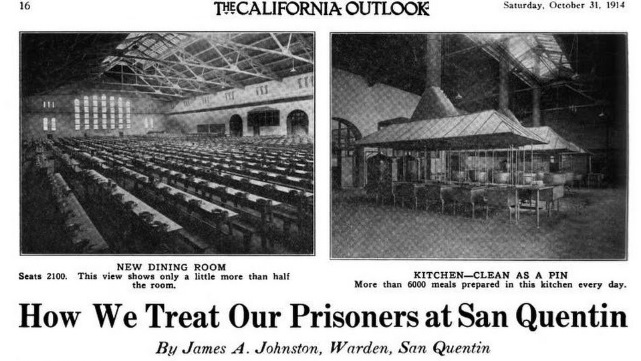
San Quentin Warden James Johnston published an article on San Quentin State Prison reforms on Oct. 31, 1914, in The California Outlook.
The warden’s piece described reception, recreation, parole and the general treatment of inmates at the state’s oldest prison.
At the time, the institution still incarcerated females. Often referred to as the reform warden, Johnston had previously served as the warden at Folsom Prison.
Warden Johnston’s efforts mirror those of today
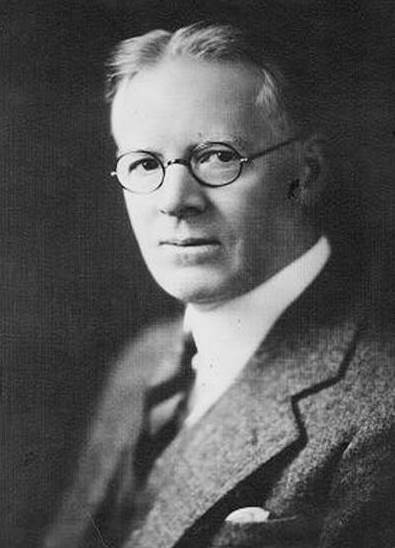
Much like CDCR’s current reform efforts, over a century ago Warden Johnston pushed for fair treatment and job training.
“San Quentin has a population today of 2,232, (with) 23 (of those being) women. All nationalities and all colors are represented,” he wrote. “They come from every county in the state, every state in the union, and every corner of the earth. (What is) given most thought is the care of their health, the advancement of education, the teaching of trades, the building of character. (This all is in) preparation for (their) return to society as law abiding citizens.”
He pointed to the tremendous costs associated with apprehending, trying and confining criminals.
“Crime, in all its shades and degrees of classifications, has received more attention than the criminal. We have noted the damage and lamented the loss but neglected the cause,” he wrote.
“The offender’s physical and mental and moral development, too long disregarded, must receive attention. The effort to redeem the man begins the moment he gets inside the gate. Everything possible is done to prevent despair and to arouse hope, to supplement sickness with health, (and) ignorance with knowledge.”
Addressing substance abuse in 1914
Offenders battling substance abuse has long been an issue for the state prison system.
“Many of those (in) prison have been addicted to morphine, opium or other drugs which makes their condition really pitiable. All such cases are assigned to the hospital immediately and given a treatment which is humane,” he wrote. “The change in appearance in drug (addicts) is really remarkable after treatment.”
In 1912, the state began hiring dentists to work in the prisons.
“The dental department has rapidly grown to be one of the most important in the institution. Two years ago, a dentist was first employed at a California prison. Now the dentist at San Quentin has six inmate assistants and they barely keep up with the work. How they managed to get along in years past is beyond understanding,” he wrote.
Education and job training efforts
“If the man is illiterate, he is assigned to school. Young men in need of rudimentary training are assigned to half day at work and half day at school. Men of mature years are placed in night schools,” he wrote.
The prison also worked with the University of California to offer courses to inmates.
“In the short time this opportunity has been available (at) San Quentin, 578 have enrolled (in) agricultural or academic courses. (Meanwhile,) 123 have completed their courses.”
Johnston thanked the governor and state legislature for acknowledging the need to train incarcerated people with employable skills.
“(The governor’s) foresight saw the necessity for training men at employments at which they might work after release. With his usual energy and great courage, he put through the legislation which has since enabled us to start manufacturing (for) the state-use system.”
According to Johnston, items crafted by the prisons were “for the use of other state institutions. At the present time, we are making shoes, clothing, tinware, beds and furniture. These articles are used in the hospitals, homes and reformatories and normal schools and offices of the state boards and commissions. Nothing is sold in the open market.”
This is similar to the modern California Prison Industry Authority.
Butchers, bakers, and barbers
The warden also touted the other job training areas of the prison, including “plenty of work for cooks, waiters, butchers, bakers, barbers and teamsters. Office men, bookkeepers and stenographers find ample opportunity for exercise of their talents in the various offices, receiving and shipping departments and commissary.”
With the popularity of automobiles on the rise, the state sought to improve the roads and implemented inmate road construction camps.
“We (also) operate a foundry and machine shop, tinning, roofing, carpenter, plumbing and paint shops, electric station, ice making and cold storage plant, laundry, print and book bindery. About 100 men work on the farm, half that number building and repairing roads and several hundred on construction work. The road work is done on the honor system. The men work under the supervision of a road boss (without) armed guards.
“Monotony, the daily grind, the deadly curse, takes hold of people shut in to a degree not appreciated by those at liberty,” he wrote. “To counteract it, work, change of work, study and play. Baseball, the great national game, is favorite and moving pictures, when we have them, come next. The mere statement that baseball and the movies lead in favor, shows how much we are alike. Believe me, our brothers behind the bars are very human.”
Critics claim prison reforms are ‘over kind’
Warden Johnston took aim at critics who claimed inmates didn’t deserve opportunities for self-improvement.
“At times we have been criticized by some people who are pleased to regard our methods as over kind. There are some of the critics of the new penology who do not seem to be satisfied unless the convicted man is doing his time hard and who would have his punishment and degradation to be the limit. They usually associate punishment with correction and discipline. I have found that there is very little relation between them. Good discipline is more likely to result from intelligent management that discovers and removes the causes of conflict, friction and disorder, than from severe measures used as punishments for the happenings which might have been avoided.”
The warden believed rewards for good behavior offered better results among the inmate population. Earlier, he had ended cruel punishment at Folsom.
“For many years it was the practice (at Folsom) to use the harshest and most drastic forms of punishment to impress prisoners who committed infractions of the rules,” he wrote. “Before I went (to Folsom), Governor Johnson told me that the stories and complaints of cruelty received by him were sickening and he hoped that we should be able to demonstrate that it was possible to manage penitentiaries without cruelties, indignities and middle-age barbarities. Today the ‘hooks,’ ‘doors,’ and ‘straight jacket’ have disappeared from California prisons. Increase in the number of privileges possible for good behavior is much more effective and has the additional merits of being intelligent and humane. … In every walk of life and with all kinds of men, I have found great power in kindness but in no other place or under any conditions does it pay as many dividends in responsiveness as in prison.”
Warden’s efforts echo those of today
Johnston wrapped up his piece by listing concise goals of the institution.
“We are not making things easy for prisoners but we are endeavoring to make things better for them. We are trying to make every man who comes under our charge understand:
- “That the violator of the law is an obstruction in the way of social progress and that he cannot offend with impunity.
- “That every human being enjoying the rights of liberty is accountable for his conduct.
- “That he is a part of the social and economic machinery of the government and though but a unit, still a unit that must be reckoned with.
- “That he owes it to himself, his family and his fellow beings to make the best effort of which he is capable towards self-support.
- “That he must respect the personal and property rights of others.
- “We are trying to teach these things by incentive, encouragement and example.
- “We accept him for the time being as a ward of the state and we are exerting the whole power of the state to make him better because of his experience, not worse, and trying to make that betterment all-sided – physical, mental and moral.”
By Don Chaddock, Inside CDCR editor
Learn more about California prison history.
Follow CDCR on YouTube, Facebook, X (formerly Twitter). Listen to the CDCR Unlocked podcast.