

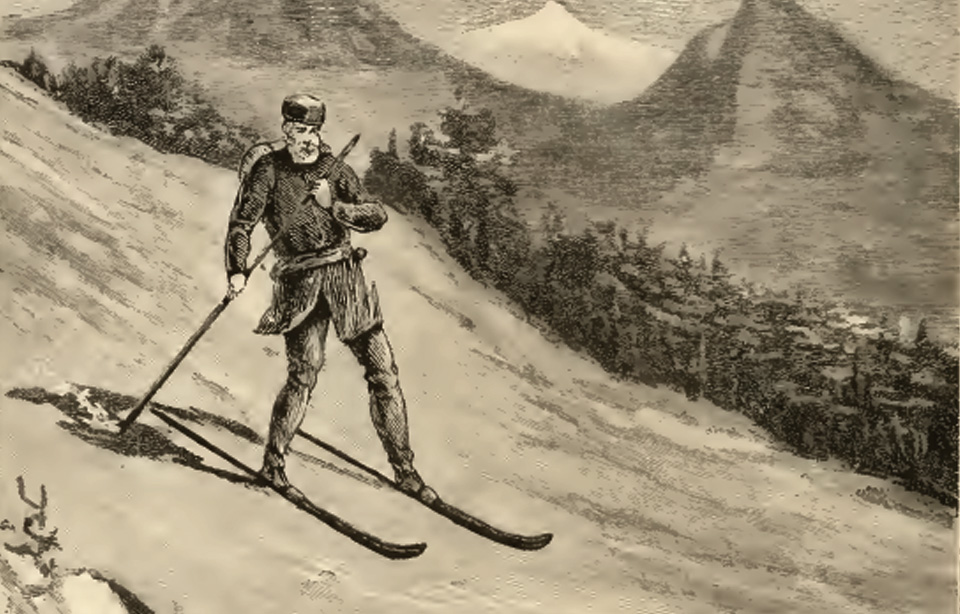
When San Quentin received mail from the east in the 1850s, they probably had John “Snowshoe” Thompson to thank.
Norwegian immigrant Snowshoe Thompson arrived in the Golden State like many others at the time, lured by the promise of gold. While he tried mining, he found his calling when he saw a newspaper advertisement seeking help delivering packages over the snowbound mountain passes.
In the early years of statehood, there was no railroad while telegraph lines and roads were scarce. Thompson used what we’d refer to today as skis, but back then, he called them snowshoes. Despite promises of payment on both sides of the mountains, he was not compensated for his efforts.
One of the few survivors of an 1860 altercation with Native Americans, Thompson served when asked, despite the risks. Inside CDCR takes a closer look at a man who stepped up to help shape California.
The lure of the Gold Rush
From the age of 2, Thompson was raised by his widowed mother. The family relocated from Norway to the U.S., slowly moving west. Eventually the California Gold Rush lured Thompson, by then a young man, to try his hand at mining in Placerville.

By 1851, it became apparent communication with California and the western area of modern-day Nevada was difficult at best without regular mail service.
Supplies and goods were shipped around the tip of South America or delivered to central America, loaded onto overland wagons to be hauled across the jungle, then reloaded on ships for transport to California. This process was time-consuming and expensive. Meanwhile, overland routes from the east were nearly impassable, especially during winter.
“The time and the conditions (were difficult as) there were no buildings or store houses for the safe keeping of goods, no banks, vaults or safes for the deposit of money or valuables. There were no telegraph lines, no quick communication between town or camp. Ever restless, ever on the move, men would be in Sonora today and gone tomorrow. No one paid the least attention to their coming or going,” according to “California Men and Events, 1769-1890,” by George Henry Tinkham, published in 1915.
The state legislature worked with the federal government find solutions.
“We are glad action is about being taken to (improve) mail regulations in California. There is no state in the Union which labors under half the disadvantages of California. Senator Gwin has been furnished with a list of practicable routes by Col. Johnson, the Census Commissioner, and Gen. Douglass, Marshal of the State,” reported the Sacramento Transcript, March 5, 1851.
West coast cut off during winter months

Two years later, efforts were still underway to maintain steady contact with California. Because so many people moved about in the west, it was often difficult to locate the sender’s intended recipient.
“By an act of Congress, approved (in) 1853, the Postmaster General was authorized to make such arrangements as he might deem advisable to insure, as far as possible, the delivery of letters sent by mail from the Atlantic states to California and Oregon to the individuals to whom they may be directed,” reported the Sacramento Daily Union, May 26, 1856.
“And we are gratified to learn (this) is about to be accomplished in what appears to us to be a safe, prompt, judicious and responsible manner,” the paper reported.
“The importance of this enterprise will be appreciated when we state that of the letters sent to California during the year, nearly one-sixth have been returned to the Dead Letter Office. Thousands of letters sent to the Pacific coast become dead letters,” reported the newspaper.
Thompson answers the call for help
When his adopted country pleaded with the public to help carry mail across the Sierra, Thompson answered.
“He took the job after seeing an ad in the Sacramento Union, ‘People Lost to the World; Uncle Sam Needs a Mail Carrier,'” according to the Smithsonian’s National Postal Museum. “To get the mail through, ‘Snowshoe’ Thompson weathered huge snowdrifts on 25-pound skis. Thompson first transported mail in 1856 on the 90-mile Old Emigrant Road between Placerville and Carson Valley, Nevada. Later, he carried mail on the Big Tree Route between Genoa, Nevada, and Murphy’s Camp.”
California was a new state and the Utah Territory included what we know today as Nevada. Many settling in the western area wanted the Utah Territory to be split, claiming Salt Lake City was too far away to truly represent those living on the coast. Being so far west of Salt Lake City came with its own share of challenges.
“To expect that every mail will be delivered in scheduled time … at all seasons of the year, would be unreasonable. It might be considered almost a miracle if it were so delivered. These remarks will apply to any Overland mail line which is run for such a long distance over a new and unsettled country,” reported the Sacramento Daily Union, Dec. 17, 1858.
Facing dangers of high Sierra

Thompson defied the odds, able to make the snowbound trek in days rather than weeks. During his treks, he braved snowstorms, unforgiving terrain, and wild animals.
“Thompson, the Carson Valley Expressman, called upon us yesterday. (He left) Carson Valley on Tuesday, Feb. 10, (and) arrived at Placerville on Feb. 12,” reported the Sacramento Daily Union, Feb. 14, 1857.
In winter 1857, he came upon a small pack of wolves.
“I was frightened (only) once during all my travels in the mountains. I was crossing Hope Valley, when I came (across) big timber wolves (eating) the carcass of some animal,” Thompson said, according to historian Mark McLaughlin.
Spotting him, the wolves lined up and came within 25 yards. Thompson held his breath and deciding it best not to show fear, he continued skiing. The wolves watched and howled but didn’t follow.
Coordinating his trips over the mountains, with packages on his back, was a daunting task, requiring ingenuity. He was innovative, crafting early snowplows to keep the passes usable.
“Thompson crossed the mountains (Dec. 17) on the summit, with sleighs, and arrived in Placerville, at 7 o’clock, without the mails. (Thompson) left Genoa yesterday, and no tidings had reached there of the delinquent mail. …Thompson says the road over the mountains is now in fine sleighing order, and that he will have no difficulty in keeping it so all winter. His snowplows work admirably,” reported the Sonoma Democrat, Dec. 23, 1858.
“Thompson was the father of all (users of) snowshoes in the Sierra. In those mountains he was the pioneer of the pack train, the stagecoach, and the locomotive,” wrote Dan de Quille in Overland Monthly, 1886.
Helping others along the way
Three men heading to the mines in Nevada found themselves caught in a snowstorm.

“(Snow was falling) so fast we could not follow our tracks back and could not see ahead. There was a fallen tree lodged against a standing one, (where we took shelter). Into this crevice, the three of us crept. (We had only) three matches. We picked twigs and limbs from the fallen tree, shook off the snow, (and) finally got a weak little flame,” reported the San Francisco Call, Jan. 14, 1900.
“Then we wrapped the blankets around us, thinking we would freeze to death. But as soon as the storm (calmed a bit), the *(town) sent out ‘Snowshoe’ Thompson to rescue us,” recalled Lucky Baldwin.
“We were half frozen when ‘Snowshoe’ found us. We drew straws with chattering teeth to see who would go back first. … I’ve covered ground in a good many ways, from an elephant’s back in India and a jinrikisha in Japan to the fastest coach and eight (horses) in California. But that ride on the back of those snowshoes was the most exciting one I ever had in my life,” he said. “Old ‘Snowshoe’ Thompson didn’t stop to say, ‘look out for corners.’ Hanging on for dear life, we went sliding down the mountain. ‘Snowshoe’ made the three trips one after another without a complaint, although that was a terrible hardship even for a man as accustomed to the snow-covered mountains (as he was).”
Shortly after getting every safely back to Nevada, they camped behind the hotel of Major Ormsby. Within short order, Thompson again answered the call for service, this time with the military.
Riding with the Rangers
Much like the Texas and California Rangers, mounted volunteer militias were formed when necessary, acting as a sort state or territorial National Guard.
When Native Americans and settlers clashed in 1860, resulting in the death of some of the settlers, the militia was called up to confront the tribes they believed responsible.
Major William Ormsby activated the Carson City Rangers and cobbled together other volunteer units to respond to the attack.
The group was described as a “motley company mustered from the mining towns and settlements in the valley, poorly mounted and armed … with wretched muskets and shotguns. (The group) was a heterogeneous mixture of independent elements, poorly armed, without discipline, and they did not believe that the Indians would fight,” according to “History of the Comstock Lode,” published in 1883.
Again, Thompson answered the call from his community, volunteering for the local Rangers. He mounted up with Ormsby’s group along with the Genoa Rangers and the Silver City Guards, led by Capt. R.G. Watkins. Like Ormsby, Watkins was a veteran of a failed expedition in Nicaragua. Watkins also lost a leg in the earlier expedition, requiring him to be tied into his saddle, according to Richard Moreno, a writer of Nevada history.
The group’s ranks swelled to 105 men with many joining from Virginia City.
Seeing their lack of unity, Ormsby pushed for the group to select a single commander, but no consensus was reached.
Relations reach boiling point
The company stopped at Williams Station where settlers were killed in an altercation with local tribes. Sifting through burned buildings, they buried the slain settlers then continued toward Pyramid Lake.
Ormsby knew many of the tribe members and considered them friends, so he hoped he could broker a peace deal.

Reaching their destination, and seeing only a few mounted Paiute tribe members, the company approached. Still out of range, one volunteer soldier fired an unauthorized shot at the tribe. For the Native Americans, the intention of the approaching army was clearly hostile. When the soldiers reached the hilltop, the tribe was gone.
Again, soldiers spotted a small Paiute group on horseback, watching the militia from another hilltop. The soldiers pushed forward. As they came to the bottom of the valley, the soldiers were outflanked on both sides by the warriors who had been hiding along the ridges.
The militia was quickly overpowered, the battle lasting only minutes.
Gunpowder smoke, screams, dust and chaos created confusion at the scene. Horses bolted as their riders fell.
Some of the militia within earshot of Major Ormsby tried to follow the last order they heard, “retreat.”
Ormsby, wounded in the arm and face, led his men up a steep trail, trying to escape. That’s when the group was confronted by more warriors.
Unable to maintain his seat, Ormsby was thrown from his saddle. Meanwhile, his men fell under bullets and arrows along the trail behind him.
A warrior’s arrows struck Ormsby twice, mortally wounding him. The 45-year-old major fell into a gully, where he died a short time later.
Thompson’s narrow escape
Still on the battlefield, with own steed dead from a gunshot, Thompson heeded the last orders he heard and tried to retreat.
“As Thompson ran for the safety of the foliage along the Truckee River, he felt hot breath over his shoulder. Expecting hand-to-hand combat with a Paiute brave, he wheeled about quickly. His elbow struck the nose of a riderless horse, saddled and bridled. He leaped onto the animal and escaped with his life. For the rest of his days, Snowshoe Thompson believed that the horse had been heaven-sent,” according to Mark McLaughlin, author and historian.
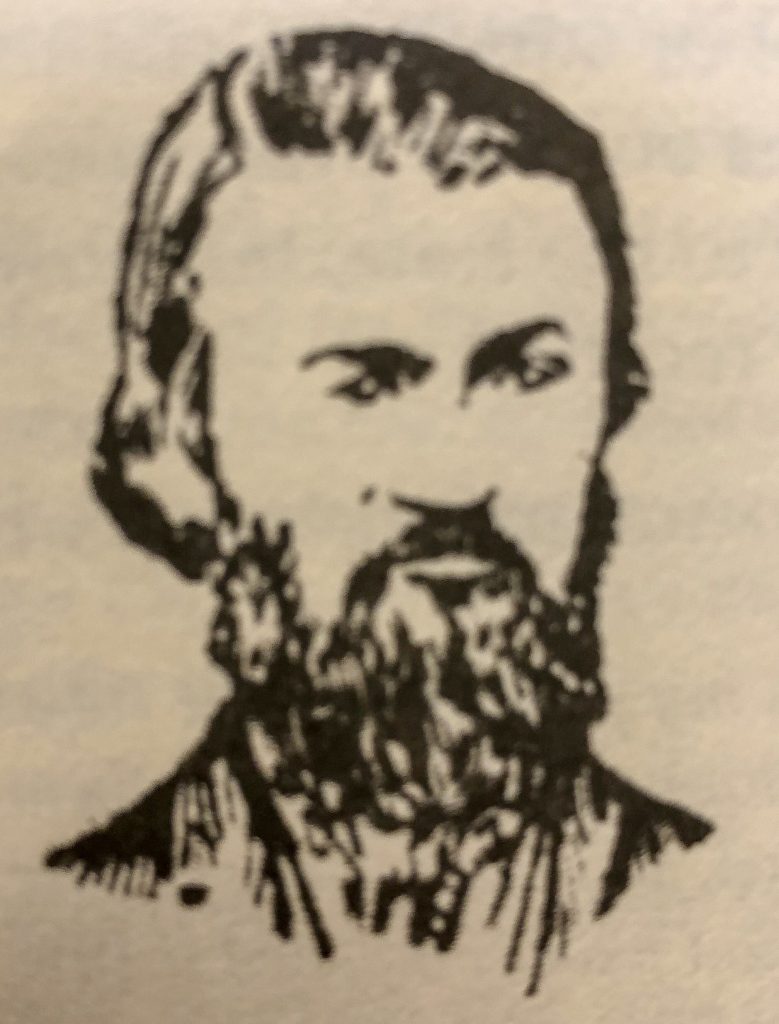
Out of the 105 men who rode to Pyramid Lake, only 29 survived.
That crushing battle sparked the activation of the California Rangers to ride to Pyramid Lake. The Rangers included former San Quentin Capt. William Byrnes (link opens new tab).
“(Capt. Byrnes’ services) were again (required) for warlike exploits, and he was called to take command of a force organized to subdue the (tribe) in Carson Valley. (Chief) Winnemucca (agreed to a) treaty (in 1860),” reported the Sacramento Daily Union, June 1, 1872.
After those altercations, it was believed a smaller territory would be easier to manage. Congress created Nevada Territory in 1861. On Oct. 31, 1864, Nevada became the 36th state during the Civil War. It’s why Nevada is “The Battle Born State.”
Back to his mail route
Thompson returned to what he enjoyed – delivering the mail.
At one point, his friends encouraged him to petition Congress for compensation. He traveled to the nation’s capital but the expense of the trip, coupled with the red-tape of government, found him frustrated and rapidly depleting his funds. He left empty-handed and returned to his mail route.
Thompson continued carrying mail until 1876 when he died at 49 years old from a burst appendix.
Buried by his side in Genoa, Nev., is his only son, Arthure, who died in 1878 at 11 years old. His wife Agnes, who passed away in 1915, is buried in the third plot.
According to reports, he was never compensated for his mail delivery service.
Did you know?
President Abraham Lincoln began his public service career at age 24 by becoming a post master.
“Lincoln’s political career illuminates a dedicated public servant with four terms in the Illinois House of Representatives, one term in the US House of Representatives, and finally serving as the sixteenth president of the United States.
“However, Lincoln’s first civil service position began at the age of 24 as the postmaster of the New Salem, Illinois, post office.
“He was appointed … May 7, 1833. The following year he won election to the Illinois House of Representatives. In 1836, Lincoln won reelection to the State House and with the closing of the New Salem Post Office, ended his tenure as Postmaster.
“With his inauguration on March 4, 1861, Lincoln became the only president of the United States to have previously served as a town postmaster,” according to the Smithsonian’s National Postal Museum.
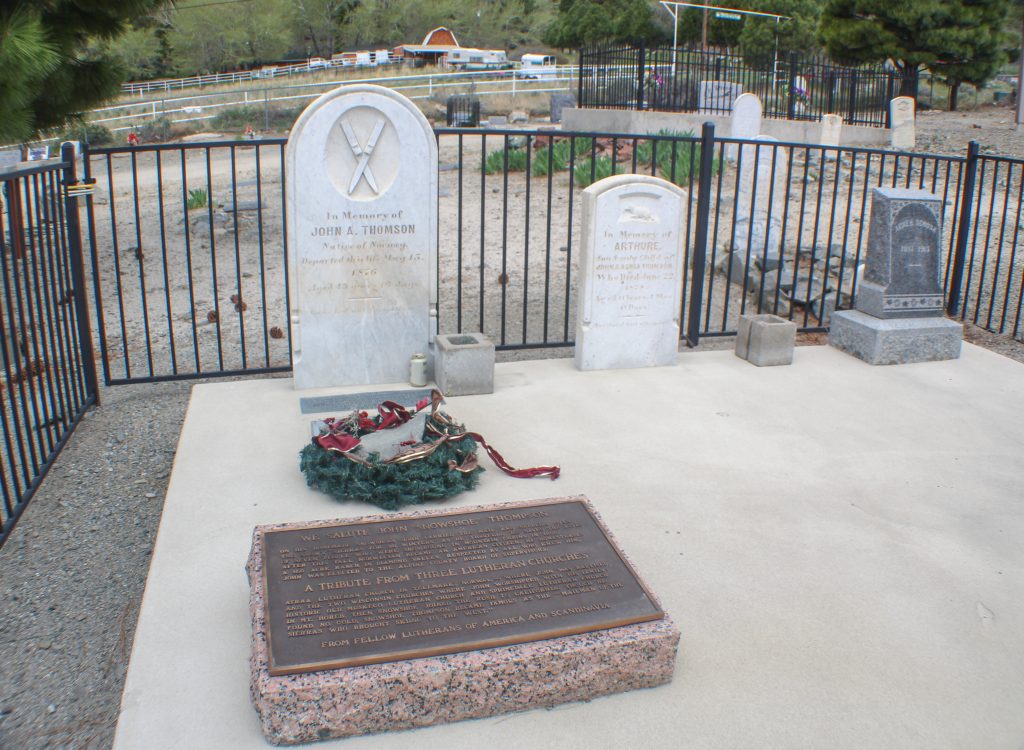
Editor’s note: For consistency, Inside CDCR opted for Thompson as the spelling of his last name but acknowledge is it often spelled Thomson or even Thomsen, depending on the source. His grave marker uses a variant of the spelling.
By Don Chaddock, Inside CDCR editor
Office of Public and Employee Communications
Learn more about California prison history.
Follow CDCR on YouTube, Facebook, X (formerly Twitter). Listen to the CDCR Unlocked podcast.