

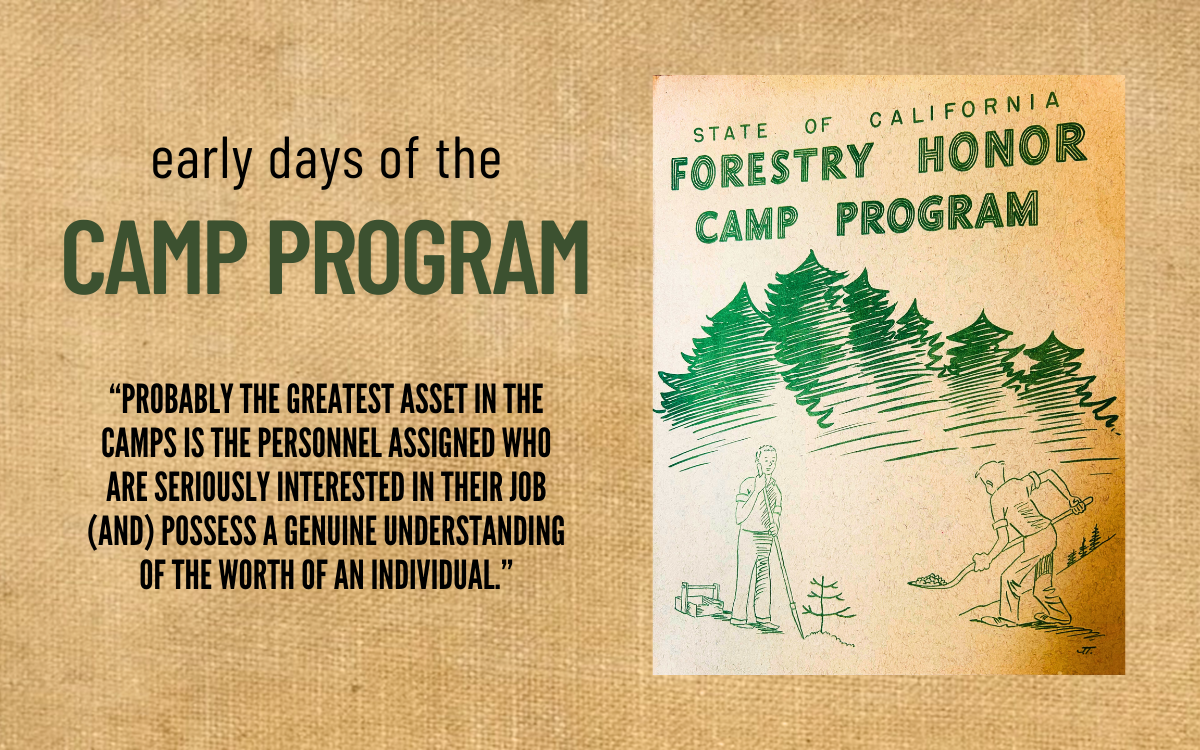
A booklet titled “State of California Forestry Honor Camp Program” was produced for the 86th Congress of Correction held in August 1956 in Los Angeles.
“The material in this small booklet was prepared for a general session meeting (and) for limited distribution to individuals interested in the development of camp programs in cooperation with correctional agencies,” begins the 27-page booklet’s foreword. “This is more than a cooperative venture. It is an experience in teamwork between agencies (resulting in our) wildland and natural resources being improved and protected by boys and men who, in turn, are provided an opportunity to re-direct their lives for return to society.”
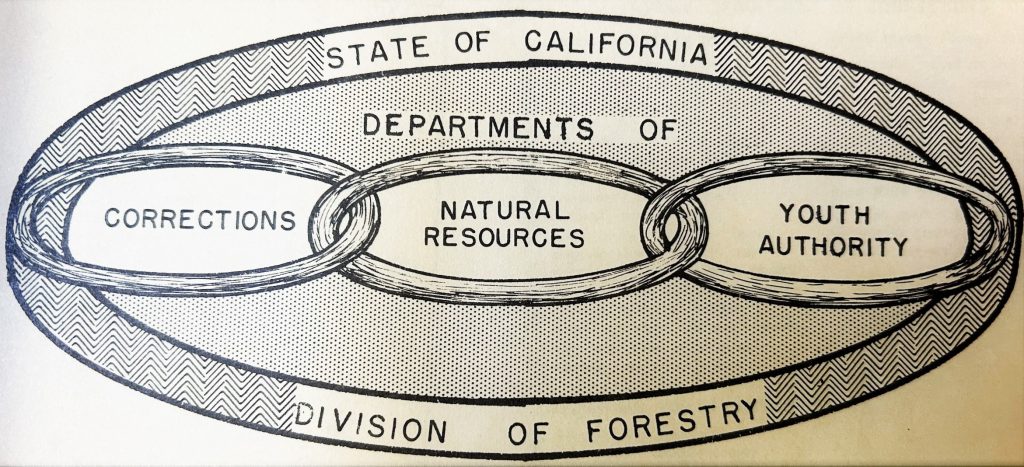
The foreword was signed by the directors of the Department of Natural Resources, Department of Corrections, Department of the Youth Authority, and the State Forester.
Designed to demonstrate how camps work in California, the booklet provided a blueprint for other states.
The following information is presented as it was written in 1956, edited for clarity. Terms such as “inmate” or “honor camp” are no longer used. Today, CDCR refers to those housed in our facilities as “incarcerated persons” while camps are “conservation camps.” While the booklet references men and boys, today there are female camps.
>> Learn more about today’s camp program on the CDCR website.
How camps work
This program makes it possible for resource agencies to accomplish needed forest improvement, recreational development and protection projects. The camp program is reaching an age of maturity. Honor camps in the forest and other watershed areas have been in operation (in California) since 1941. They have stood the tests of time, security, work accomplishment, legislative study, and economy.
The camp responsibility is divided by the two agencies. The housekeeping, custodial, health, recreation, and disciplinary phases are charged to the correctional agency. Meanwhile, the work project program and the direction and supervision of the projects in the field are those of the work agency.
In addition, there is adequate equipment provided for field work in fighting forest fires and constructing and maintaining fire roads, trails, telephone lines, fire breaks, fire hazard reduction, and control of forest insects and disease.
Camp program structure in 1956
Camps are administered by the California Institution for Men in Chino as well as state prisons at Folsom, San Quentin and Soledad. Each institution having camps under its supervision has a correctional captain in charge of all camp operations. He has a lieutenant in charge of each camp (with) five correctional officers assigned to each camp. The captain has a correctional officer who acts as his clerk and an officer who transports men and supplies to and from the camps.
Camps offer counseling, religion, education
Nearly all of the camps have a group counseling program developed. Our short experience with this program has shown it to be one of the most effective treatment programs yet tried. Morale has been improved and tensions relieved by allowing the men to “let off steam” and express or vent some of the hostilities in a permissive atmosphere. This has resulted in better rapport between personnel and inmates, as well as better attitudes.
Religious services are held in all camps either by visiting religious group or the regular institutional chaplains.
Correspondence courses are provided through cooperation with several universities as well as the educational division of the institution.
Except in those camps very close to institutions, men are released on parole or discharge directly from the camp. Parole officers visit the camps regularly to counsel with the men scheduled for release and to prepare pre-release reports.
Staff are camps’ greatest assets
Probably the greatest asset in the camps is the personnel assigned who are seriously interested in their job. (They should also be interested in) the satisfaction of helping boys and men (rehabilitate). Personnel (should have) a variety of experience and background, (but) all must have certain characteristics in common. Namely, they should possess a genuine understanding of the worth of an individual and (believe in) the camp program.
After more than 10 years of successful operation, this program is no longer an experiment. It has proved to be practical and worthwhile.
By Don Chaddock, Inside CDCR editor
Learn more about California prison history.
Follow CDCR on YouTube, Facebook, X (formerly Twitter). Listen to the CDCR Unlocked podcast.