


After California became a state in September 1850, the Legislature passed a law establishing all county jails would serve as state prisons until a permanent prison could be built.
San Francisco had the county jail ship the Euphemia while Sacramento’s was the La Grange.
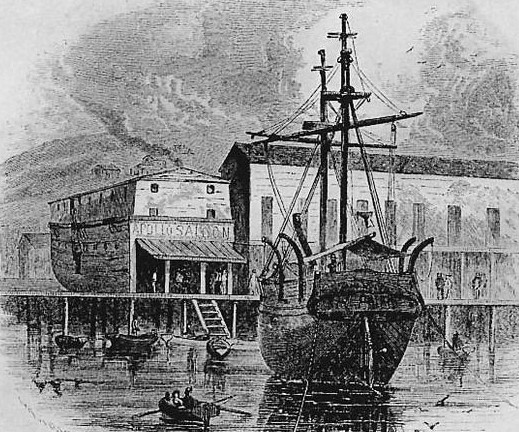
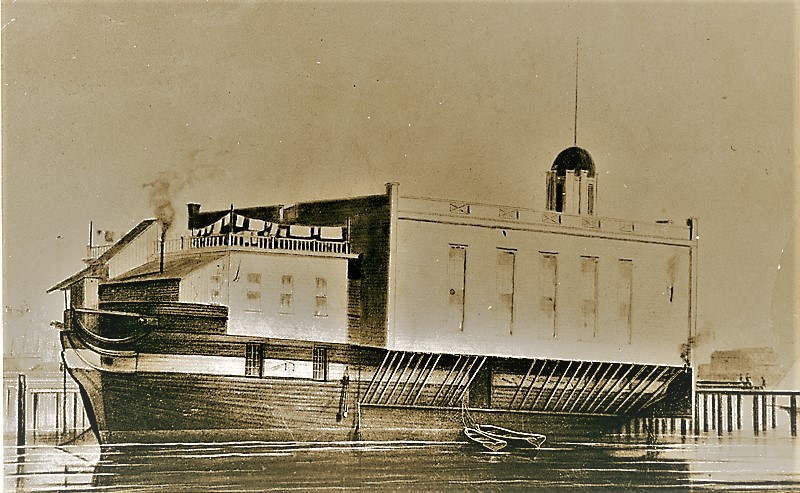
Seeing opportunity, San Francisco Sheriff Coffee Jack Hayes acquired the Waban, a ship abandoned in San Francisco Bay by gold seekers. The sheriff then had it outfitted as a prison ship.
In December 1851, with 40 incarcerated people on board, Hayes sailed to Angel Island and then to Point San Quentin in 1852.
Since the beginning of statehood, the department has helped maintain public safety while encouraging those in our custody to better themselves through education and learning job skills.
Did you know? The first incarcerated person on the Waban was Charles Currier, a 22-year-old cabinet maker. He was initially received aboard the Sacramento County jail ship the La Grange Jan. 25, 1851. When the Waban was activated, he was transferred to the new ship and helped build what would become San Quentin.
Shaping the prison system
From its beginning, ships played a pivotal role in shaping the state’s prison system. Without reliable land transportation, the prison relied on ships for supplies and working the quarry on a nearby island.
In this installment, Inside CDCR looks more closely at the department’s small fleet of ships.
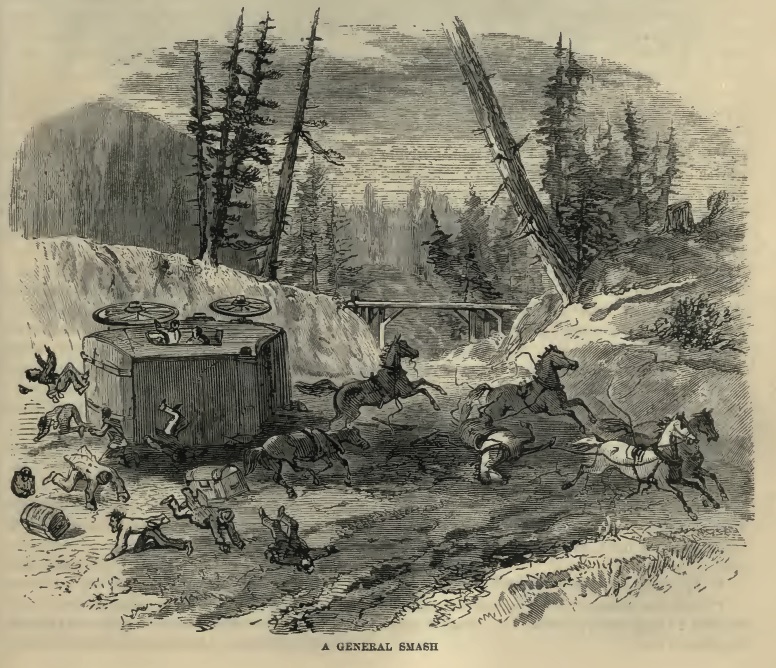
San Quentin, the only prison at the time, relied on ships to transport goods and passengers because roads were often sketchy and impassable.
The docks in San Francisco, Los Angeles and San Diego bustled with activity, jobs at the ready for those willing to put in a hard day’s work.
The state prison’s small fleet of ships

At the time, the prison used incarcerated people considered low risk for violence as clerks and ranch hands.
The state prison at San Quentin also maintained a small fleet of ships, contracting with other ship captains for various services.
Much like clerks and ranch hands, low risk incarcerated people were also used as dock workers and sailors.
Like today’s transportation units and hubs, in the early days of the prison system, there was a “Department of Vessels.” Thanks to the 1855 Report of the Prison Directors, we know quite a bit about those vessels.
Records of ships in service at prison

Ships listed on the “statement of property in and around the state prison … on the first day of January 1856” include the schooner Mariposa, the sloop Pike County and the sloop Marin.
The prison also employed two “captains of vessels, $1,800 each, per annum” as well as a “crew to man two vessels (for) $2,400.” The prison directors’ report states, “Vessel account, for one boat for island, cordage, ratlin, tar, paints, oars, etc., $566.66.”
According to James Estell, “There being no stone to build the wall with, I refused to let (the state prison directors) have stone unless they bought the prison brig (Waban) and materials. Agreement was made, for which I was to receive $7,000.”
Estell held the contract with the state to manage the prison.
Multiple vessels at prison

The Mariposa was captained by George Lee, the Marin’s captain was George Johnson, and the Pike County’s captain was Thomas Riley. The prison also employed an Overseer of Vessels, paying J.M. Gray $100 per month.
“The lease between James M. Estell and the State, for Marin Island, expires June 1, 1856. Unless some provision (is) made by the state, there will be no place to confine the prisoners at present employed therein. (There are) about 100.”
An 1857 report, featuring sworn deposition of Captain of the Guard George Wells, gave an accounting of the California prison ships and crews. Wells had worked at the prison for three years.
“Sloop Marin, 70 tons freight. Captain and mate, and three or four convict sailors – more employed baling, under a guard,” he said. “Sloop Pike County, about 70 tons, same number. Schooner Mariposa, condemned. Three-masted schooner (Estella), about 150 tons; crew free, captain and mate, and six convicts. … Convicts employed on vessels are short-timed men (with) two, three and four months to serve. (They) are (kept) locked under hatches (when not working).”
According to the 1858 Report Concerning Property at State Prison, by Joint Committee of the Legislature, there was:
- one yawl boat, bad order, valued at $1
- the sloop Black Cloud, old, valued at $100
- and the sloop Pike County, good order, valued at $2,000.
The 1858 report indicates the Marin was still in use, while the Mariposa’s seaworthiness was in doubt.
“The Marin is under charter and is now on this coast in the vicinity of Cape St. Lucas. (She is) now schooner rigged, having been changed by Estell at a cost of some $500,” the report states.
The fate of the Mariposa

“(The Mariposa’s) bottom is wormed and in bad condition, and her value now about $700 or $800. The Mariposa has been hauled up on the beach, and passed upon as worthless,” the report continues.
To back up the claim, P.R. Hanna, a San Francisco shipwright, surveyed the ship and claimed the Mariposa there was no point in trying to save it.
“The schooner Mariposa was hauled up on the beach and condemned by a regular survey. She was perfectly useless, unless for firewood,” according to Hanna’s findings.
The Mariposa appears in later records, apparently repaired and put back into service.
What is a wormed ship? Wormed refers to a boat’s hull when it is infested with marine organisms, particularly shipworms or teredo worms, which are known for boring into wood and causing significant damage. These worms can destroy wooden ships by drilling passages through the wood with their shells.
Marin hauls lime for subcontractor
Meanwhile, the Marin was leased out to a man named James T. Stelle, according to his sworn deposition dated March 6, 1858.
“Estell chartered her to me as state property. The charter papers were signed by him, as lessee of the state prison. I do not know the amount I have paid to Gen. Estell for her use, to the present time. (Also,) I rechartered the sloop to Tubbs & Co. for four months, with the privilege (of extension to) 12 months,” he wrote. “I had her for carrying lime from Santa Cruz to San Francisco. I was to pay, for her use, $125 per month, payable in lime.”
Squabbling over who owns ships
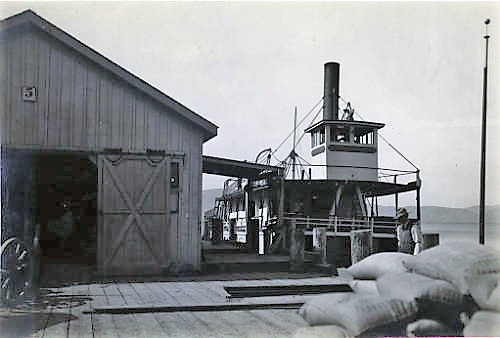
There was a contentious relationship between the prison lessee and the state. After the state retook control of the prison, property disputes arose. Estell claimed ownership of some property while prison sublessee J.F. McCauley claimed ownership of other vessels. During the inventories taken at the time, there were even more ships listed.
“Property claimed by J.F. McCauley (included) schooner William Hicks, of San Francisco, (valued at) $10,000; new whale boat (valued at) $200; (three) scow-boats, large, (valued at) $100; three-masted schooner H.T. Clay (valued at) $12,000,” according to the 1858 Appendix of the Senate Journals.
References to the sloop Ida are also made in other reports from the mid-1850s.
In an 1860 Report of the Committee on Property Outside of the Wall, the committee listed “two captains of boats – transports – and three guards detailed for boat service.”
What eventually became of the ships is up for debate. Some claim parts from the Waban, such as heavy timbers, were used to construct buildings at San Quentin. No definitive records related to the ships’ fates have been found.
Story by Don Chaddock, Inside CDCR editor
See more images related to early San Quentin and take a deeper dive into the prison’s history.
Learn more about California prison history.
Follow CDCR on YouTube, Facebook, X (formerly Twitter).