

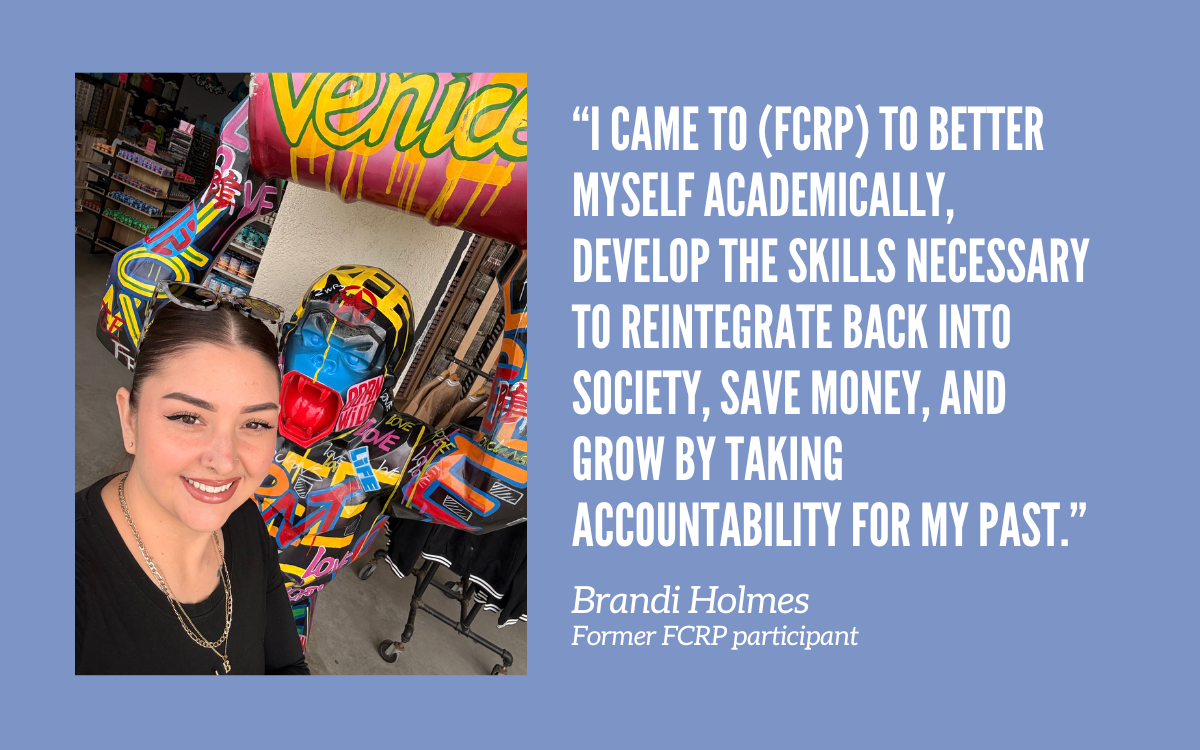
Brandi Holmes started her journey toward rehabilitation at CDCR 14 years ago when she was incarcerated at 22 years old.
“When I first entered incarceration, I carried not only the weight of my sentence, but also the consequences of my worst mistake. I lacked direction, stability and any sense of purpose,” she said. “However, over the years in prison, I made the decision to change the course of my life.”
Holmes said the turning point came when she transferred to the Female Community Reentry Program (FCRP) in July 2024. The FCRP, along with its companion Male Community Reentry Program (MCRP), provide voluntary, evidence-based programming for eligible individuals with two years or less remaining on their prison sentence. As participants progress through structured in-house programming, they become eligible for approved off-site passes to pursue employment and higher education. FCRP, launched in 2014, operates in six locations, with approximately 400 current participants. MCRP, launched in 2015, operates in seven locations, with approximately 800 current participants.
Research shows incarcerated people who participated in community reentry programs recidivate far less than people who did not. Building on the success of these programs, CDCR is in the process of activating additional locations as part of its 20-Year Master Plan.
“I came to the program with specific goals, to better myself academically, to develop the skills necessary to reintegrate back into society successfully, save money, and grow by taking accountability for my past,” Holmes said.
From prison to FCRP
Holmes admitted her transition had challenges.
“During the process I learned I still carried old manipulative behaviors that no longer served me. These got me in minor troubles,” she said. Still, she said she is grateful for these much-needed bumps in the road. “They were a reminder of what didn’t work for me, which then allowed me to figure out what does work.”
During her time at the FCRP, Holmes took key steps toward achieving her goals. She obtained three certificates through the East Los Angeles College Addiction Studies program and recently finished her last two classes before starting an internship to be a counselor.
Holmes also earned her associate degree in Psychology and has started a bachelor’s program at Cal State LA, majoring in Rehabilitation Services and minoring in Psychology. She secured housing on campus at Cal State LA until summer 2027 through Project Rebound.
In addition, she has become a certified Medi-Cal Peer Support Specialist and completed Domestic Violence counseling training.
“These accomplishments have not only expanded my knowledge on topics that I am passionate about, but they have built my confidence in my own ability to succeed.”
On a personal level, Holmes worked on her mindset and emotional growth by participating in self-help programs, counseling, and group discussions while at the FCRP. She said she learned the importance of responsibility, accountability, communication, and making positive choices.
‘Taught me discipline, teamwork’
Holmes also gained valuable professional skills through her 500 hours of work experience through the Substance Use Disorders Earn and Learn (SUDEAL) grant. “This has prepared me for employment and taught me discipline, teamwork, and a strong work ethic,” she said. “I now understand the importance of contributing positively to my community and how much of a difference I can make by showing up for clients daily.”
She secured full-time employment through LA Centers for Alcohol and Drug Abuse, working with the LGBTQ community, and looks forward to being a counselor with this community.
As a former FCRP participant and now released to parole supervision, Holmes said she received the tools, support, and opportunities to become the best version of herself. “I am committed to continuing this journey of growth and transformation and making a meaningful impact in my life and the lives of others.”
Submitted by Mary Xjimenez, information officer II (supervisor)
Office of Public and Employee Communications
Follow CDCR on YouTube, Facebook, X (formerly Twitter).