

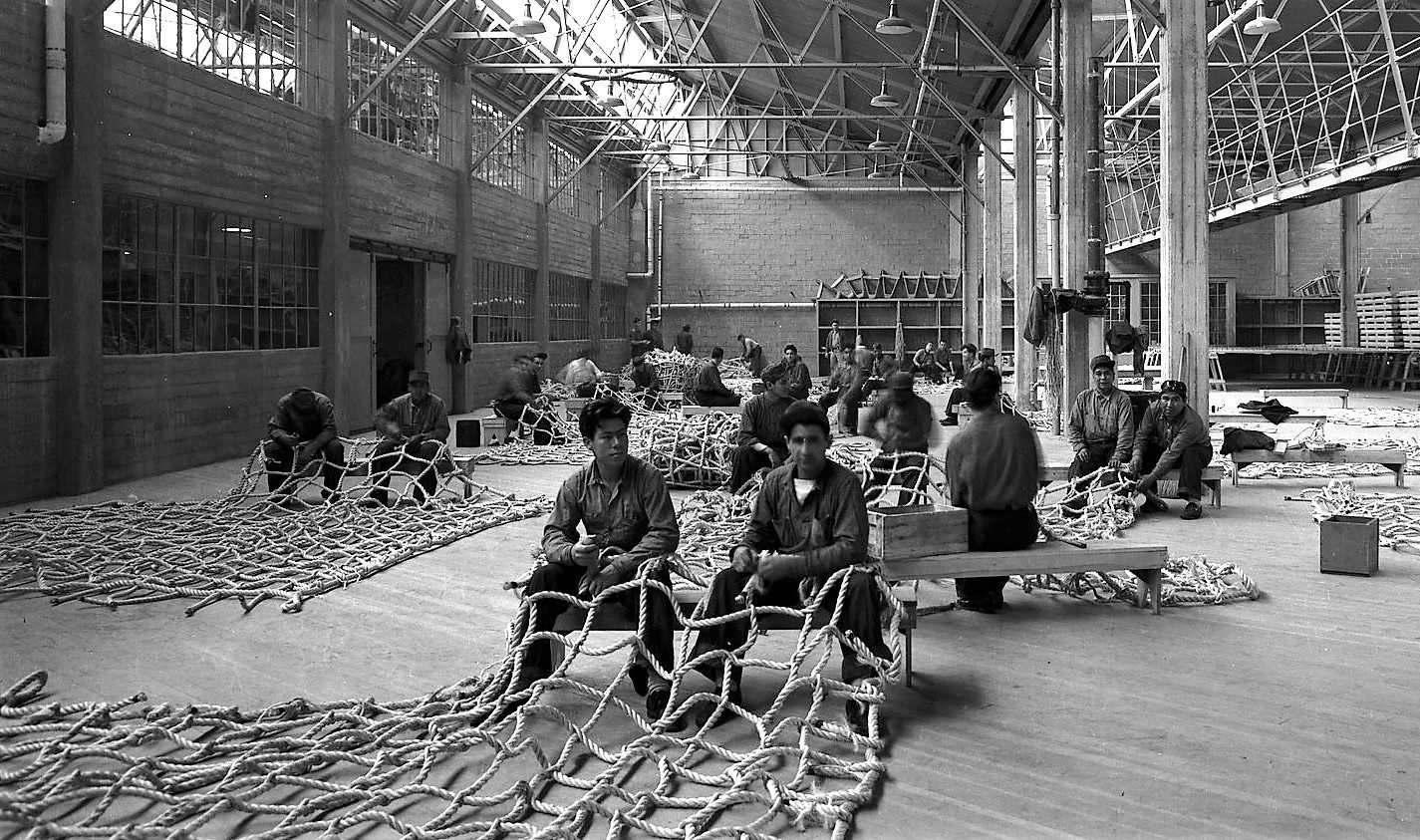
(Editor’s note: This year marks 80 years of reform, evolving into today’s CDCR. Throughout 2024, Inside CDCR will look at landmark moments in 1944.)
Public troubles came to a head when a Governor-appointed commission recommended completely reorganizing the prison system. Their final report was submitted Jan. 21, 1944.
Governor Earl Warren wasted no time implementing the commission’s recommendations, formally establishing the California Department of Corrections in July 1944.
Much like today’s efforts to effect change through the California Model, state leaders faced a daunting task to create a department from scratch 80 years ago.
California officials gathered information on best practices from other states and countries, similar to what today’s leaders have done by visiting Norway.
The state prison population was relatively low in 1944 as most men and women were fully engaged in World War II.
“Every authority believes that after the war is over, crime will increase and prison populations will soar to new high levels,” the report states. “If the prisons could be reorganized now, the new system could pass through the experimental stage and be ready to assume the tremendous responsibilities which will be thrust upon prison management in the difficult reconstruction period which will follow at the end of the war.”
80 years of reform: Culture shift
Unlike today, there was no single authority overseeing prisons prior to 1944.
“Folsom, San Quentin, and the California Institution for Men at Chino operate under the jurisdiction of a Board of Prison Directors,” according to the report. “The California Institution for Women at Tehachapi operates under an independent Board of Trustees.”
As pointed out in the report, the prisons operated under different guidelines issued by each warden.
“There actually exists three systems in the direction of Folsom, San Quentin and California Institution for Men,” the report states. “While they operate under the jurisdiction of a non-salaried Board of Prison Directors, the actual management is under the direction of three separate wardens whose contacts with the board are infrequent and primarily of an advisory nature.”
Centralizing administration
“The committee finds there is a complete lack of continuity of policy and administration. Each institution (is) going in its own separate direction regardless of the effect (on) the state’s overall penal (system).”
According to the report, the committee argued the prison system “should be consolidated in one department.”
Also, “the internal management of the prison system is in dire need of a competent reorganization (as) lines of authority and responsibilities are not clearly defined.”
The committee members also argued for a single executive to be placed in charge rather than a multi-member non-paid board. This executive should be “skilled and trained in modern penological practices, chosen because of his knowledge and experience in institutional management.”
The report includes recommendations familiar to today’s employees. These include parole reentry services, merit-based hiring practices, and in-service training.
Final report recommendations:
- redesigning areas of San Quentin and Folsom prisons
- implementing a merit-based hiring system with detailed job descriptions
- establishing a career system to allow employees a chance to promote
- hiring full-time chaplains to serve the incarcerated population
- establishing rules and regulations to eliminate racial discrimination
- reorganizing the camp system with adequate staffing and “a single camp administrator”
- placing the Bureau of Paroles under the new department, working closely with prisoners in a “pre-parole education program.”
By Don Chaddock, Inside CDCR editor
Office of Public and Employee Communications
Related content:
- Walter Gordon was one of the committee members, representing parole. Read the previous story on Gordon, who served as the first African American police officer in Berkeley.
- Senator Charles Deuel was another member of the committee. He advocated for the creation of California Vocational Institution, later renamed Deuel Vocational Institution in his honor. Read the story.
- See how the Yacht Bandit’s escapades at Folsom State Prison resulted in major reforms of the entire prison system. Read the story published in 2014.
- In 2023, the parole law marked 130 years since it was passed. Learn more about the first four people who earned parole in November and December 1893. Read the story.
Learn more about California prison history.
Follow CDCR on YouTube, Facebook, X (formerly Twitter). Listen to the CDCR Unlocked podcast.