

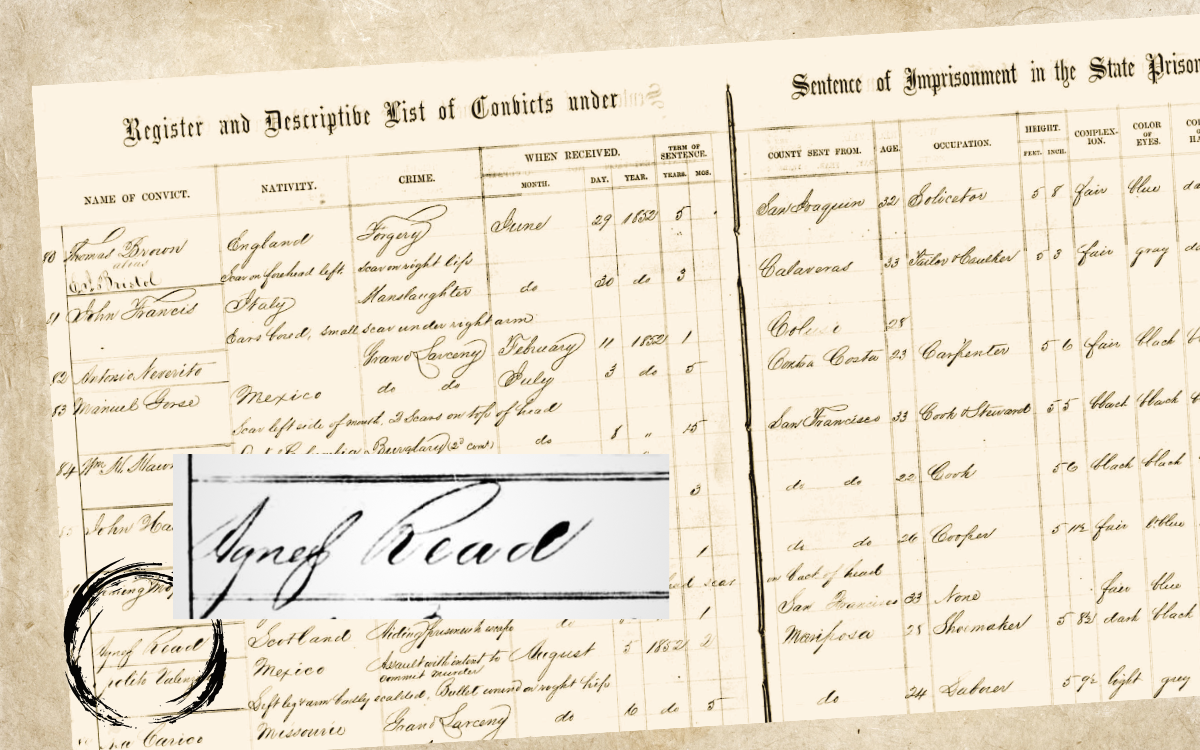
Women serving sentences in state prison began with Agnes Read who was sent to the prison ship, the Waban, in 1852.
The Waban was purchased by San Francisco Sheriff John Coffee “Jack” Hays, a former Texas Ranger and military veteran of the Mexican American War. After acquiring the Waban, the ship was converted to a prison, using 5,500 feet of redwood lumber to build cells. In December 1851, he received the first 40 people sentenced to state prison and headed to Angel Island.
>>RELATED: Read the story about ships serving as the state’s first prisons.
Prison ship Waban receives women beginning in 1852
Agnes Read, a 33-year-old Scottish native, was convicted out of San Francisco for aiding a prisoner to escape. She was received July 8, 1852.
Some sources claim she was the 26th person sent to the ship under a one-year sentence. The register lists her as having a fair complexion, blue eyes, and dark hair. Her occupation is listed as “none.” When speaking about Read, former California Institution for Women Superintendent Iverne Carter said she was a “dance hall entertainer.”
>> RELATED: Read the story on Carter’s 1965 speech.
The second female incarcerated on the Waban was Saledeno Perequita, received Aug. 21, 1852. She was a 32-year-old “washer woman” sentenced to two years for grand larceny from Tuolumne County. She is listed as a native of Mazatlán.
The 39th person sent to the ship, and the third woman, was Carmine Nunez, 32, sent from Sacramento County to serve one year for grand larceny. The native of Chile was received Sept. 6, 1852. Her occupation is listed as “none.” She is described as being 5-foot-2, cross-eyed, with a dark complexion, black hair and black eyes. She was discharged Aug. 18, 1853.
Circus performer sent to Waban
Others included a 30-year-old circus rider named Lilly C. Smith from New York, received Nov. 8, 1852. She was convicted of grand larceny out of San Francisco and sentenced to two years. The register includes an odd note, which appears to be the word “ruptured.” In the 1800s, the term “ruptured and crippled” referred to people with orthopedic or mobility impairments. The register also lists her as 5-foot-6 with a fair complexion, hazel eyes, and black hair. The document notes she was discharged but doesn’t include the date.
The next was Dolores Martinez, 19, a washer woman from Mexico. She was also received Nov. 8, 1852, sentenced to one year for manslaughter out of San Francisco. The register lists her as 4-foot-11 with a dark complexion, black hair and black eyes. She’s listed as “discharged” but no date is given.
Mary Ann Wilson, a native of Scotland, was received June 20, 1853, to serve one year for robbery out of San Francisco. The 19-year-old is listed as a servant. She was 5 feet tall with a fair complexion, blue eyes, and dark hair. Other distinguishing characteristics included “one long scar on forefinger of right hand, a large scar on left eyebrow, and one scar above right eyebrow.” A note in the register indicates she was pardoned June 10, 1854.
By Don Chaddock, Inside CDCR editor
Women working in prison started in 1885
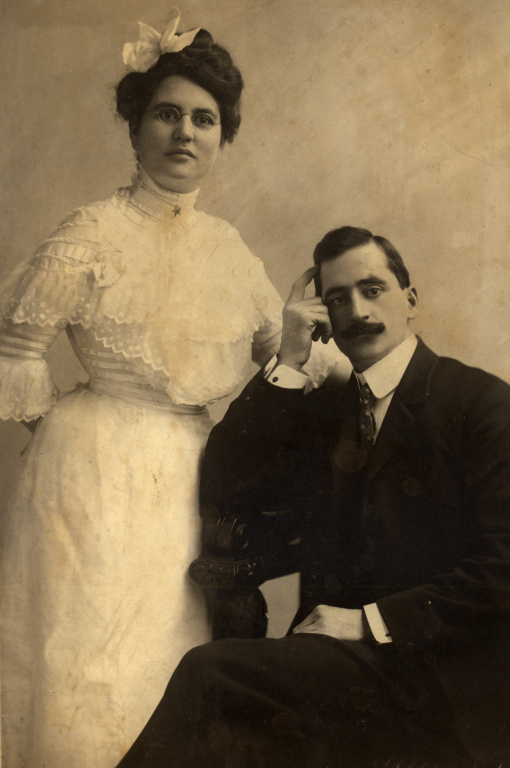
Genevieve Smith was an early women’s ward matron at San Quentin. She earned $840 per year while her husband Richard earned $780 per year as a guard. She served in the role from 1909 until 1914. Learn more about her and other early female prison staff.
Learn more about California prison history.
Follow CDCR on YouTube, Facebook, X (formerly Twitter). Listen to the CDCR Unlocked podcast.