

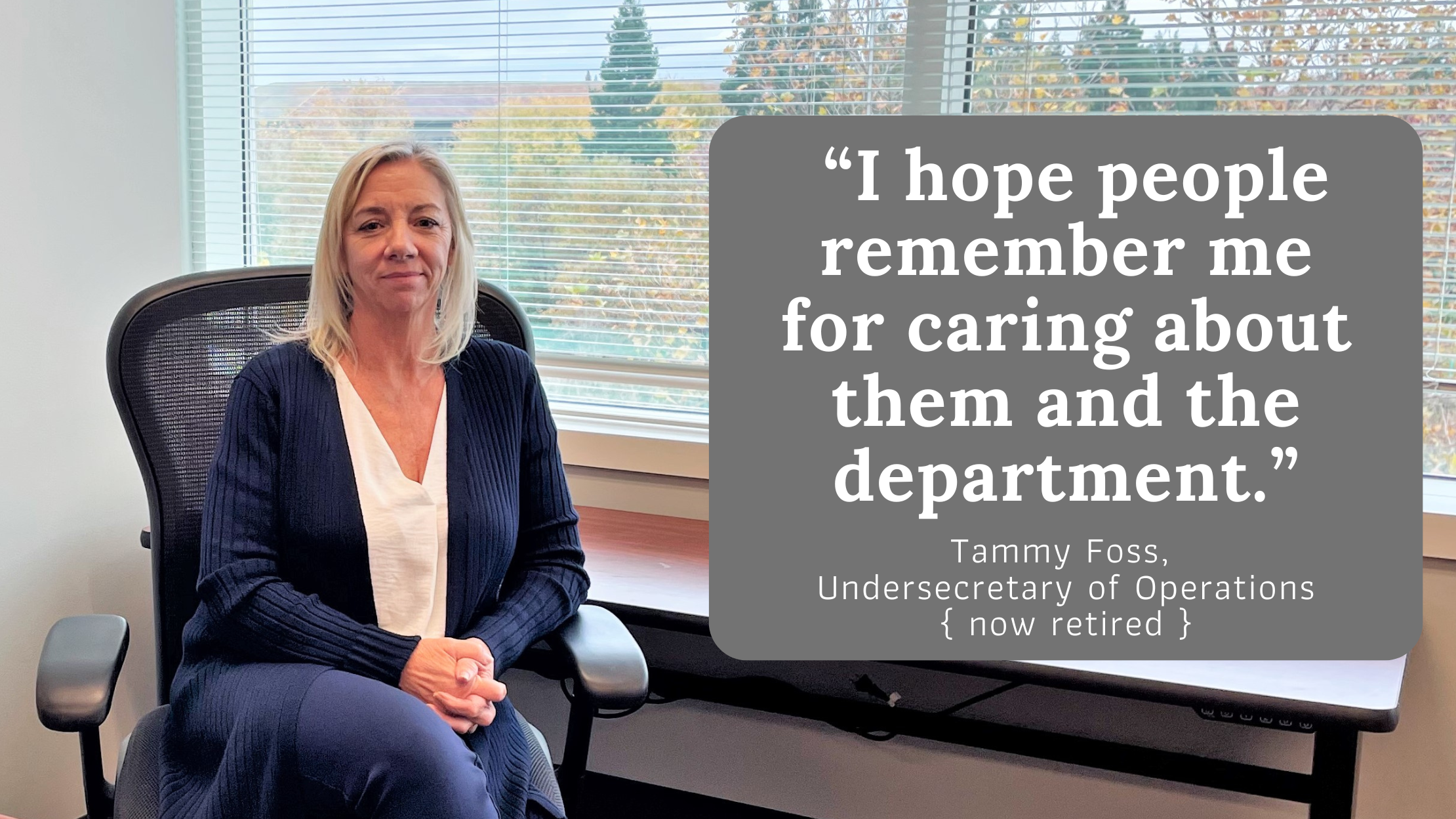
After nearly 30 years with the department, Undersecretary Tammy Foss is looking forward to the next chapter in her life: retirement.
Her career began as a correctional officer in 1996 at Pelican Bay State Prison in Crescent City. She’s worked various jobs across the department, serving in leadership roles at Pelican Bay, San Quentin, High Desert State Prison, headquarters, California Correctional Health Care Services, and leading Salinas Valley State Prison as warden 2018 to 2019.
When word of her pending retirement reached an incarcerated person and his wife, they reached out to thank her for making a difference.
“I think (my husband) sees you as the first person of authority (who) really gave him a chance and were completely fair in all your decisions with us. The respect he feels allows him to move forward and to be proud of who he is today. As his wife and the person who loves him completely, I also think you are amazing and want you to know that I have so much respect for you,” she writes. “I will always be thankful to you.”
Inside CDCR caught up with Foss just before she retired to discuss her career, highlights and advice for others.
“The department has so many opportunities, there is something for everyone. It was such a great experience learning the different areas, from custody, business services, health care, and headquarters.”
Tammy Foss, Undersecretary of Operations, retired
Q&A with Tammy Foss, Undersecretary of Operations

What are some of your favorite moments during your nearly 30-year career?
I have a lot of great memories over the years, and some not so great. Some of my favorites are watching people I have worked with over the years promote and grow in their career.
Mentoring people who reach out to me for advice, makes me feel proud and that I made a difference. (I’ve met) so many great people in the department and (who have become) friends who will now last a lifetime. In addition, seeing some of the incarcerated population I had discussions with on their behavior and their future ways (now) changing their ways and working toward healing (and) rehabilitation. (They) tell me I made a difference to their future.
How would you describe the department today when compared to the 1990s?

When I started the department, the focus was much more on housing the inmate population and very little on reentry and rehabilitation. In addition, staff wellness wasn’t really discussed. Now there is a focus on preparing our incarcerated population for going home, knowing they are going to be our neighbors and in our communities. This is a positive for staff and our communities.
In addition, understanding our staff go through a lot working in these environments and showing we care, providing services to our staff. Allowing them to be part of changing the way we do business has been such a great positive change in our department.
Looking back, what are some of the biggest changes you’ve seen in the department?
The department has gone through a lot of changes since I started. (Back then), the population was overcrowded with inmates housed in gymnasiums. There was not a lot of rehabilitation opportunities for the population. Over the years, with various legislation, rehabilitation opportunities have increased. College is now offered in all our institutions and there is a focus on reentry and normalization.
I worked in the Security Housing Unit (SHU) as a correctional officer at Pelican Bay State Prison. The SHU was a high security area within a prison used for prisoners who may pose a danger to others; the SHU is no longer in existence.
When you go back to Pelican Bay State Prison, there is no longer a gymnasium full of bunks. Now you find programming in these areas. The prior SHU is now a Level II non-designated programming facility.
Where there were gray walls, now colorful murals cover the walls. The population is programming, gardening, and learning skills. The reduction in the population allows for our institutions to increase programming, allows for staff to be more engaged.
You’ve held many different types of positions in the department. How do you believe this helped further your career?
The department has so many opportunities, there is something for everyone. It was such a great experience learning the different areas, from custody, business services, health care, and headquarters. In my current role, I have had the opportunity to work with Division of Adult Parole Operations, Office of Victim and Survivor Rights and Services, as well as the Board of Parole Hearings. It has been a blessing. I believe my background has allowed me to make contacts with extremely talented people who educated me and allowed me to grow to be able to move forward.
What advice do you have for people seeking to promote in the department?
Every day you go to work you are interviewing for your next promotion. Take the opportunities and seek out special projects. Don’t be afraid to make mistakes, we all do, it is how we react to the mistakes that will make the difference.
Anything else you’d like to add?
When I started with the department, I had no idea what an Undersecretary was or what it meant in our department. I had no idea I would become a warden at a level IV prison, and definitely not the Undersecretary. It was not a goal I thought about. I feel so blessed to have this journey and be part of something so important. I hope people remember me for caring about them and the department.
Story by Don Chaddock, Inside CDCR editor
See more stories highlighting CDCR/CCHCS staff.
Follow CDCR on YouTube, Facebook, X (formerly Twitter).