

Department of Corrections and Rehabilitation - Operations Manual
Chapter 7 – Adult Case Records Information
76010.5.5 Social History
Article 1 – Uniform Case Records Systems
71010.1 Policy
-
Penal Code (PCPenal Code) Section 2081.5 requires the Secretary to keep complete case records of all incarcerated persons under the custody of the department. The case records shall be made available to the Board of Parole Hearings (BPHBoard of Parole Hearings (formerly Board of Prison Terms)) at such times and in such forms as BPHBoard of Parole Hearings (formerly Board of Prison Terms) may prescribe.
-
Case records shall include all information received from the courts, probation officers, sheriffs, police departments, district attorneys, the State Department of Justice, the Federal Bureau of Investigation, and any other interested agencies and persons.
-
Case records shall also include records of diagnostic findings, considerations, actions, and dispositions with respect to each incarcerated person’s classification, treatment, employment, training, and discipline.
71010.2 Purpose
-
This article defines the authority for and the implementation of the department’s Uniform Case Records System.
71010.3 Definitions
-
Central File (C-File) – The file, maintained on an electronic CDCRCalifornia Department of Corrections and Rehabilitation-approved platform or in hard copy form, containing case records for each incarcerated person.
71010.4 Central File Security
-
Only personnel with approval from the Chief Deputy Warden at the institution level, and the Hiring Authority for non-institution personnel, shall have access to an incarcerated, supervised, or discharged person’s C-File or copies of its contents.
-
C-Files and case records information shall only be accessed, viewed, modified, or received by authorized users.
-
C-Files shall not be removed from State property.
-
Hard copies of C-Files shall be kept in a secure container. C-Files needing to be relocated shall be sent via certified or registered mail to ensure safe transport and control.
-
All hard copies of C-Files that are removed from the Case Records office for any purpose shall be kept in a secure environment under the supervision of personnel authorized to handle such materials.
-
Hard copies of C-Files shall be housed in or returned to the Case Records office at the close of business each workday or as soon as possible after an emergency.
-
Except for the Attorney General’s (AGAttorney General) Office, Office of the Inspector General (IG), BPHBoard of Parole Hearings (formerly Board of Prison Terms), and the Governor’s Office, incarcerated, supervised, or discharged persons’ case records shall not be released to any agency or any person outside the department without a court order or a valid authorization from the incarcerated, supervised, or discharged person. The AGs office, the IGs office, BPHBoard of Parole Hearings (formerly Board of Prison Terms), or the Governor’s office may be provided with case records information via any CDCRCalifornia Department of Corrections and Rehabilitation-approved method.
-
In response to a court order, the incarcerated, supervised, or discharged person’s case record(s) shall be provided via a CDCRCalifornia Department of Corrections and Rehabilitation-approved method. For case records in hard copy form, the documents shall be redacted by, transported by, and remain under the control of a delegated departmental employee, as designated by the Warden or Assistant Deputy Director.
-
The password(s) and pin(s) provided to unencrypt information assets shall not be provided together in a single communication, but shall be provided in separate emails, letters, or phone calls. If the receiving party takes possession of portable technology and does not return the departmental asset to Case Records, the security and destruction of the asset is the responsibility of the receiving party.
-
Incarcerated, supervised, and discharged persons are prohibited from accessing
C-File information other than authorized copies of documents within their own C-Files, upon written request. Incarcerated, supervised, and discharged persons shall not have copies of any information that is classified as confidential. -
Incarcerated, supervised, and discharged persons, their attorneys, and third parties shall:
-
Review copies of C-Files via a CDCRCalifornia Department of Corrections and Rehabilitation-approved method.
-
Return any information asset provided by the Case Records office to the Case Records office upon completion of a review.
-
Have no direct access to a C-File for any purpose.
-
-
Incarcerated persons shall not be assigned in Case Records offices or in any area in which there is access to network computers, except when they are under constant and direct supervision.
-
Notwithstanding Subsection 71010.4(l), appropriately classified and assigned incarcerated persons may be permitted in Case Records offices to perform such duties as building maintenance or janitorial services.
-
C-File reviews, information assets used for C-File reviews, and the return of said information assets shall be logged as directed by the Chief, Case Records Services.
-
Any requests to access or use departmental information assets that are not covered in this section shall be referred to the Chief, Case Records Services by the local Correctional Case Records Manager (CCRMCorrectional Case Records Manager) for approval.
71010.5 Policy Directives
-
Departmental employees reviewing a C-File shall:
-
Consult with the appropriate institution’s Case Records or Parole Case Records (PCR) office concerning any issues related to the C-File or its contents.
-
Attempt to assist the institution’s Case Records or PCR office to correct any problems related to the C-File that are identified during review.
-
-
The Chief, Case Records Services shall report uncorrected variations to the Director, Division of Adult Institutions.
-
Counselors, Parole Agents, supervisory staff, and other employees, as assigned, who are responsible for generating evaluations, reports, and chronos, are responsible for the validity and accuracy of information contained in such reports.
-
Case Records staff shall:
-
Interpret court commitment orders.
-
Initiate the criminal identification process.
-
Analyze an incarcerated person’s legal status to determine the crime(s) and sentence(s) with applicable enhancements, aggravations, limitations, and credit earning eligibility.
-
Review an incarcerated person’s current and prior criminal histories to determine State prison eligibility.
-
Enter commitment information into an incarcerated person’s C-File.
-
Verify the different types of release and discharge dates in the C-File and, as applicable, in BPHBoard of Parole Hearings (formerly Board of Prison Terms) information assets.
-
Direct the preparation of legal forms for the transfer, extradition, parole, and discharge of persons under the jurisdiction of the department.
-
Analyze and act for the department on subpoenas and collateral court orders.
-
Certify departmental case records, as required by law.
-
Review the individual case actions of various authorities to assure legal and policy compliance.
-
Act as a consultant to departmental staff, court officers, incarcerated persons, and other governmental agencies or authorized persons regarding:
-
Departmental responsibility under pertinent laws and administrative standards.
-
The interpretation and application of laws and standards related to incarcerated persons’ receipt, sentencing, parole, and release.
-
-
Report discrepancies identified during the review of a C-File to the appropriate party for review and remediation.
-
71010.5.1 Uniformity
-
Variations in the methods of recording vital information, as established by the Chief, Case Records Services, regarding incarcerated, supervised, and discharged persons shall not occur.
-
Differences of opinions or interpretations as to the processes established by the Chief, Case Records Services between institutions’ Case Records offices and PCR, concerning methods of recording vital information, shall be brought to the attention of Case Records Services for resolution.
-
The institutions’ Case Records offices and PCR shall suggest methods for the resolution of differences of opinions or interpretations.
-
The final decision on all such issues shall be made by the Chief, Case Records Services.
-
71010.5.2 Communications to Correctional Case Records Managers
-
To ensure the clarity and consistency of information, communications from or on behalf of the Chief, Case Records Services shall be distributed to the CCRMs in writing whenever possible.
-
Communication shall take place between the Chief, Case Records Services and the CCRMs on technical matters associated with processes related to Case Records functions. Information which may have a direct impact on carrying out Case Records functions shall be communicated to the Chief, Case Records Services. Communication may be conducted verbally or in writing.
71010.6 Roles and Responsibilities
-
The Chief, Case Records Services shall:
-
Plan, develop, and administer regulations and policy governing the department’s Uniform Case Records System.
-
Assume responsibility and accountability for the accurate interpretation and application of laws, administrative standards, and court decisions related to the processing, maintenance, and control of all case records within the department’s Uniform Case Records System.
-
Directly supervise one or more Case Records Administrators.
-
Act as an administrative and technical advisor to executive management on matters related to the department’s Uniform Case Records System.
-
Act as the primary department liaison to other governmental agencies, courts, and legislators or other persons on matters related to the department’s Uniform Case Records System.
-
Determine the functional needs of the departmental Uniform Case Records System and assign the appropriate priorities.
-
When available local resources are inadequate to accomplish all assigned Case Records functions and any omission of certain duties may have an impact on an institution’s Case Records office or PCR, the Chief, Case Records Services shall determine the needs of the facility or PCR office and assign appropriate priorities.
-
Local variations to established policy or procedure shall occur only with the knowledge and approval of the local Warden, Assistant Deputy Director, and the Chief, Case Records Services, and may be permitted only on a temporary basis.
-
-
Case Records Administrators shall:
-
Supervise departmental Case Records units.
-
Conduct field audits
-
Interpret and implement laws.
-
Assess the impact of applicable provisions within published court decisions.
-
Advise on the implementation of administrative policies.
-
Plan and coordinate departmental recordkeeping and training and development programs.
-
Provide administrative and procedural support to CCRMs within assigned institutions and PCR offices.
-
Act as a liaison between Case Records Services and departmental divisions on matters related to the department’s Uniform Case Records System.
-
-
CCRMs shall:
-
Direct Case Records functions in institutions, headquarters offices, and PCR.
-
Ensure that applicable audits and cross audits of C-Files are performed by a Correctional Case Records Analyst (CCRACorrectional Case Records Administrator), Correctional Case Records Supervisor (CCRSCorrectional Case Records Supervisor), or CCRMCorrectional Case Records Manager, as scheduled and as directed by the Chief, Case Records Services.
-
Assume responsibility for the accuracy and legal content of case records in C-Files and the accurate calculations of sentence, parole, and release dates.
-
In the event an incarcerated or supervised person is released from an institution or the jurisdiction of the department prior to or later than the correct release date, the CCRMCorrectional Case Records Manager or designee shall call a Case Records Administrator at Case Records Services. Upon confirmation with the Case Records Administrator, the CCRMCorrectional Case Records Manager shall submit a complete report to the Chief, Case Records Services outlining the details of the erroneous release. Including a recommendation to eliminate similar incidents in the future.
-
-
CCRSs shall:
-
Perform legal and policy interpretations related to the processing, maintenance, and control of incarcerated, supervised, and discharged persons’ case records.
-
Supervise the work of CCRAs and clerical staff.
-
Act as liaisons regarding case records with county, state, and federal agencies; courts; and departmental units.
-
-
CCRAs shall:
-
Under the general supervision of CCRSs, perform complex, analytical, and technical work in the processing, maintenance, and control of incarcerated, supervised, and discharged persons’ case records.
-
Perform and document assigned audits of C-Files, as scheduled, utilizing an audit checklist and procedure approved by the Chief, Case Records Services.
-
Calculate incarcerated and supervised persons’ release and discharge dates, applying credits and enhancements.
-
Interpret and apply appropriate laws, policies, and procedures.
-
Act as liaisons to other units and outside agencies, entities, and individuals regarding case records.
-
-
Supervising Case Records Technicians shall direct the Case Records Technicians (CRTs) in maintaining and processing documents within incarcerated, supervised, and discharged persons’ C-Files.
-
CRTs are responsible for preparing, processing, and maintaining documents in incarcerated, supervised, and discharged persons’ C-Files.
71010.6.1 Signing of Documents
-
Pursuant to the provisions of PCPenal Code Section 5055, the following are authorized to sign the indicated documents on behalf of the Secretary:
-
Certification of criminal records, pursuant to PCPenal Code Section 969(b).
-
Chief, Case Records Services.
-
Case Records Administrators.
-
CCRMs.
-
CCRSs.
-
CCRAs.
-
-
Letters authorizing transfer to another jurisdiction under a court decision:
-
Chief, Case Records Services.
-
Case Records Administrators.
-
Parole Case Records Administrator.
-
CCRMs.
-
CCRSs.
-
CCRAs.
-
-
Letters authorizing transfer to another jurisdiction under a court decision:
-
Wardens
-
Assistant Deputy Director, Field Operations
-
-
Letters designating other states or federal facilities as the places of confinement for California incarcerated persons in accordance with PCPenal Code Section 2900(b)(2) and (3):
-
Chief, Case Records Services.
-
Case Records Administrators
-
CCRMs.
-
CCRSs.
-
CCRAs.
-
Sacramento Control Office (SACCOSacramento Control Office Unit, Reg. I).
-
Classification and Parole Representative, SACCOSacramento Control Office Unit, Reg. I.
-
CCRMCorrectional Case Records Manager, SACCOSacramento Control Office Unit, Reg. I.
-
CCRSCorrectional Case Records Supervisor, SACCOSacramento Control Office Unit, Reg. I.
-
CCRAs, SACCOSacramento Control Office Unit, Reg. I.
-
-
-
71010.7 Reporting
-
Violations of this policy shall be reported, in writing, to the Warden, Assistant Deputy Director, or the Warden’s or Assistant Deputy Directors designee, and the Chief, Case Records Services.
71010.8 Alternative Directives
-
If compliance with any component of this article is not feasible, or if deviation from a component of this article is necessary to support a business function, the respective CCRMCorrectional Case Records Manager shall formally request direction from the Warden, the Assistant Deputy Director, or the Warden’s or Assistant Deputy Director’s designee, and the Chief, Case Records Services. At no time shall the contents of this article supersede a higher legal authority, including a code, regulation, or court decision.
71010.9 Revisions
-
The Director, Division of Adult Institutions or designee shall be responsible for ensuring that the contents of this article are kept current and accurate.
References
-
(1) CCRCalifornia Code of Regulations, Title 15, Division 3, Chapter 1, Articles 3 and 3.5.
-
(2) DOMDepartment Operations Manual, Chapter 4, Articles 54,55,59,60, and 61.
-
(3) Government Code Sections 11549.3 and 11549.5
-
(4) PCPenal Code Sections 969(b), 2081.5, 2900(b)(2)-(3), and 5055.
-
(5) W&I Section 1731.5(c).
Revision History
-
(1) Revised: January 7, 1993.
(2) Revised: August 1, 2024.
Article 2 – Case Records Service Unit
71020.1 Policy
-
Uniform CRUs are established which have statewide operational responsibility.
71020.2 Purpose
-
This section sets forth the procedures of the CRUs which have statewide functions and application.
71020.3 Case Records Service Units
-
The Identification/Warrants (IDInstitutions Division (see DAI)) Unit, Archives Unit, Sacramento Control Office (SACCOSacramento Control Office Unit, Reg. I), and the LPULegal Processing Unit are departmental records units. These units provide centralized services to departmental staff, other law enforcement agencies, and interested persons on the status of persons committed to the Department.
71020.4 Identification/Warrants unit Hours of Operation
-
The unit operates 24 hours a day, seven days a week.
71020.4.1 Identification/Warrants Unit Supervision
-
Indirectly supervised by a correctional case records administrator.
-
Directly supervised by an Office Services Supervisor II.
71020.4.2 Functions of Identification/Warrants Unit
-
The functions of the IDInstitutions Division (see DAI)/Warrants Unit include:
-
Locator.
-
Identification number/research.
-
Warrant dispatch.
-
71020.4.3 Duties of Identification/Warrants Unit Staff
-
Staff assigned to the unit:
-
Locate the region of a parolee’s supervision.
-
Identify inmate’s assigned facility housing.
-
Provide commitment data to law enforcement and other authorized agencies with a need to know.
-
Provide information on persons discharged from the Department since 1957.
-
Place holds pursuant to PCPenal Code 3056 and/or W&I 3151 for the P&CSDParole & Community Services Division (see DAPO).
-
Conduct file searches and issue new identification numbers for newly received felons and civil addicts committed to the Department.
-
Respond to telephone inquiries that require nonconfidential information concerning felons/civil addicts.
-
Aid facilities and parole regions in identifying and locating inmates/parolees when the identification number is unknown.
-
Maintain the Department’s warrants register.
-
Maintain the FAX services for the Department and the BPT .
-
Act as headquarters’ duty officer. Receive facility duty officer reports by telefax service.
-
Dispatch BPT and NAEANarcotic Addiction Evaluation Authority warrants issued on parolees-at-large, releasees-at-large, and facility escapes. Warrants shall be abstracted by FAX upon request.
-
Microfilm and maintain the file of confidential material on discharge cases.
-
71020.4.4 Resources Available to Determine Status of Individuals
-
The below-listed resources are available to unit staff to identify, locate, and determine the status of individuals:
-
OBISOffender Based Information System.
-
DDPSDistributed Data Processing System.
-
Microfiche commitments 1976 to current.
-
Microfilm commitments prior to 1976.
-
Warrants register.
-
CLETSCalifornia Law Enforcement Telecommunications System.
-
71020.4.5 Procedures for Issuing Departmental Numbers
-
All departmental identification numbers shall be issued by the IDInstitutions Division (see DAI) Unit.
-
All identification numbers shall be issued in numerical order.
-
Receiving facilities shall telephone the unit for assignment of a CDC identification number.
-
To facilitate processing the volume of persons received at reception centers, the IDInstitutions Division (see DAI)/Warrants Unit shall issue blocks of numbers.
-
In exceptional cases, inmates may be received at a facility other than a reception center. In those instances in which an inmate is received after normal working hours, the facility shall hold the person without a CDC number until the morning of the first workday. On the first workday, a CDC number shall be obtained.
-
71020.4.6 Confirmation of Numbers Issued
-
OBISOffender Based Information System shall forward a printout of all facility admits at the close of “moves” each day.
-
The printout shall include:
-
CDC number.
-
Full name.
-
Date of birth.
-
Old CDC numbers (if known).
-
CI&ICriminal Identification and Information number (if known).
-
-
Upon receipt of this printout, IDInstitutions Division (see DAI) Warrants Unit staff shall research all the available resources to determine whether or not the person has previously been committed to the Department.
-
Due to the possible effect on the classification and housing of the new inmate, this research shall be given a high priority.
-
IDInstitutions Division (see DAI) Warrants Unit staff shall promptly advise facility case records staff of the results of the research for old CDC numbers.
71020.4.7 Types of Departmental Numbers
-
An “H” shall prefix all numbers issued to male felons. When all “H” numbers have been issued, a “J” shall prefix all numbers issued to male felons.
-
A “W” shall prefix all numbers for female felons.
-
An “N” shall prefix all numbers issued to civil addicts.
-
Numbers 1 to 19999 shall be reserved for female civil addicts.
-
Numbers 20000 to 99999 shall be reserved for male civil addicts.
-
71020.5 Archives Unit Location
-
The Archives Unit is a departmental function located at CMFCalifornia Medical Facility.
71020.5.1 Archives Unit Supervision
-
Directly supervised by a Correctional Case Records Supervisor.
-
Indirectly supervised by the CCRMCorrectional Case Records Manager at CMFCalifornia Medical Facility.
-
Functionally supervised by a Correctional Case Records Administrator.
71020.5.2 Functions of Archives Unit
-
Discharge file section:
-
Receive and account for case records of discharged inmates delivered to the unit.
-
Audit incoming files for completeness and documentation of administrative and release board actions on the CDC Form112, Chronological Inmate History.
-
-
Document request and certification section:
-
Process requests for documents authorized pursuant to the IPAInformation Practices Act. See CCCorrectional Counselor 1798 for further details.
-
Process requests for proof of prior convictions for inmates/residents discharged from the Department. See PCPenal Code 969(b).
-
71020.5.3 Requests for Information From Archives Unit
-
Requests for information, documents, or certifications shall indicate:
-
Name.
-
CDC number.
-
Date of discharge as records are filed in date order.
-
71020.5.4 Microfiching of Records Going to Archives Unit
-
The complete case record of all persons discharged shall be microfiched at the assigned parole region prior to transfer to the Archives Unit. See DOMDepartment Operations Manual 71020.5.6 and71020.5.7 for exceptions.
71020.5.5 Transferring Records to Archives Unit
-
All records and documents forwarded to the unit shall be identified by name, number, and discharge date on the CDC Form134, Records Transfer Checksheet.
71020.5.6 Archives File Retention
-
Health records. Retain in hard copy for seven years after discharge, then destroy (CCRCalifornia Code of Regulations (22) 70751[c]).
-
Fingerprint cards and photographs. Retain in hard copy for 30 years, then destroy.
-
All other remaining case records retain in microfiche 30 years, then destroy.
71020.5.7 Records Transfer Exceptions
-
Discharge cases that need to be retained in hard copy one year and then processed as in DOMDepartment Operations Manual 71020.5.6, include:
-
Out-to-court discharges.
-
Prisoners from other agencies.
-
Prisoners from the federal prison system or a federal agency.
-
DMHDepartment of Mental Health (see Department of State Hospitals DSH) patients received pursuant to W&I 7301.
-
Prisoners from other states received pursuant to PCPenal Code 2902 or11190.
-
Safekeeping cases pursuant to PCPenal Code 4007.
-
-
Hard-copy files of “N” number residents not amenable for treatment shall be retained at the facility/region for six months after discharge and then processed as above.
-
Hard-copy files of discharged diagnostic study “Z” cases shall be retained in reception centers six months and then forwarded to the Archives Unit where they shall be retained an additional two and onehalf years.
-
Hard-copy files of discharged public interest cases shall be transferred to the Archives Unit and retained for 30 years prior to referral to the State Archives.
71020.5.8 Procedures for Disposing of the Records of a Deceased/Discharged Individual
-
Records of the deceased shall be handled according to the following:
-
Retain in the facility or parole region for six months or until conclusion of any litigation.
-
Forward files to the Archives Unit where they shall be retained intact for three years from the date of death or conclusion of any litigation, whichever is later.
-
The CCRMCorrectional Case Records Manager shall determine the status of the litigation prior to transfer.
-
71020.5.9 Procedures for Reviewing a Discharged Individual’s Records
-
Requests for review of discharge records originating outside the Department shall be submitted to the supervisor of the Archives Unit for processing.
-
Discharge records shall be forwarded to the CCRMCorrectional Case Records Manager of the facility or parole region nearest the requester’s office for subsequent review.
-
Case records requested by the AGAttorney General’s Office shall be forwarded directly to the requesting deputy.
-
Case records shall be returned to the Archives Unit as soon as possible after the records have been reviewed.
-
The supervisor of the Archives Unit shall maintain a listing indicating:
-
Name.
-
CDC number.
-
Discharge date.
-
Name of requester.
-
Location where file forwarded.
-
Date file forwarded.
-
Date file returned.
-
-
The supervisor of the Archives Unit shall follow up every 30 days to ensure that all records are returned to the unit.
71020.6 Sacramento Control Office
-
The SACCOSacramento Control Office Unit, Reg. I Unit is located at Region I headquarters.
71020.6.1 Supervision of Sacramento Control Office
-
The SACCOSacramento Control Office Unit, Reg. I Unit is directly supervised by a Correctional Case Records Supervisor.
-
Certification of criminal records, pursuant to PCPenal Code Section 969(b).
-
-
Indirectly supervised by a Case Records Manager.
-
Functionally supervised by a Correctional Case Records Administrator.
71020.6.2 Sacramento Control Office Functions
-
Functions of the SACCOSacramento Control Office Unit, Reg. I Unit include:
-
Recording commitments and tracking inmates serving terms in other jurisdictions, including:
-
Escapees from the Department who have been convicted and received by another jurisdiction.
-
Consecutive cases.
-
Concurrent cases.
-
In Re Stoliker cases.
-
Western Interstate Corrections’ Compact cases.
-
-
Verify and document work history on inmates eligible for the work incentive program.
-
Make arrangements to have inmates returned to the Department to complete their term when the other jurisdiction makes them available.
-
71020.7 Supervision of LPU
-
Directly supervised by a CCRMCorrectional Case Records Manager.
-
Indirectly supervised by the Chief, Correctional Case Records Services.
71020.7.1 LPU Functions
-
Manually process inmate legal status for all cases with life commitments, zero to one-year and one-day commitments, and other indeterminate terms.
-
Process commitment and legal status for persons committed pursuant to PCPenal Code 1170 (a)(2) (excessive credit).
-
Review legal documents and computerized legal status of cases with sentence discrepancies and communicate with the court for resolution.
71020.7.2 Responsibility of LPU for Cases Housed in CYA
-
The LPULegal Processing Unit functions as a reception center and facility case records office for those cases sentenced to State prison pursuant to W&I1731.5(c), but housed in a CYASee Division of Juvenile Justice (DJJ) facility.
-
LPULegal Processing Unit staff shall communicate with CYASee Division of Juvenile Justice (DJJ) staff and coordinate the maintenance of the records and computation of the correct release date.
71020.7.3 LPU Discrepant Commitments Responsibility
-
Discrepant cases are those cases in which errors in sentencing are detected from the data entered into the OBISOffender Based Information System or detected by case records staff.
-
LPULegal Processing Unit staff shall review legal documents and case material when received from a reception center or facility and communicate with the court to resolve the discrepancy.
-
When no response is received from the court within 45 days, a second letter shall be sent to the trial court.
-
When no response is received from the court within 30 days after the second letter, the case shall be referred to the DA’s Office.
-
After a case has been referred to the DA’s Office, no further action shall be taken by LPULegal Processing Unit staff.
-
When a court responds and states that the previous order shall stand, no further action shall be taken by LPULegal Processing Unit staff.
-
71020.7.4 LPU’s Responsibility for Forwarding Material
-
Upon resolution of any discrepancies or completion of the legal status, the below-listed material shall be forwarded to the appropriate facility/region for inclusion in the C-File:
-
CDC Form 188, Legal Status Summary.
-
Original case summary and confinement calculation.
-
Original, amended, or modified Abstracts of Judgments or MinuteOrders received in LPULegal Processing Unit.
-
Copies of all correspondence to or from LPULegal Processing Unit regarding the case.
-
71020.8 Revisions
-
The Deputy Director, Institutions Division, or designee shall be responsible for ensuring that the contents of this article are kept current and accurate.
71020.9 References
-
PCPenal Code §§ 969(b), 1170(a), 1203.03, 1731.5(c), 2902, 3056, 4007, and 11190.
-
W&I §§ 1798, 3151, and 7301.
-
CCRCalifornia Code of Regulations (15) § 70751(c).
-
CCCorrectional Counselor § 1798.
-
DOMDepartment Operations Manual § 71020.
Article 3 – Types of Records
72010.1 Policy
-
The Department has developed and authorized the use of standardized forms and records. These forms and records prepared and used in various offices throughout the Department enable a uniform records system to be maintained.
72010.2 Purpose
-
This section defines the various forms and records and how they are to be prepared and maintained.
72010.3 CDC Form 131, Inmate Identification Card
Revised December 14, 2012-
A CDC Form 131, Inmate Identification Card, shall be prepared for each inmate received by the Department.
72010.3.1 Disposition of Inmate Identification Card When Transferring
-
Identification cards shall accompany inmates on transfer between facilities. Inmates may carry their identification cards or, at the discretion of the transporting officer, identification cards may be picked up and retained by the transporting officer while the inmate is in transit. If carried by the transporting officer, identification cards shall be immediately available to staff of any facility layover and to the receiving facility for reissue to the inmates upon arrival at their facility.
72010.3.2 Replacement of Lost Identification/Privilege Cards
Revised December 14, 2012-
Any inmate who loses, mutilates, or destroys an identification card shall be charged for making a new one.
72010.4 CDC Form 115, Rule Violation Report
-
CDC Form 115, Rule Violation Report, shall be prepared and distributed in accordance with the CCRCalifornia Code of Regulations Article 5, and DOMDepartment Operations Manual 52080.
-
A copy of the CDC Form 115 shall be numbered and filed in chronological order to constitute a register of facility violations in compliance with PCPenal Code 2081.
-
One copy of the CDC Form 115, with the subsequent investigation reports, shall be given to the inmate and one copy shall be filed in the inmate’s C-File.
-
Procedures for referring disciplinary reports to the BPT are outlined in this manual, CCRCalifornia Code of Regulations, and the BPT Rules.
-
State DOJDepartment Of Justice JUS Form 8715 shall be prepared when a violation is to be referred to the local authorities for possible prosecution. Upon return of the completed form from the local authorities, one copy shall be filed in the inmate’s C-File, disciplinary section. The CCRMCorrectional Case Records Manager shall secure a copy of the commitment in any case where the authorities have indicated on JUS Form 8715 that the final disposition was a commitment to State prison.
72010.5 CDCR Form 106, Visiting Questionnaire
-
The CDCRCalifornia Department of Corrections and Rehabilitation Form 106, Visiting Questionnaire, shall be retained in a folder and maintained by visiting room staff.
-
The Visiting Questionnaire folder together with the CDC Form 120, Visiting Card, shall be transferred with the inmate.
-
72010.6 CDC Form 128s, Progress Reports
-
The CDC Form 128 series (chronos) are used by staff to provide progress reports on inmates.
-
The original of all reports, except the CDC Form 128-G, Classification Chrono, and the CDC Form 128-E, Vocational Chrono, shall be mounted on CDC Form 108, C-File Chrono SheetGeneral.
-
The chrono need not be typed. When handwritten, chronos shall be in black ink and legible.
-
Staff who have contacts of interest with inmates, relatives of inmates, or other persons interested in an inmate are encouraged to document these contacts on the appropriate CDC Form 128.
-
A route slip or similar device may be used when the chrono is directed to staff members before being placed into the C-File.
-
The last name of the person writing the report shall be placed on the bottom line on the far right-hand corner.
-
In addition to the date the report was written, the bottom line shall contain a descriptive title line indicating the subject matter contained in the report.
72010.7 CDC Form 128‑A, Custodial Counseling Chrono
-
The CDC Form 128-A (white in color) shall be used only for the purpose of recording minor acts of nonconformance. The CDC Form 128-A shall be affixed to the CDC Form 108 in the disciplinary section of the C-File.
72010.7.1 CDC Form 128‑B, General Chrono
-
The CDC Form 128-B (canary yellow in color) shall be used by staff when the subject matter to be reported involves matters of classification, parole, or social service.
-
This form shall be used by counselors and chaplains when making reports on the religious activity or outside contacts of inmates.
-
The number of contacts shall be indicated and any evidence of insight or change of attitude shall be noted.
-
Staff shall use this form if none of the other forms in the CDC Form 128 series are applicable to record information regarding contacts with inmates or persons interested in inmates.
-
Housing officers shall use the CDC Form 128-B to report such information as the inmate’s relationships with fellow inmates, behavior, personal cleanliness, general attitude, and personality.
-
The CDC Form 128-B-1 is initiated when an adverse classification action may occur or a major program change is anticipated.
-
CDC Form 128-B shall be affixed to the CDC Form 108 in the general chrono section.
-
CDC Form 128-B-1 shall be affixed to the CDC Form 108 in the classification section.
-
The CDC Form 128-P, Credit Action, is prepared by the correctional case records staff when manually processing a change in release date.
-
72010.7.2 CDC Form 128‑C, Medical/Psychiatric/Dental/Chrono
-
The CDC Form 128-C (pink in color) is used by the medical, psychiatric, and dental departments in place of a “memo.” An exception is the psychiatric report prepared for the BPT.
-
The CDC Form 128-C shall be affixed to the CDC Form 108.
-
72010.7.3 CDC Forms 128‑D, E & F, Education Chronos
-
The CDC Form 128-D (white with blue ink) is used for reporting progress (not registration) in day or evening high school courses.
-
The CDC Form 128-E (blue) is used for reporting progress in day or evening vocational training courses.
-
CDC Form 128-F (green) is used for reporting progress in day or evening elementary school courses.
-
The appropriate forms are used for each course in which the student enrolls and shall be completed:
-
At the end of each quarter.
-
As a progress report prior to a parole board appearance.
-
When the inmate drops out of class or for some other reason does not finish the course.
-
With the bottom line containing the date and name of the course. The word “Day” or “Evening” (whichever does not apply) shall be crossed out.
-
The CDC Forms 128-D and F shall be affixed to the CDC Form 108. The CDC Form 128-E shall be affixed to the CDC Form 109.
-
72010.7.4 CDC Form 128‑G, Classification Chronos
-
The CDC Form 128-G (goldenrod in color) is used to record all classification committee decisions.
-
The CSRClassification Staff Representative shall use CDC Form 128-G to record the approval or disapproval of transfers. This CDC Form 128-G shall become the official transfer authorization document.
-
The CDC Form 128-G shall be affixed to CDC Form 108-A.
72010.7.5 Classification Records
-
A “call sheet” serves as a notice of a committee meeting and is issued to all members of the classification committee by one member who is designated as committee secretary. This notice shall list the names of the inmates to be considered and the date and time of the meeting.
-
A “result sheet” noting committee decisions shall be prepared by the committee secretary and distributed to the CCRMCorrectional Case Records Manager and other facility staff on a need-to-know basis.
-
The committee recorder shall send notification of committee actions by memo or use of the “Result Sheet” to the Department heads responsible for carrying out the decisions of the committee.
72010.8 CDC Form 192, Custody Summary Folder
-
The CDC Form 192, Custody Summary Folder, is no longer prepared at reception centers. Wardens, however, have the option of preparing, using, and maintaining a custody summary folder during the inmate’s stay at the facility.
-
Upon transfer, parole, or discharge, the custody summary folder shall be destroyed and not forwarded with the remaining departmental records.
-
Custody summary folders shall not be used for filing confidential information apart from information contained in the confidential folder of the inmate’s C-File.
-
Nonconfidential documents in the custody summary folder shall be made available for disclosure at the time the inmate or the inmate’s attorney is authorized to examine the nonconfidential portion of the inmate’s C-File.
-
When screening the custody summary folder for confidential information, it shall be given the same care as a preview screening of the C-File.
72010.9 CDC Form 114‑A, Detention/Segregation Records
-
The CDC Form 114-A, Detention/Segregation Record, shall be prepared for each inmate housed in lockup status. The record shall be prepared in the lockup housing unit and maintained inside the cell inspection log folder where the inmate is housed.
-
Prior to forwarding the records to the case records office, documents shall be placed in an 8 1/2″ x 11″ manila folder. The inmate’s identification number and name shall be affixed in ink to the folder.
-
If the inmate is released to the general population, the records shall be forwarded to the case records office for retention with the C-File.
-
If an inmate remains in lockup at the same facility for an extended period of time, the records shall be forwarded to the case records office every six months for filing and a new record created by the lockup housing unit staff.
-
The case records office shall maintain this “satellite file” in close proximity to the C-File (similar to the manner in which “slough” files were maintained). If the inmate is transferred to another facility, the segregation record file shall be sent with all other records.
-
72010.10 CDC Form 101, Work Supervisor’s Report
-
The CDC Form 101, Work Supervisor’s Report, shall be routed to the records office for inclusion in the inmate’s C-File on CDC Form 109, Work Report Chrono Sheet.
72010.11 CDC Form 144, Control Card
-
The CDC Form 144, Control Card, is prepared initially in the reception center and maintained by the case records staff in the facility and parole region.
-
When an inmate is transferred, paroled, or returned to custody, the card shall be forwarded with the C-File.
-
Definitions and instructions for completing the control card are discussed below:
-
Control Date
-
The control date is that date which next requires action or disposition regarding an inmate or parolee. The cards shall be filed in chronological order by the date in the control date section.
-
-
Number
-
The inmate’s/parolee’s departmental identification number (CDC number).
-
-
Name
-
The inmate’s/parolee’s commitment name.
-
-
Parole Unit
-
This section is for region case records staff to record the parole unit to which the parolee is assigned.
-
-
Lifer Court Notices Required
-
This section is marked to indicate that a notice to the court shall be sent prior to a BPT hearing on lifer cases or other indeterminate sentence law (ISLIndeterminate Sentence Law) cases as requested.
-
-
Parolee-at-Large/Releasee-at-Large (PALParolee-At-Large/RALRelease-At-Large)
-
This section is for region case records staff to record a parolee’s/releasee’s status and the date the parolee/releasee was declared PALParolee-At-Large/RALRelease-At-Large.
-
-
72010.11.1 Indeterminate Sentence Law (ISL) Data
-
The following information shall be entered on ISLIndeterminate Sentence Law cases:
-
Parole Date
-
An ISLIndeterminate Sentence Law parole date is entered in this block if the inmate has been granted an ISLIndeterminate Sentence Law parole date by the BPT.
-
-
Primary Term
-
The primary term discharge date is entered in this block if a primary term has been granted by the BPT.
-
-
Board Date/Civil Addict Program (CAPCorrective Action Plan) Annual Review Date
-
The month and year in which an inmate is scheduled for their next ISLIndeterminate Sentence Law board hearing or, for a civil addict, their next annual review date or date specified by the NAEANarcotic Addiction Evaluation Authority .
-
-
72010.11.2 Determinate Sentence Law (DSL) Data
-
The following information shall be entered in DSLDeterminate Sentence Law cases:
-
Maximum (MaxMaximum) DSLDeterminate Sentence Law Date/CAPCorrective Action Plan Maximum Time in Program
-
The maximum (MaxMaximum) date an inmate may remain in a facility on a DSLDeterminate Sentence Law term or DSLDeterminate Sentence Law recalculation or, in the case of a parolee, the MaxMaximum date a parolee can remain under parole supervision. For civil addicts, this date is the MaxMaximum date a person can remain in the civil addict program.
-
-
DSLDeterminate Sentence Law Release Date/CAPCorrective Action Plan MaxMaximum Time in Custody
-
The date an inmate is scheduled for release on a DSLDeterminate Sentence Law recalculation or, in the case of a parolee returned to custody, the scheduled date for release from custody. For civil addicts, this date is the MaxMaximum date a person can remain in custody.
-
-
Discharge Review Date/CAPCorrective Action Plan Clean Consecutive Months on Outpatient Status (OPSOutpatient Status)
-
The date one year after release to (or returned to) active parole status. For civil addicts, this is the date that shall indicate the conclusion of the clean consecutive months in outpatient status (OPSOutpatient Status) for discharge consideration or the date the civil addict rolls over to civil addict parole.
-
-
72010.11.3 Miscellaneous Information
-
This section shall be used to record status of extended term screening. Case records staff may record other information in this section as needed.
72010.12 CDC Form 112, Chronological Inmate History
-
The CDC Form 112, Chronological Inmate History, shall be filed as the second sheet in the case summary section of the C-File.
-
If additional pages are needed, the inmate’s name, CDC number, and chronological page number shall be entered at the bottom of each page.
72010.12.1 Corrections to CDC Form 112
-
Use of white-out or correction tape is prohibited.
-
When an entry is no longer valid (e.g., detainer dropped, release date changed, or posting error), a single line shall be drawn through the entry. The notation “No Longer Valid,” the date and staff initials shall be placed adjacent to the lined-through material.
72010.12.2 Postings to CDC Form 112
-
Entries on the CDC Form 112 shall only include inmate movement/location, data affecting legal status, release and discharge date, length of parole, requests from law enforcement agencies, courts, or interested parties requiring responses, and all BPT and NAEANarcotic Addiction Evaluation Authority actions.
-
All entries on the CDC Form 112 shall be clear, legible and in black ink except those which are specifically designated to be in red ink.
-
All entries shall be initialed.
-
Only the abbreviations listed below and the standard facility abbreviations shall be used to provide uniformity.
72010.12.3 Departmental Rubber Stamp Specifications
-
Rubber stamp specifications:
-
All capital letters in plain bold type. Average six characters per inch, letters one-quarter inch high.
-
72010.12.4 Rubber Stamp Postings/Red Ink Stamp
-
Red ink stamp:
-
WANTED BY ___ (Write in the agency warrant/hold/detainer number, expiration date. Date stamp document when received and post this in left column.)
-
NO LONGER WANTED BY _____ (Write in the agency warrant/hold/detainer number. Use date received. Cross out original wanted notice.)
-
NOTICE REQUESTED _____ (Write in kind of request. Note if CDC Form 128-R is confidential.)
-
72010.12.5 Rubber Stamp Postings/Black Ink Stamp
-
Black ink stamp:
-
Report requested, PCPenal Code 1170(d).
-
Report mailed, PCPenal Code 1170(d).
-
72010.12.6 Postings/Handwritten in Red Ink
-
Handwritten in red ink (sample abbreviations as noted):
-
Escaped.
-
Escaped while on temporary community leave (TCLTemporary Community Leave).
-
Apprehended by _____.
-
Apprehended by _____ after expiration of TCLTemporary Community Leave.
-
Public interest case.
-
72010.12.7 Postings/Handwritten in Black Ink
Updated June 3, 2025-
Handwritten in black ink (sample abbreviations as noted):
-
Received (rec’d) reception center, SQRC (condemned), other jurisdiction.
-
Rec’d facility-interfacility transfer.
-
Rec’d reception center as parole violator returned to custody (PVRTCParole Violator Return To Custody).
-
Rec’d reception center as parole violator returned with new term (PVWNTParole Violator Returned With New Term).
-
Rec’d community correctional facility.
-
Out-to-court (OTCOut To Court)−witness, new trial/new charge (NT/NCNew Charge), further proceedings.
-
Court-return to finish term (Crt Ret TFTCourt-Return To Finish Term).
-
Court-return with new term (Crt Ret WNTWith a New Term).
-
Released to TCLTemporary Community Leave.
-
Returned from TCLTemporary Community Leave (Ret’d from TCLTemporary Community Leave).
-
Ret’d from escape.
-
Paroled to Region _____, unit name (Par to Reg).
-
Ret’d to Parole, Region _____, unit name (Ret’d to Par Reg) (after release on appeal bond/bail, court order, including while out-to-court.)
-
Discharged.
-
Deceased.
-
Pardon granted.
-
Commutation of sentence.
-
File audited.
-
Additional commitment rec’d.
-
Amended abstract of judgment rec’d, case #_____ (specify what was amended).
-
Discharged from previous term, case #_____ (BPT Rule 2649).
-
Commitment vacated/recalled/judgment suspended, case #_____.
-
Arrested/located.
-
Waiver of extradition (out-of-state arrest).
-
Reinstate on parole effective _____.
-
Schedule for revocation.
-
Continue on parole.
-
Earliest possible release date (EPRDEarliest Possible Release Date).
-
Current release date.
-
MaxMaximum release date (MRDMax Release Date).
-
Minimum (MINMinimum)/MAX DSLDeterminate Sentence Law date.
-
Projected revocation release date (PRRDProjected Revocation Release Date).
-
All Board actions, hearing date, dead time, parolee-at-large (PALParolee-At-Large) date, discharge review date (DRDDischarge Review Date), controlling discharge date (CDDControlling Discharge Date), revocation release date (RRDRevocation Release Date), ISLIndeterminate Sentence Law date.
-
-
____Days Credit Lost. CDC 115, Dated ____ Log #____
-
____Days credit Restored. CDC 115, Dated ____ Log #____
72010.12.8 Items Not Posted to CDC Form 112
-
The following items shall not be posted:
-
Release to out-to-court and return same day.
-
Optional/unconditional waiver signed (this shall be part of the BPT action).
-
72010.12.9 Other Postings to CDC Form 112
-
Any entries not listed above shall be written out and not abbreviated to provide a clear understanding and meaning of the entry.
72010.13 Purging/Retention of C‑File Material
-
When using C-Files, the counselor shall purge assigned case files of nonessential documents in accordance with the following procedures to maintain the C-File at a more manageable and less costly size and to improve the validity of case information.
72010.13.1 General Purge/Retention Guidelines
-
Eliminate duplication by retaining no more than a single copy of any item.
-
Retain all legal documents and one copy of all parts of the case summary.
-
Discard mail envelopes received with items placed in the file after the return address is copied onto the item.
-
Apply departmental criteria for determining confidentiality before disposing of material.
-
All nonconfidential material removed from the file shall be given to the inmate unless otherwise indicated.
-
Confidential material removed from the file shall not be given to the inmate but shall be destroyed.
-
-
No material shall be removed from the C-File which affects the facility security or the health and safety of inmates or others. If material does affect either, the specified retention schedule for that item is waived and the item shall be retained in the file. For example:
-
A threat on a person’s life might be documented on an informational chrono, which according to the retention schedule is due for purging. Because of the safety issue, the reviewer shall retain that chrono in the file.
-
-
Do not use local “in-house” forms in lieu of departmental forms. In cases where a local form was used, purge it according to the criteria established for the departmental form.
72010.13.2 Specific Purge/Retention Instructions
Revised July 22, 2013-
The following instructions apply to the types of documentation which may be found in a case file and shall be followed in the purge processes:
-
Board Report
-
Retain in hard copy; microfiche at discharge.
-
-
Psychiatric Evaluation
-
Retain in hard copy; microfiche at discharge.
-
-
Responses to PCPenal Code 3042 Notice
-
Retain in hard copy; microfiche at discharge.
-
-
Statement by Judge and DA
-
Not usually received on CDC form, but is the PCPenal Code 1203.1 statement which shall be retained in hard copy; microfiche at discharge.
-
-
Writs Filed by Life Prisoners
-
Regardless of the issue raised or the named parties, writs shall be retained until discharge. Numerous writs filed by litigious inmates may be retained in a separate file. Microfiche at discharge.
-
-
Correspondence Regarding the Prisoner and the Offense
-
Retain in hard copy; microfiche at discharge.
-
-
CDC Form 101, Work Supervisor’s Report
-
Retain in hard copy; microfiche at discharge.
-
-
CDC Form 102, Release Statement and Clothing Authorization
-
Purge all but most recent one.
-
-
CDCRCalifornia Department of Corrections and Rehabilitation Form 104, Property and Cash Receipt– Arrival
-
Do not file in C-File. Maintain current copies in property room.
-
-
CDC Form 105, Application for Mail and Visiting Privileges
-
Do not file in C-File. Retain in visiting office.
-
-
CDCRCalifornia Department of Corrections and Rehabilitation Form 106, Mail and Visiting Privilege Questionnaire
-
Do not file in C-File. Retain in visiting office.
-
-
CDC Form 112, Chronological History
-
Retain in hard copy; microfiche at discharge.
-
-
CDC Form 114-A, Isolation-Segregation Record
-
Retain in hard copy; microfiche at discharge.
-
-
CDC Form 114-D, Order and Hearing for Placement in Segregation Housing
-
Retain in hard copy; microfiche at discharge.
-
-
CDC Form 115, Rule Violation Report (Administrative)
-
Retain in hard copy; microfiche at discharge.
-
-
CDC Form 115-A, Serious Rule Violation Report
-
Retain in hard copy; microfiche at discharge.
-
Incident reports attached to CDC Forms 115 retained in hard copy; microfiche at discharge.
-
-
-
CDC Form 122, Property and Cash Receipt–Release
-
Do not file in C-File. Retain in property room.
-
-
CDC Form 123, Body Receipt
-
Retain in hard copy; microfiche at discharge.
-
-
CDC Form 126, Certificate of Driver Eligibility
-
Retain in hard copy; microfiche at discharge.
-
-
SOMSStrategic Offender Management – Notification in Case of Inmate Death, Serious Injury, or Serious Illness CDC Form 128-A, Custodial Counseling
-
Retain in hard copy; microfiche at discharge.
-
-
CDC Form 128-B, General Chrono
-
Retain in hard copy; microfiche at discharge.
-
-
CDC Form 128-B-1, Notice of Classification Hearing
-
Retain in hard copy; microfiche at discharge. These are needed for accreditation.
-
-
CDC Form 128-C, Medical-Psych-Dental
-
Retain in hard copy; microfiche at discharge.
-
-
CDC Form 128-C-1, Reception Center Medical Clearance/Special Instructions
-
Retain in hard copy; microfiche at discharge.
-
-
CDC Form 128-D, E, and F, Education Progress Reports
-
Retain in hard copy; microfiche at discharge.
-
-
CDC Form 128-G, Classification Chrono
-
Retain in hard copy; microfiche at discharge.
-
-
CDC Form 128-L, Education College
-
Retain until BPT hearing (documentation, parole consideration, progress or rescission) which occurs after the conduct documented on the form, then purge.
-
-
CDC Form 128-M, Group Test Results
-
Retain in health records.
-
-
CDC Form 128-O, Document Receipt
-
Retain in hard copy; microfiche at discharge.
-
-
CDC Form 128-P, Loss of Credit Notification
-
Purge all but most recent notice.
-
-
CDC Form 128-P-1, Notice of Work Credits
-
Purge all but most recent notice.
-
-
CDC Form 128-R, Requested Notice of Escape or Transfer of Custody
-
Retain in hard copy; microfiche all but most recent notice.
-
-
CDC Form 138, Fingerprint Card
-
Retain in hard copy.
-
-
CDC Form 146, ReleaseMotion Pictures, etc.
-
Retain in hard copy; microfiche at discharge.
-
-
CDC Form 158, Certification of Education Achievement
-
Do not file in C-File. Retain in education/vocational office.
-
-
CDC Form 161, Warden’s Checkout Order
-
Do not file in C-File. Retain in separate record office file for one year in addition to the current year.
-
-
CDC Form 188, Cumulative Case Summary-Face Sheet
-
Retain in hard copy; microfiche at discharge.
-
-
CDC Form 191, Inmate Time Card
-
Retain in hard copy; purge 60 days after last credit gain unless an appeal is pending.
-
-
CDC Form 193, Trust Account Withdrawal Order
-
Do not file in C-File. Retain in trust office.
-
-
CDC Form 198-A, Source of Information
-
Retain in hard copy; microfiche at discharge.
-
-
CDC Form 202, Request for Education Record
-
Do not file in C-File. Retain in education office.
-
-
CDC Forms 203, 204-A, 205-A, 206, 207-A, and 208
-
All these forms are obsolete.
-
-
CDC Form 209, Psychological Test Results
-
Retain in health record.
-
-
CDC Form 241, Request for Military Service Data
-
Purge when answer received.
-
-
CDC Form 248-A, Letter of Inquiry Re: Application for Employment
-
Retained in C-File only until reply is received, then purge.
-
-
CDC Form 255, Off-Site Work Assignment Eligible List
-
Do not file in C-File. Retain in custody office.
-
-
CDC Form 260, Personal Clothing Disposition
-
Do not file in C-File. Retain in property room.
-
-
CDC Form 279-L, Facility Appearance Evaluation Sheet
-
Retain in hard copy; microfiche at discharge.
-
-
CDC Forms 294 and 295, Western Interstate Corrections Compact Agreement and Cooperative Transfer Agreement
-
Retain in hard copy; microfiche at discharge.
-
-
CDC Forms 341, 342, 343, and 344, Discharge Certificates
-
Retain in hard copy; microfiche at discharge.
-
-
CDC Form 345, Power of Attorney and Authorization for Deposit
-
Retain latest in hard copy; microfiche at discharge.
-
-
CDC Forms 360, 360-A, 361, 362-A, and 362-B, NAEANarcotic Addiction Evaluation Authority Vote Sheet
-
Retain in hard copy; microfiche at discharge.
-
-
CDC Form 600, Wanted Persons System NotificationAddendum A
-
Retain current wants in hard copy. Purge upon cancellation.
-
-
CDC Form 602, Inmate/Parolee Appeal Form
-
Retain in hard copy; microfiche at discharge.
-
-
CDC Form 611, Release Program Study
-
Purge all but most recent one. Microfiche at discharge.
-
-
CDC Form 616, Form Letter–Request for Disposition of Probation, Waiver of Appearance and Right to Attorney
-
Purge when adjudicated.
-
-
CDC Forms 629-A and 629-B SHUSecurity Housing Unit term of initial confinement, and re-determination of SHUSecurity Housing Unit confinement term.
-
Retain in hard copy attached to CDC 115, microfiche at discharge.
-
-
CDC Form 643, Demand for Hearing and Trial
-
Retain in hard copy; microfiche at discharge.
-
-
CDC Form 644, Notice of Presumptive Death
-
Microfiche at discharge.
-
-
CDC Form 661, Form Letter to Inmate Re: Wanted by Other Agencies
-
Retain in hard copy; microfiche at discharge.
-
-
CDC Form 669, Motion to Dismiss Criminal Charges Pending
-
Retain in hard copy; microfiche at discharge.
-
-
CDC Form 678, Confinement Computation Retain in hard copy; microfiche at discharge.
-
CDC Form 679-A Credit/Term Computation
-
Retain in hard copy; microfiche at discharge.
-
-
CDC Form 679-A Credit/Term Computation
-
Retain in hard copy; microfiche at discharge.
-
-
CDC Form 695, Appeals Office Screening Decision
-
Retain in hard copy; microfiche at discharge.
-
-
CDC Form 801, Notice of Detainer
-
Retain in hard copy, purge when returned to Department custody or paroled.
-
-
CDC Form 802, Interstate Compact/Placement Agreement
-
Retain in hard copy; microfiche at discharge.
-
-
CDC Form 804, Notice of Pending CDC 115
-
Retain in hard copy; purge when CDC 115 is adjudicated.
-
-
CDC Form 810, Confidential Information Listing
-
Retain latest in hard copy; microfiche at discharge.
-
-
CDC Forms 811 and 811-A, Confidential Information Removal Notice
-
Retain latest in hard copy; microfiche at discharge.
-
-
CDC Forms 812, Notice of Critical Case Information– Safety of Persons; 812-A, Notice of Critical Information–Prison Gang Identification; and 812-B, Notice of Critical Information–Disruptive Group Identification
-
Retain in hard copy; microfiche at discharge.
-
-
CDC Form 813, Release From Liability
-
Retain in hard copy; microfiche at discharge.
-
-
CDC Form 819, Personal/Confidential Information Disclosure/Access Log
-
Retain in hard copy; microfiche at discharge.
-
-
CDC Form 833, Record Release Authorization
-
Retain in hard copy; microfiche at discharge.
-
-
CDC Form 839, Initial Classification Score Sheet
-
Retain in hard copy; microfiche at discharge.
-
-
CDC Form 840, Reclassification Score Sheet
-
Retain in hard copy; microfiche at discharge.
-
-
CDC Form 850, Detainer Summary
-
Retain in hard copy; microfiche at discharge.
-
-
CDC Form 888, Notice of Request for Search
-
Do not file in C-File. Retain in visiting office.
-
-
CDC Forms 913 and 914, Override and Sentence Date Entry
-
Do not file in C-File.
-
-
CDC Form 916, Credit Time Waiver
-
Retain in hard copy; microfiche at discharge.
-
-
CDC Form 958, Application for Restoration of Credits
-
Retain in hard copy; microfiche at discharge.
-
-
CDC Form 1502, Activity Report
-
Retain in hard copy; microfiche at discharge.
-
-
CDC Form 1503, Parolee Face Sheet
-
Retain in hard copy; microfiche at discharge.
-
-
CDC Form 1504, Parole Release Authorization
-
Retain in hard copy; microfiche at discharge.
-
-
CDC Form 1506, Transfer/Correction/Residence Change
-
Retain in hard copy; purge at discharge.
-
-
CDC Form 1507, Record of Interview (Reentry)
-
Retain in hard copy; microfiche at discharge.
-
-
CDC Form 1508, Parolee’s Monthly Report
-
Do not file in C-File.
-
-
CDC Form 1509, Assistance Receipt
-
Do not file in C-File.
-
-
CDC Form 1510, Loan Repayment Receipt
-
Do not file in C-File.
-
-
CDC Form 1512, Form Letter Permit to Drive a Vehicle.
-
Obsolete, purge.
-
-
CDC Form 1515, Notice and Conditions of Parole
-
Retain in hard copy; purge at discharge.
-
-
CDC Form 1515-L, Conditions of Release
-
Retain in hard copy; microfiche at discharge.
-
-
CDC Form 1519, Request to Exercise/Restore Civil Rights
-
Obsolete, purge.
-
-
CDC Form 1521-A, Actions of the Parole & Community Services Division
-
Retain in hard copy; purge at discharge.
-
-
CDC Form 1521-B, Charge Sheet
-
Retain in hard copy; purge at discharge.
-
-
CDC Form 1521-C, Case Summary
-
Retain in hard copy; purge at discharge.
-
-
CDC Form 1521-D, Recommendation Review Decision Sheet
-
Retain in hard copy; purge at discharge.
-
-
CDC Form 1524, PALParolee-At-Large Report
-
Retain in hard copy; purge at discharge.
-
-
CDC Form 1526, Visitation Permit
-
Retain in hard copy; purge at discharge.
-
-
CDC Form 1529, Parole and Probation Form A, Reply to Parole Investigation Request
-
Retain in hard copy; purge at discharge.
-
-
CDC Form 1530, Parole and Probation Form B, Report of Violation
-
Retain in hard copy; purge at discharge.
-
-
CDC Form 1531, Parole and Probation Form 1, Parole Investigation Request
-
Retain in hard copy; purge at discharge.
-
-
CDC Form 1532, Parole and Probation Form 2, Report of Sending State
-
Retain in hard copy; purge at discharge.
-
-
CDC Form 1533, Parole and Probation Form 3, Agreement to Return
-
Retain in hard copy; purge at discharge.
-
-
CDC Form 1534, Parole and Probation Form 4, Parole Progress and Conduct Report
-
Retain in hard copy; purge at discharge.
-
-
CDC Form 1535, Out-of-State Travel Permit
-
Retain in hard copy; purge at discharge.
-
-
CDC Form 1536, Request for Cooperative Investigation
-
Retain in hard copy; purge at discharge.
-
-
CDC Form 1538, Opening and/or Closing Notice
-
Retain in hard copy; purge at discharge.
-
-
CDC Form 1539, Tracer Letter #1 (PALParolee-At-Large)
-
Do not file in C-File.
-
-
CDC Form 1540, Final Request Concerning Parolee (PALParolee-At-Large)
-
Do not file in C-File.
-
-
CDC Form 1541, Request for Submission of Monthly Report
-
Do not file in C-File.
-
-
CDC Form 1548, Parolee Outpatient Clinic Referral
-
Do not file in C-File.
-
-
CDC Form 1551, Transfer Investigation Request
-
Do not file in C-File.
-
-
CDC Form 1570, Guidelines for Parole
-
Do not file in C-File.
-
-
CDC Form 1580, Request for Criminal Record (DOJDepartment Of Justice)
-
Do not file in C-File.
-
-
CDC Form 1600, Arrival ReportWork Furlough Inmates
-
Retain in hard copy; purge at discharge.
-
-
CDC Form 1601, DepartureWork Furlough
-
Retain in hard copy; purge at discharge.
-
-
CDC Form 1604, Agreement of State Prisoner to Participate in Community Correctional Facility Program
-
Retain in hard copy; purge at discharge.
-
-
CDC Form 1608, NAEANarcotic Addiction Evaluation Authority Vote Sheet
-
Retain in hard copy; microfiche at discharge.
-
-
CDC Form 1610, Authorization and Waiver Methadone Maintenance Program
-
Do not file in C-File.
-
-
CDC Form 1611, Request for Furlough Absence
-
Do not file in C-File.
-
-
CDC Form 1614, Employment Information
-
Do not file in C-File.
-
-
CDC Form 1628-B, NAEANarcotic Addiction Evaluation Authority Board Report ReviewSpecial Comments
-
Retain in hard copy; microfiche at discharge.
-
-
CDC Form 1632, Discharge ReviewRetain in Parole Report
-
Retain in hard copy; purge at discharge.
-
-
CDC Forms 1664 Through 1672, Agreement on Detainers
-
Retain in hard copy; microfiche at discharge.
-
-
CDC Form 1676, Hearing Data (Case Data)
-
Retain in hard copy; microfiche at discharge.
-
-
CDC Form 7252, Request Authorization for Temporary Removal for Medical Treatment
-
Retain in hard copy; microfiche at discharge.
-
-
72010.13.3 Parole & Community Services Division Forms: Purge/Retention
-
P&CSDParole & Community Services Division (see DAPO) Forms:
-
P&CSDParole & Community Services Division (see DAPO) Form 101, Form Letter
-
Obsolete, purge.
-
-
P&CSDParole & Community Services Division (see DAPO) Form 102, Corrected Discharge Date/Notification of Death
-
Obsolete, purge.
-
-
P&CSDParole & Community Services Division (see DAPO) Form 103, Form Letter
-
Retain in hard copy; purge at discharge.
-
-
P&CSDParole & Community Services Division (see DAPO) Form 104, Form Letter
-
Obsolete, purge.
-
-
P&CSDParole & Community Services Division (see DAPO) Form 105, Affidavit
-
Obsolete, purge.
-
-
P&CSDParole & Community Services Division (see DAPO) Form 106, MemoTransmittal
-
Obsolete, purge.
-
-
P&CSDParole & Community Services Division (see DAPO) Form 107, Weekly Discharge List
-
Retain in hard copy; purge at discharge.
-
-
P&CSDParole & Community Services Division (see DAPO) Form 180, P&CSDParole & Community Services Division (see DAPO) Route Slip
-
Do not file in C-File.
-
-
P&CSDParole & Community Services Division (see DAPO) Forms 181 and 181-B, Costs of Detention
-
Do not file in C-File.
-
-
P&CSDParole & Community Services Division (see DAPO) Form 182, Cooperative Case Referral
-
Obsolete, purge.
-
-
P&CSDParole & Community Services Division (see DAPO) Form 183, Prescription
-
Obsolete, purge.
-
-
P&CSDParole & Community Services Division (see DAPO) Form 184, POCMonthly Activities Report
-
Do not file in C-File.
-
-
P&CSDParole & Community Services Division (see DAPO) Form 185, Records Card
-
Obsolete, purge.
-
-
72010.13.4 Non‑departmental Forms: Purge/Retention
-
Non-departmental forms:
-
Abstract of Judgment
-
Retain in hard copy; microfiche at discharge.
-
-
Minute Order
-
Retain in hard copy; microfiche at discharge.
-
-
Charging Document
-
Retain in hard copy; microfiche at discharge.
-
-
Sentencing Transcript
-
Retain in hard copy; microfiche at discharge.
-
-
PORProbation Officer Report
-
Retain in hard copy; microfiche at discharge.
-
-
Appellate Opinion:
-
Lifer Cases
-
Retain in hard copy; microfiche at discharge.
-
-
Nonlifer Cases
-
If affirmed, destroy when final.
-
-
-
Remittitur
-
Retain in hard copy; microfiche at discharge.
-
-
Board Decision
-
Retain in hard copy; microfiche at discharge.
-
-
Requests for Notice of Board Hearings and Correspondence From Victims and Next-of-Kin
-
Retain in hard copy; microfiche at discharge.
-
-
General Correspondence
-
Purge at review for documents two years old except items containing crucial information in the judgment of the reviewing counselor; microfiche at discharge.
-
-
Current CI&ICriminal Identification and Information SSCHState Summary - Criminal History
-
Retain in hard copy; microfiche at discharge.
-
-
Current FBIFederal Bureau of Investigation Reports
-
Retain in hard copy; microfiche at discharge.
-
-
Arrest Reports Re: Instant Offenses or Requested by NAEANarcotic Addiction Evaluation Authority
-
Retain in hard copy; microfiche at discharge.
-
-
All Violation Reports
-
Retain in hard copy; microfiche at discharge.
-
-
All Referrals to Outpatient Status/Civil Addict Parole
-
Retain in hard copy; microfiche at discharge.
-
-
All Release Program Studies (Outpatient Status/Civil Addict Parole)
-
Retain in hard copy; microfiche at discharge.
-
-
72010.14 CDC Form 135, Transfer Record
-
A CDC Form 135 shall be prepared listing the number and name of each inmate being transferred.
-
A separate CDC Form 135 shall be prepared for each facility or facility of a complex.
-
Under “Remarks,” the sending facility shall note those cases requiring emergency or special handling (e.g., emergency psychiatric, serious escape risk, SHUSecurity Housing Unit placement) but not confidential information.
-
The inmate’s privilege group shall be indicated in the remarks.
-
The CDC Form 135 shall be prepared in quintuplicate, signed by case records staff, and forwarded with the case records to the receiving and release (R&RReceiving and Release) sergeant for further processing.
-
The CDC Form 135 shall be signed by the transporting officer as a receipt for the inmates and their records.
72010.14.1 Distribution of CDC Form 135
-
One copy of the CDC Form 135 shall be returned by R&RReceiving and Release to the case records office of the sending facility where it shall be retained for one year in addition to the current year.
-
One copy of the CDC Form 135 shall be delivered to the sending facility control room.
-
The remaining three copies of the form shall be carried by the transportation officer to the receiving facility for the following distribution:
-
One copy and any confidential information to the receiving facility’s control room.
-
One copy with the inmate’s records to the case records office of the receiving facility where it shall be retained for one year in addition to the current year.
-
The remaining copy is retained by the transporting officer.
-
72010.14.2 New CDC Form 135 For Layovers
-
Case records staff of a layover facility shall prepare a new CDC Form 135 listing all inmates being transferred from their facility including those enroute.
-
The new CDC Form 135 shall be used as a receipt for the inmates and their records on departure from the layover facility.
-
Notations shall be made under “Remarks” to indicate the origin of the transfer (e.g., en route from CIMCalifornia Institution for Men).
-
When it is apparent that the departmental transportation vehicle shall arrive at a layover facility after regular working hours, the sending facility shall FAX the names, numbers, and destination of those inmates who are stopping over.
-
This shall enable the case records staff of the layover facility to prepare the CDC Form 135 in advance.
72010.14.3 Parole Violators Returned From County Jail
-
For each parole violator picked up at a county jail by departmental transportation, the receiving facility’s staff shall prepare a CDC Form 123, Body Receipt, upon arrival.
-
Any confidential memos/chronos shall be delivered to receiving facility staff for immediate evaluation.
72010.15 CDC Form 134, Records Transfer Checksheet
-
A CDC Form 134 shall be prepared in duplicate listing the records for transfer to another facility or parole region and using the inmates listed on the CDC Form 135 or the CDC Form 161.
-
An entry shall be made in each square of the sheet after the inmate’s name to indicate that the record is enclosed, delayed, or nonexistent. The disposition of the Form 134 is as follows:
-
The original of the Records Transfer Checksheet shall accompany the records to the records office of the receiving facility/region where it shall be retained one year in addition to the current year.
-
The duplicate shall be retained by the records office of the sending facility/region one year in addition to the current year.
-
72010.16 IW/TIP Records
-
The IW/TIP requires proper recording and documentation of an inmate’s participation in a work/training assignment for the purpose of granting worktime credit.
-
DOMDepartment Operations Manual 73030 of this manual provides detailed procedures for the completion and processing of the CDC Form 191, Inmate Time Card, and worktime credit chronos.
-
Time cards shall be filed in the general chrono section of the inmate’s C-File.
-
72010.16.1 Transfer of Time Cards
-
If a time card is received in the case records office after an inmate and his records have been transferred, the information from the card shall be entered into the computer.
-
After entry into the computer, the time card shall be mailed immediately by first-class mail to the receiving case records office for placement in the inmate’s C-File.
72010.16.2 Missing Time Report
-
The time collection computer program does not permit granting of worktime credits when there are gaps in an inmate’s record.
-
Timely entry of correct worktime data for each day is absolutely necessary.
-
A missing time report is computer-generated which enables each facility and parole region (community correctional center cases only) to receive a monthly listing of missing computer entries of worktime records.
-
The missing time report provides a method for staff to make immediate follow-up of any missing time thereby enabling case records staff to grant accurate worktime credits in a timely manner.
-
The missing time report shall be routed to facility department heads for further distribution to supervisor(s) for follow-up.
-
Staff shall review their timekeeping records and prepare a time card or chrono for inmates under their supervision who are listed on the report.
72010.16.3 Missing Time Report Format
-
The missing time report is printed in CDC numerical order within the following categories:
-
Not vested.
-
Vested.
-
-
Missing time information shall continue to be shown on each monthly listing until a time card or time chrono has been received and entered into the computer by case records staff.
72010.17 Revisions
-
The Deputy Director, Institutions Division, or designee shall be responsible for ensuring that the contents of this article are kept current and accurate.
References
-
PCPenal Code § 2081.5.
-
CCRCalifornia Code of Regulations (15) (3).
-
DOMDepartment Operations Manual §§ 52080 and 73030.
Revised History
-
1. Revised: June 3, 2025.
Article 4 – Initial Intake Procedure
72020.1 Policy
-
Inmates received by the Department must be accompanied by proper documentation and authorization, and their identity must be verified to prevent inadvertent acceptance of persons not legally committed to CDCRCalifornia Department of Corrections and Rehabilitation.
-
If CDCRCalifornia Department of Corrections and Rehabilitation Intake Control Unit (ICU) has been notified by a county that a new commitment prisoner or a referral pursuant to Penal Code (PCPenal Code) Section 1203.03 is ready to be transported, the Department is unable to accept delivery by the fifth working day, and the abstract of judgment or minute order has been completed, PCPenal Code Section 4016.5(d) states that county shall be reimbursed for costs incurred resulting from the prisoner’s detention.
-
California Code of Regulations (CCRCalifornia Code of Regulations), Title 2, Division 2, Financial Operations, Chapter 1, Victim Compensation and Government Claims Board, Section 776, states a county is entitled to reimbursement for allowable expenses incurred in the transportation of a State prisoner to a State institution.
72020.2 Purpose
-
This Section establishes standard procedures for the orderly acceptance and processing of inmates in a controlled, expedient manner into departmental institutions.
-
This Section establishes standard procedures for the reimbursement to a county when the county has notified CDCRCalifornia Department of Corrections and Rehabilitation of the detention of a new commitment State prisoner in a county facility in excess of five working days from the date of county notification to ICU.
-
This Section also establishes standard procedures for reimbursement of allowable expenses incurred in the transportation of State prisoners.
72020.3 Types of Inmates/Cases Received by the Department
-
Inmates received by CDCRCalifornia Department of Corrections and Rehabilitation include:
-
New commitments.
-
Diagnostic commitments [PCPenal Code 1203.03].
-
Safekeepers (PCPenal Code 4007).
-
Out-to-court returns with new terms or to finish terms.
-
Parole Violators With New Terms (PVWNTParole Violator Returned With New Term) or Parole Violators Returned To Custody (PVRTCParole Violator Return To Custody).
-
Outpatient returnees with new commitments or to finish commitments.
-
72020.3.1 New Commitment County Reimbursement
-
CDCRCalifornia Department of Corrections and Rehabilitation shall reimburse a county for each day of a prisoner‘s detention, starting on the day following the fifth working day (Monday through Friday, excluding holidays as outlined in Government Code Section 19853) after the county notifies CDCRCalifornia Department of Corrections and Rehabilitation it has a prisoner ready for transfer to CDCRCalifornia Department of Corrections and Rehabilitation and delivery is denied.
-
Reimbursement begins for each day in excess of five working days from the date the county notified CDCRCalifornia Department of Corrections and Rehabilitation ICU that delivery of the prisoner was denied.
-
The county will not be reimbursed for the detention of a prisoner for any period of time prior to notification and within the five working days after notification.
-
Notification Processes:
-
Notification to CDCRCalifornia Department of Corrections and Rehabilitation ICU shall be on or before the Friday prior to the week of transport. If a county’s designated Receiving Center (RCReception Centers) is unable to accept delivery of the prisoner, the county shall contact ICU. ICU will either:
-
Direct the county to deliver the prisoner to an alternate RCReception Centers with available beds; or
-
Verify that CDCRCalifornia Department of Corrections and Rehabilitation is currently unable to accept delivery of the prisoner at any RCReception Centers.
-
-
-
If a county refuses or is unable to deliver the prisoner to the designated or alternate RCReception Centers, the county will no longer be eligible for reimbursement. Upon notification from CDCRCalifornia Department of Corrections and Rehabilitation ICU of the inability to accept delivery of the prisoner at any RCReception Centers, the county shall e-mail, in CDCRCalifornia Department of Corrections and Rehabilitation’s approved format, the following information to CDCRCalifornia Department of Corrections and Rehabilitation ICU:
-
The name of each detained prisoner denied delivery to CDCRCalifornia Department of Corrections and Rehabilitation, along with his or her criminal investigation and identification number, and date of birth;
-
The certified abstract of judgment date or minute order date for each prisoner denied transfer;
-
Verification the prisoner denied delivery by CDCRCalifornia Department of Corrections and Rehabilitation is medically fit for transport.
-
-
Priority shall be given to inmates incurring non-routine medical expenses who are otherwise medically capable of transporting to CDCRCalifornia Department of Corrections and Rehabilitation. If a county attempts to deliver a prisoner to CDCRCalifornia Department of Corrections and Rehabilitation without notifying ICU and the RCReception Centers is unable to accept delivery of the prisoner, the date of notification will be the date the county attempts to deliver the prisoner to CDCRCalifornia Department of Corrections and Rehabilitation. In the event beds become available at an RCReception Centers for the prisoner whose delivery was initially denied, CDCRCalifornia Department of Corrections and Rehabilitation will notify the county of the bed availability and the county shall arrange for delivery of the prisoner to the identified RCReception Centers. The county shall deliver the prisoner within two working days of CDCRCalifornia Department of Corrections and Rehabilitation’s notification of bed availability. If the county is unable to deliver the prisoner within two working days, reimbursement will not be authorized for any additional days.
72020.3.2 Allowable Expenses
-
CDCRCalifornia Department of Corrections and Rehabilitation is responsible for reimbursement to counties for expenses incurred for the transportation of the State prisoner from a county facility to CDCRCalifornia Department of Corrections and Rehabilitation as outlined in CCRCalifornia Code of Regulations, Title 2, Section 776. Reimbursement claims must be submitted to CDCRCalifornia Department of Corrections and Rehabilitation within six months of the end of the month in which the costs were incurred.
72020.4 Intake Procedures
-
Reception centers or receiving institutions shall prepare required departmental forms on inmates received with new commitments.
-
In processing arrivals at institutions, standard procedures shall be followed.
72020.4.1 Receiving Responsibility: Receiving and Release (R&R)
-
In processing arrivals the R&RReceiving and Release sergeant shall:
-
Verify that new/additional commitments are valid and certified. The court order is deemed certified if it has any two of the following:
-
Original judge’s signature.
-
Original county/court clerk’s signature.
-
Original county seal.
-
-
Refer to Correctional Case Record Manager (CCRMCorrectional Case Records Manager) any questionable documents for verification.
-
Make a print of arrival’s right index finger on the commitment document.
-
Assign a CDC identification number (CDC number) for new commitments.
-
Record each newly admitted inmate’s number and name in the reception center roster.
-
Prepare Forms
-
Prepare a Body Receipt in duplicate and distribute:
-
Original to person delivering inmate.
-
Copy to C-File.
-
-
-
Receive new arrival’s cash, securities, and other personal property and complete a CDCRCalifornia Department of Corrections and Rehabilitation Form 104, Property and Cash Receipt Arrival, in quadruplicate and distribute:
-
White, retained in R&RReceiving and Release.
-
Yellow, to inmate.
-
Green, to trust office with case/securities.
-
Pink, to remain with valuable property envelope.
-
-
Have inmate complete a CDCRCalifornia Department of Corrections and Rehabilitation Form 345, Authorization for the Secretary to Maintain Trust Account, and forward to C-file.
-
Prepare the Strategic Offender Management System (SOMSStrategic Offender Management) – Notification in Case of Inmate Death, Serious Injury, or Serious Illness, on all new commitments.
-
The CCRMCorrectional Case Records Manager shall prepare the SOMSStrategic Offender Management-Notification in Case of Inmate Death, Serious Injury or Serious Illness for commitments received by mail.
-
This information is used to prepare the FBIFederal Bureau of Investigation Form FD-249; Fingerprint Cards, and then the form is destroyed.
-
The chrono section of the “Notification in Case of Inmate Death, Serious Injury, or Serious Illness” shall be removed and forwarded to Case Records for the C-File.
-
-
CDC Form 103-B
-
The CDC Form 103-B, Associate Warden–Custody Inmate Record Card, may be used in a facility at the discretion of the Warden. This form is not a part of the inmate C-file and shall not be retained therein.
-
72020.4.2 Disposition of Personal Clothing
-
New arrivals may send civilian clothing out of the facility at their own expense or designate that the facility dispose of it.
72020.4.3 Fingerprints
-
Four sets of fingerprints and complete information shall be provided on four FBIFederal Bureau of Investigation Form FD-249, except for 90-day placements (PCPenal Code 1203.03).
-
R&RReceiving and Release Responsibility
-
On 90-day placements, only one FBIFederal Bureau of Investigation Form FD-249 shall be sent to California Department of Justice (DOJDepartment Of Justice) on an FBIFederal Bureau of Investigation card.
-
-
Required Information
-
The following information is required on all FBIFederal Bureau of Investigation Form FD-249s:
-
Date subject was received by the facility.
-
County of commitment.
-
Commitment offense(s).
-
Court case number(s), crime(s) including probation revocation when applicable, proper code section(s), and sentence(s) shall be specified.
-
For diagnostic cases, the charge shall be “PCPenal Code 1203.03.” The charge resulting in PCPenal Code 1203.03 commitment shall not be reflected.
-
Inmate’s full commitment name [see DOMDepartment Operations Manual 73010.6.1], CDC number, contributing facility’s identification number, and the name of the facility submitting the card.
-
-
-
Additional Commitments
-
If an additional commitment is involved, indicate the type.
-
Court return with new term.
-
Additional commitment received by mail.
-
Escape return with new term.
-
PVWNTParole Violator Returned With New Term.
-
Civil Addict cases shall specify outpatient return with a new commitment.
-
-
-
Parole Violators
-
PVRTCParole Violator Return To Custody:
-
In the charge box, note “Parole Violator” or “Outpatient Returnee.”
-
In the final disposition box, note “P.R.T.C.”
-
-
PVWNTParole Violator Returned With New Term:
-
In the charge box, note “Parole Violator with New Term” and include county, case number, code and section number, and offense in narrative form.
-
In the final disposition box, place the new term(s) (i.e., Parole Violator with New Term and years of term. Do not include code number).
-
-
-
Audit of Information
-
All FBIFederal Bureau of Investigation Form FD-249s shall be audited to ensure that they are proper, accurate, and complete in form.
-
FBIFederal Bureau of Investigation Form FD-249s that do not contain all the required information shall be returned to the processing facility by DOJDepartment Of Justice.
-
Returned FBIFederal Bureau of Investigation Form FD-249s shall be forwarded to the facility of confinement for correction and resubmission to DOJDepartment Of Justice.
-
On a daily basis, and no later than four working days after receipt of the inmate, two of the FBIFederal Bureau of Investigation Form FD-249s shall be mailed to:
-
California Department of Justice Bureau of Criminal Information and Analysis 4949 Broadway Room F-109 Sacramento, CACorrectional Administrators 95820-1528
-
-
-
Records Office
-
The remaining two FBIFederal Bureau of Investigation Form FD-249s will be filed in the C-file. One shall be permanently retained there, and the other one shall be sent out to the Division of Adult Parole Operations (DAPODivision of Adult Parole Operations (formerly P&CSD)) when the inmate is released on parole.
-
72020.4.4 Inmate Photograph Specifications
-
Inmate photographs must meet the following specifications:
-
Photographs and negatives produced for other than institutional use shall have both the front and side views of the inmate. The size of the picture and negative shall be three inches (height) by four inches (width) with no border. The side view shall be on the left side of the photograph facing the front view.
-
All photographs shall be taken in a reduction scale of 7:1. The ground glass on the camera will be marked to provide 2 3/8 inches from the top of the head to the bottom of the number board.
-
Number boards shall be used on all front view photographs and be approximately eight inches (width) by four inches (height). They shall contain only the following information:
-
“CALIFORNIA PRISON” in 1/2 inch letters. Civil addict commitments will show as “CALIFORNIA REHABILITATION CENTER.”
-
Inmate’s CDC number in one inch numbers.
-
Inmate’s name in 1/2 inch letters (initials and last name).
-
Date photograph taken in 1/2 inch numbers.
-
-
-
Photographs shall reflect as nearly as possible the normal appearance of the inmate. Excessive smiles or squints that distort the shape of the eyes and mouth shall be avoided.
-
Inmates shall be photographed every five years or when there is a distinct change in physical appearance.
-
-
-
Staff Responsibility
-
Staff shall refer inmates to the institutional photo lab for a new photograph when their appearance differs markedly from the photograph on their privilege or identification card or in the C-file.
-
Referrals shall be in writing with a copy to CCRMCorrectional Case Records Manager.
-
72020.4.5 Confidential Folders
-
Upon receiving information that an inmate has a prior CDC number and was discharged on or after 1-1-80, the following shall be done.
-
Reception Center Case Records Staff
-
Query Offender Based Information System (OBISOffender Based Information System) for confidential file flag.
-
If there is a confidential flag, immediately contact IDInstitutions Division (see DAI)/Warrants Unit Confidential Folder clerk.
-
Request the Confidential Folder and have pertinent information relayed immediately for use by custody and counseling staff prior to receipt of the folder.
-
-
-
IDInstitutions Division (see DAI)/Warrants Unit
-
Mail Confidential Folders by First Class Mail the same day request is received.
-
If the material in the Confidential Folder is deemed nonconfidential (see DOMDepartment Operations Manual 61020) the IDInstitutions Division (see DAI)/Warrants Unit, Confidential Folder clerk, shall be notified to remove the confidential flag from OBISOffender Based Information System.
-
The Confidential Folder, with the notation “Deemed Nonconfidential,” shall be returned to the Archives Unit with the discharged file.
-
-
-
72020.4.6 Case Files for Parole Violators/CCRM Responsibility
-
The CCRMCorrectional Case Records Manager shall communicate with the appropriate regional CCRMCorrectional Case Records Manager, using the telephone, FAX, or OBISOffender Based Information System, advising them of the receipt of the parole violator(s) and shall request that the case files be forwarded immediately.
-
Case files on parole violators (PVRTCParole Violator Return To Custody or PVWNTParole Violator Returned With New Term) shall be requested daily.
-
Parole regions shall forward requested files to the institution immediately.
-
72020.4.7 Parolees With New Commitments
-
Non-life commitment parolees who have been revoked and returned to prison with a new commitment shall not be automatically discharged.
-
Case Records Staff
-
Case Records staff shall determine whether or not to discharge a prior commitment for a parolee returned to prison with a new commitment in accordance with BPHBoard of Parole Hearings (formerly Board of Prison Terms) Rule 2649.
-
A parolee who has been returned with a new commitment but whose parole has not been revoked shall be presented to the BPHBoard of Parole Hearings (formerly Board of Prison Terms) on the Miscellaneous Proceedings Calendar at the reception center or receiving facility.
-
72020.4.8 Safekeepers
-
The PCPenal Code 4007 provides for housing of county prisoners in State prisons for safekeeping, hospitalization, or because the county jail is unsafe or unfit. The Warden shall immediately, upon receiving such prisoner, advise The Director in writing.
-
Records Office Responsibility
-
The IDInstitutions Division (see DAI)/Warrants Unit will issue all “S” numbers and the headquarters OBISOffender Based Information System staff will enter all “Admission” movements.
-
The following information shall be telephoned to the IDInstitutions Division (see DAI)/Warrants Unit prior to receiving an “S” number:
-
Reviewing facility’s name.
-
Name, title, and telephone number of person requesting the “S”
-
number.
-
Safekeeper’s date of birth.
-
Safekeeper’s ethnicity.
-
Safekeeper’s CI&ICriminal Identification and Information number (or state that the CI&ICriminal Identification and Information number is unavailable).
-
Admitting agency.
-
-
The C-file shall be processed in accordance with DOMDepartment Operations Manual 71020.5.7.
-
72020.5 Case Summary
-
Information from the following documents may be used in the preparation of the case summary. Upon receipt they shall be placed in the C-file.
-
Abstracts of Judgment or Minute Orders.
-
Statements of judge and DA.
-
PORProbation Officer Report.
-
Transcript of proceedings at the time of sentence.
-
Copy of the indictment or information.
-
CI&ICriminal Identification and Information SSCHState Summary - Criminal History.
-
All correspondence pertaining to the inmate’s case.
-
-
Responsibility of Case Records Staff
-
The CCRMs are responsible for incorporation into the case summary all legal information pertaining to the inmate’s case, e.g., statement of the judge and DA.
-
72020.5.1 Legal Status
-
Instructions for completion of the legal status section of the case summary are in DOMDepartment Operations Manual 73010.
72020.5.2 Commitments Not Processed Through a Reception Center
-
Newly received commitments not processed by the reception center or for whom a recent case summary is not available shall have a case summary prepared by the C&PRClassification & Parole Representative or designee of the facility to which the inmate is assigned.
72020.5.3 Former “Z” Cases (PC 1203.03) Case Records Staff
-
When an inmate is received on a felony sentence and was previously a “Z” case, the following shall occur:
-
Request the “Z” file from the Archives Unit if it has been shipped to that unit. When it is received:
-
Destroy the following material from the “Z” file:
-
All worksheets used by staff during processing.
-
CDC Form 112, Chronological History.
-
SOMSStrategic Offender Management-Notification in Case of Inmate Death, Serious Injury or Serious Illness.
-
FBIFederal Bureau of Investigation Form FD-249, Fingerprint Card.
-
CDCRCalifornia Department of Corrections and Rehabilitation Form 345, Authorization for the Secretary to Maintain
-
Trust Account.
-
Draw a line through the “Z” number on the medical file; place the new
-
CDC number on the file and forward it to the medical department.
-
If part of the case summary is used, the new CDC number shall be typed above the “Z” number and the “Z” number lined out.
-
Draw a line through the “Z” number on all remaining material and incorporate it into the new C-file. Materials not used shall be destroyed.
-
72020.5.4 PC 1170 (A)(2) Commitments
-
The Legal Processing Unit (LPULegal Processing Unit) records commitments for persons sentenced pursuant to PCPenal Code 1170(a) (2) and not delivered to prison.
-
The PCPenal Code 1170(a) (2) provides for disposition of cases in which the amount of pre-prison credit exceeds the sentence under the Determinate Sentence Law (DSLDeterminate Sentence Law). The BPHBoard of Parole Hearings (formerly Board of Prison Terms) rules provide the same provisions for cases sentenced under the Indeterminate Sentence Law (ISLIndeterminate Sentence Law).
72020.5.4.1 Procedures for Processing Commitments
-
DSLDeterminate Sentence Law
-
Upon receiving a judgment under the provision of PCPenal Code 1170(a)(2), LPULegal Processing Unit shall process the case as follows:
-
To conform with DSLDeterminate Sentence Law commitments:
-
Term(s) shall be calculated and a CDC Form 188 prepared.
-
If the preprison credit exceeds the DSLDeterminate Sentence Law term including period of parole, the CCRMCorrectional Case Records Manager shall notify the sentencing court that the person has completed the prison term and period of parole and should be released from custody.
-
If the preprison credit exceeds the DSLDeterminate Sentence Law term, but not the period of parole, the case shall be presented to the BPTH for consideration of waiver of parole. The court shall be advised of the BPTH decision. If parole is not waived, the court shall be advised to order the individual to the appropriate parole office for parole supervision.
-
If the preprison credit does not exceed the DSLDeterminate Sentence Law term, the CCRMCorrectional Case Records Manager shall notify the court. The notification shall include information reflecting the computation and the amount of time remaining to be served.
-
-
-
ISLIndeterminate Sentence Law
-
To conform with ISLIndeterminate Sentence Law commitments:
-
Term(s) shall be recalculated pursuant to PCPenal Code 1170.2(a) using a CDC Form 678, Cumulative Case Summary Confinement Computation, and the case screened for possible extended term hearing.
-
The CDC Form 678, Probation Officer Report (PRO), Information, and related documents shall be presented to the BPHBoard of Parole Hearings (formerly Board of Prison Terms) for review and disposition.
-
If the person is not scheduled for an extended term hearing and is overdue for release on the date calculated under PCPenal Code 1170.2(a), the CCRMCorrectional Case Records Manager shall notify the sentencing court that the prison term is completed and the person should be released from custody. If the preprison credit does not satisfy the period of parole, the court shall be advised to order the person to report to the appropriate parole office for parole supervision.
-
If the person is not overdue for release or if the person is scheduled for an extended term hearing, the CCRMCorrectional Case Records Manager shall notify the court that the person must be delivered to the Department. The notification to the court shall include a copy of the CDC Form 678 or BPHBoard of Parole Hearings (formerly Board of Prison Terms) Form 1091, Screening Form, and include the amount of time remaining to be served unless the person is scheduled for an extended term hearing.
-
-
-
Person Not Delivered
-
Those cases that require a person not be delivered shall be processed as follows:
-
Assign CDC number.
-
Route to OBISOffender Based Information System for input of commitment information.
-
Prepare departmental records.
-
If discharged, microfiche and forward all documents to the Archives
-
Unit.
-
If paroled, forward all documents to the appropriate parole region
-
CCRMCorrectional Case Records Manager.
-
-
-
Note: CDC numbers and departmental records shall not be issued and/or prepared until it has been determined that the pre-prison credit exceeds the term and the person will be discharged or placed under parole supervision.
72020.5.5 Direct Release to Parole From Court
-
In certain situations courts will sentence a person directly to the Department for parole supervision. The appropriate parole authority will make the final decision to retain or waive parole supervision.
72020.5.6 Former Division of Juvenile Justice Files
-
If a new arrival is identified as a former Division of Juvenile Justice (DJJDivision of Juvenile Justice (formerly CYA)) ward or is being discharged to the Department’s jurisdiction, the CCRMCorrectional Case Records Manager shall contact DJJDivision of Juvenile Justice (formerly CYA) ward master files.
-
The DJJDivision of Juvenile Justice (formerly CYA) will provide a copy of the clinical summary for use by the counselor. If a complete file is needed, it will have to be specifically requested.
72020.6 Processing Inmates Tried Under Interstate Agreement on Detainers
-
Individuals confined in facilities outside California’s jurisdiction may request disposition of charges pending in California pursuant to PC1389, Interstate Agreement on Detainers. Upon completion of court proceedings, these individuals must be returned to the sending jurisdiction.
-
If a California commitment is received to run concurrent with previously imposed terms, the Director is authorized to designate a facility of another jurisdiction as the place of reception on the California term (PCPenal Code 2900).
72020.6.1 Processing Procedures – Concurrent Commitments
-
Region I, Case Records Office is responsible for processing these cases.
-
The received date on the CDC Form 188, Legal Status, shall be either:
-
The date of receipt by the other jurisdiction after sentencing by California.
-
The date of sentencing in California if the subject was not present.
-
-
The term’s start date shall be the same as the received date except for probation revocation cases.
-
The term’s start date on probation revocation cases shall be the date the inmate was originally received by the other jurisdiction.
-
The CDC Form 112 shall be posted as follows.
-
Example:
-
01/01/73-Received at Colorado State Prison.
-
(Date of Detainer)-Colorado State Prison designated as place of reception on this term pursuant to PC2900.
-
01/01/74-Received at NRC-CMFCalifornia Medical Facility (transfer from Colorado State Prison).
-
72020.7 Revisions
-
The Director, Division of Adult Institutions, or designee shall be responsible for ensuring that the contents of this article are kept current and accurate.
72020.8 References
-
PCPenal Code §§ 1170(a)(2), 1170.2(a), 1203.03, 1389, 2081.5, 2082, 2900, 2901, 3058.5, 4007, and 4016.5(d).
-
GCGovernment Code §§ 19853.
-
Government Claims Board Section 776.
Article 5 – Central File and Transfer of Records
72030.1 Policy
-
Uniform records shall be maintained on persons under the jurisdiction of the Department.
72030.2 Purpose
-
This section sets forth the procedures for the uniform preparation of an inmate’s C-File and other departmental records pertaining to an inmate.
72030.3 C‑File
-
The C-File is the central depository for copies of all documents, correspondence, and reports pertaining to each inmate.
-
A C-File is inaugurated for each new inmate upon admission in the Department.
72030.4 Filing Order
-
The C-File is divided into 11 sections. Specific items are designated to be filed in respective sections.
-
Like documents shall be grouped together in chronological order, most recent information on top.
72030.4.1 Case Summary Section
-
CDC Form 261, Order of Filing.
-
CDC Form 112, Chronological Inmate History.
-
Legal status sheet.
-
Case summary/PORProbation Officer Report or police report if PORProbation Officer Report is not available.
-
Latest report to paroling board.
-
CI&ICriminal Identification and Information/FBIFederal Bureau of Investigation SSCHs.
-
Other related forms and documents.
-
PCPenal Code 1203.03 reports.
-
PCPenal Code 1170(d) reports.
-
CDC Form 916, Time Credit Waiver.
72030.4.2 Legal Documents Section
-
CDC Form 1151, Legal Status Audit Sheets.
-
CDC Form 1130, LPULegal Processing Unit DocumentTransmittal.
-
CDC Form 819, Personal/Confidential Information Disclosure/Access Log.
-
Minute Order.
-
Abstract of Judgment.
-
Court remittitur(s).
-
Court decisions.
-
Sentencing transcript.
-
PCPenal Code 1203.01 statements.
-
Information.
-
Legal correspondence.
-
CDC Form 123, Body Receipt.
-
Other related forms and documents.
-
CDC Form 138, Fingerprint Card(s).
72030.4.3 Classification Section
-
CDC Form 262, Custody Classification – Assignment.
-
CDC Form 840, Reclassification Score Sheet.
-
CDC Form 812, Notice of Critical Case Information – Safety of Persons.
-
CDC Form 812-A, Notice of Critical Information – Prison Gang Identification.
-
CDC Form 812-B, Notice of Critical Information – Disruptive Group Identification.
-
CDC Form 128-B-1, Notice of Classification Hearing. (Filed on a CDC Form 108-A, Chrono Sheet – Classification.)
-
CDC Form 114-D, Order and Hearing for Placement in Segregated Housing.
-
CDC Form 839, Classification Score Sheet.
-
CDC Form 108-A, Chrono Sheet – Classification (all CDC Form 128G Chronos).
-
Other related forms and documents.
72030.4.4 Disciplinary Section
-
CDC Form 804, Notice of Pending CDC 115.
-
CDC Form 115s, Rules’ Violation Reports and attached Incident Reports.
-
CDC Forms 629-A, Segregation Housing Unit (SHUSecurity Housing Unit) Term of Initial Confinement, and 629-B, Redetermination of SHUSecurity Housing Unit Confinement Term.
-
DA response.
-
Other incident reports.
72030.4.5 General Chronos Section
-
CDC Form 108, Chrono Sheet – General (CDC Form 128-A).
-
CDC Form 958, Application for Restoration of Credit.
-
CDC Form 108, Chrono Sheet – General (SOMSStrategic Offender Management – Notification in Case of Inmate Death, Serious Injury, or Serious Illness and all CDC Form 128s except for A, B-1, E and G).
-
CDC Form 109, Chrono Sheet – Work Reports (all CDC Forms 101 and 128-E Chronos).
-
Other related forms and documents.
72030.4.6 Miscellaneous Section
-
CDC Form 191, Inmate Time Cards and Time Chronos (taped on an 8″ x 11″ sheet of paper).
-
CDC Form 602, Inmate/Parolee Appeal Form.
-
Miscellaneous correspondence.
-
CDC Form 345, Power of Attorney and Authorization for Deposit.
-
CDC Form 601, Temporary Community Leave Request.
-
CDC Form 1604, Agreement to Participate in Community Work Furlough Program.
-
Other related forms and documents.
72030.4.7 Detainers Section
-
CDC Form 850, Detainer Summary.
-
Detainers (all documents related to specific detainers together).
-
All nonconfidential notices.
-
Advance release notices.
-
Other related forms and documents.
72030.4.8 Parole Section
-
Parole violation/activity reports.
-
CDC Form 102, Statement Release.
-
CDC Form 1515, Notice and Condition of Parole.
-
DOJDepartment Of Justice Form SS 8047, Notice of Registration Requirement.
-
CDC Form 611, Release Program Study.
-
Other related forms and documents.
72030.4.9 BPT and NAEA Section
-
Addenda.
-
Permanent addenda.
-
Board decision forms.
-
BPT /NAEANarcotic Addiction Evaluation Authority Appeals.
-
Board generated psychiatric reports.
-
Other related forms and documents.
-
Like documents grouped together.
72030.4.10 Microfiche Section
-
Microfiche duplicate copy of previously filmed records.
72030.4.11 Confidential Section
-
Confidential file folder containing material designated as confidential.
72030.5 Movement of Records
-
All inmate case records, C-File, subsidiary records, and inmate records’ cards shall be moved with the inmate at time of transfer.
72030.5.1 Transfers
-
See DOMDepartment Operations Manual 72010 for use and preparation of CDC Form 134, Records Transfer Check Sheet.
-
The facility case records office shall provide an advance transfer notice to each facility department of the names and identification numbers of each inmate scheduled for transfer.
-
The notice shall include the inmate’s destination, date, and time of transfer, and the date and time the records are required to be delivered to the case records office.
-
Each facility department shall deliver to the case records office their respective records at the time stated.
-
In the event of emergency transfer and/or time does not permit advance written notice, case records staff shall telephone the departments and request immediate delivery of the records.
-
The sending facility/parole region shall affix all material in C-File prior to transfer.
-
All case records for each inmate shall be transferred with the inmate to the receiving facility, except as provided in DOMDepartment Operations Manual 72030.7.
-
Legal documents and worktime records received after the case records have been transferred shall be forwarded expeditiously by First Class Mail to the CCRMCorrectional Case Records Manager of the receiving facility.
-
Parole violators will have files returned from parole regions to the receiving facility as provided in DOMDepartment Operations Manual 75010.14.3.
-
72030.6 Transfer of ID Cards
Revised December 14, 2012-
The receiving and release (R&RReceiving and Release) sergeant of the sending facility shall collect and process inmates’ identification cards.
-
Cards are retained for immediate return to the inmate upon arrival at the receiving facility.
-
The receiving facility shall ascertain that all IDInstitutions Division (see DAI) cards have been delivered by the transporting staff and are returned to the inmates upon arrival at the facility.
72030.7 Transfers Out‑to‑Court
Revised October 2, 1992-
When an inmate is transferred to another facility for out-to-court release, the following listed records only shall be transferred with the inmate:
-
CDC Form 103-B Card.
-
Health Record (medical/psychiatric file).
-
CDC Form 120, Visiting Records Card.
-
Chrono or memos setting forth any special handling or needs.
-
Photocopy of transfer FAX or removal order.
-
Photocopy of last CDC Form 128-G.
-
Photocopy of CDC Form 812/812(a)/812(b).
-
Photocopy of CDC Form 839/840.
-
Photocopy of up-to-date legal status summary.
-
Photocopy of current Abstract of Judgment(s).
-
CDC Form 801, Departmental Detainer.
-
Two photographs.
-
-
The records shall be placed in a manila envelope clearly labeled with the inmate’s name and CDC number.
-
All other case records shall be retained at the sending facility/region (community correctional facility cases).
-
Sending facility staff shall be responsible for all casework and term computations.
-
The en route facility shall ensure that any body receipts, court documents, or any other case material is forwarded with the inmate at the time of their return to the sending facility.
72030.7.1 Parole/Discharge While Out‑to‑Court
-
If an inmate paroles/discharges while out-to-court, the sending facility shall notify the en route facility and the holding law enforcement agency to remove the Department’s detainer.
-
The sending facility shall notify the parole unit and region staff of the change in status and the parolee’s location.
-
Both facilities shall ensure that all of the inmate’s records are forwarded to the designated region case records office.
-
If the inmate discharges while out-to-court, the en route facility shall return all of the records to the sending facility where they shall be retained in hard copy one year and then processed as in DOMDepartment Operations Manual 71020.5.4.
-
Both facilities shall ensure that all of the inmate’s records are forwarded to the sending facility.
72030.7.2 Paroled Cases
Revised October 2, 1992-
When an inmate is released to parole, all case records shall be forwarded to the appropriate region case records office no later than 10 working days after release.
-
Facility departments shall review the daily movement sheet each day and shall immediately forward the records of each released inmate to the case records office.
-
Miscellaneous File Material
-
Miscellaneous file material received in the case records office, after the records have been forwarded to the region case records office, shall be screened by supervisory staff. Only material that may affect the security of the facility or inmate shall be forwarded to the region for filing.
-
A CDC Form 134 shall be prepared and completed.
-
All records for each inmate shall be secured together for packaging and shipping.
-
-
Legal documents
-
Legal documents received after the records have been forwarded shall be expeditiously mailed by first-class mail to the CCRMCorrectional Case Records Manager of the appropriate parole region.
-
72030.7.3 Discharged Cases
Revised October 2, 1992-
Region case records staff shall microfiche each inmate’s/parolee’s records within 30 days of discharge.
-
Records of all inmates/residents discharged directly from the facility shall be forwarded to the appropriate region to be microfiched.
Region I Region II Region III Region IVIntravenous FSPFolsom State Prison SQCalifornia State Prison, San Quentin CCICalifornia Correctional Institution RJDRichard J. Donovan Correctional Facility at Rock Mountain MCSPMule Creek State Prison CTFCorrectional Training Facility CORCalifornia State Prison, Corcoran CVSPChuckawalla Valley State Prison CCCCalifornia Correctional Center PBSPPelican Bay State Prison CIMCalifornia Institution for Men CRCCalifornia Rehabilitation Center NCWF DVIDeuel Vocational Institution NKSPNorth Kern State Prison CIWCalifornia Institution for Women SCCSierra Conservation Center ASPAvenal State Prison WSPWasco State Prison CMCCalifornia Men's Colony CMFCalifornia Medical Facility CCWFCentral California Women's Facility LACCalifornia State Prison, Los Angeles County SOLCalifornia State Prison, Solano or Statute of Limitations CCWFCentral California Women's Facility CALCalipatria State Prison ISPIronwood State Prison -
If the microfiching is contracted to a private vendor, the region case records office shall ensure that the records are processed and forwarded to the Archives Unit.
-
The microfiche format shall follow the order of filing for C-Files.
-
File material from satellite records, visiting, education, etc., which are included in the C-File, shall be microfiched on the appropriately designated or miscellaneous microfiche.
-
Not to be microfiched
-
The following records shall not be microfiched and the hard copies of these files shall be forwarded to the Archives Unit with the microfiches of the C-File:
-
Medical and psychiatric files.
-
Fingerprint cards.
-
Photographs.
-
Files of discharged “Z” cases (those referred for diagnostic commitment under PCPenal Code 1203.03).
-
-
-
Facility/region case records staff shall process cases of deceased inmates as provided in DOMDepartment Operations Manual 71020.5.8.
72030.7.4 Previously Microfiched Cases
-
C-Files that contain fiches in the old microfiche format:
-
The previous master and duplicate fiches shall be placed in envelopes labeled “old format.”
-
All new fiches shall be made in the revised format and placed in separate envelopes.
-
The envelope containing the old master fiches shall then be securely fastened together with the envelope containing the new master fiches to form one file for shipment. The envelopes containing the old and new duplicate fiches shall likewise be secured together to form another file for shipping.
-
-
One master and one duplicate set of fiches, excluding the confidential folder, shall be made and sent to the Archives Unit located at CMFCalifornia Medical Facility in Vacaville.
72030.7.5 Confidential File Folder
-
The C-File confidential folder, the folder master, and the duplicate fiches (fiche #10, confidential) shall be sent to the IDInstitutions Division (see DAI)/Warrants Unit. The IDInstitutions Division (see DAI)/Warrants Unit shall fiche the confidential material.
72030.7.6 Shipping Files to Archives
-
Any files (master or duplicate fiche, or hard copy) sent to the Archives and IDInstitutions Division (see DAI)/Warrants Units shall be accompanied by a CDC Form 134, Records Transfer Check sheet, which clearly indicates the inmate’s/parolee’s full name, CDC number, and the date of their discharge. Microfiche and hard copy files shall be forwarded from the parole regions to the Archives Unit no less than once a week.
-
All masters and duplicates shall be shipped and stored in such a manner as to prevent mutilation or destruction. Masters shall be packaged and mailed separately from the duplicates to prevent chemical damage to the masters and to reduce the risk of loss.
-
Case records staff shall determine if the used C-File folders are reusable. Serviceable folders shall be shipped to the nearest reception center for reuse and unserviceable folders discarded.
72030.7.7 Disposition of File Material After Microfiching
-
Upon completion of microfiching, the DGSDepartment of General Services or the State-approved local contractor shall be contacted to destroy the original file documents.
72030.8 Revisions
-
The Deputy Director, Institutions Division, or designee shall be responsible for ensuring that the contents of this article are kept current and accurate.
72030.9 References
-
PCPenal Code § 2081.5.
-
DOMDepartment Operations Manual § 71020.
Article 6 – Detainers
72040.1 Policy
-
Detainers shall be processed in a uniform manner to ensure proper disposition.
72040.2 Purpose
-
This article sets forth the policies for the uniform processing of detainers placed against incarcerated, supervised, and discharged persons, by other agencies or those placed with another agency by the department.
72040.3 Detainers
-
Detainers are documents received from a law enforcement or prosecutorial agency indicating an incarcerated person is wanted by that agency. Written legal authority is provided with the detainer, e.g. arrest warrant, or court order, and specifies the basis for the detainer.
-
Detainers are issued by the department to place a hold on an incarcerated person released to another agency prior to their release date. These detainers, referred to as holds herein, are covered in the DOMDepartment Operations Manual section 72040.11.
72040.4 Directives
-
The department’s detainer policies provide, information regarding any detainer, or detainer inquiry response shall be recorded utilizing a departmentally approved platform and called to staff attention within four hours of receipt to determine what effect, if any, the detainer might have on the incarcerated person’s custody.
-
Designated staff are responsible for evaluating detainers and determining whether immediate action is necessary. This action may include notifying the watch commander for consideration of higher custody placement or notifying the Correctional Counselor (CCCorrectional Counselor)-I/II or Classification and Parole Representative (C&PRClassification & Parole Representative) for casework follow-up. This decision shall be recorded by the designated staff utilizing a departmentally approved method.
-
Designated staff shall also review detainers received on incarcerated persons temporarily housed (en route and out-to-court), as the receiving facility may no longer be appropriate based on the offense. In such cases, the C&PRClassification & Parole Representative at the receiving facility shall be contacted.
-
The Warden or Assistant Deputy Director is authorized to designate staff to evaluate detainers. However, this responsibility shall not be sub-delegated. Those delegated to evaluate detainers shall come from one of the following staff positions:
-
C&PRClassification & Parole Representative
-
Watch Commander
-
Captain
-
Captain/Associate Warden (AWAssociate Warden)
-
Chief Deputy Regional Administrator
-
Correctional Counselor (CCCorrectional Counselor)-II
-
-
The designated evaluator shall immediately restrict the incarcerated person’s movement to ensure the security of the facility and the public if the evaluation warrants it.
-
The title of the position designated shall be submitted to the Deputy Director, Institutions, with a copy to the Office of Legal Affairs.
-
Unless authorized by the Secretary, no employee of the department shall request a detainer be lifted or make an appeal on behalf of an incarcerated person.
-
If a justifiable hardship is placed on an incarcerated person due to the continuance of a detainer, the Warden shall present a factual statement concerning the circumstances to the Secretary. Further action shall be taken only with the Secretary’s approval.
72040.5 Roles and Responsibilities
-
The following positions have certain responsibilities to ensure the detainer system works accurately:
-
Mail Room Supervisor
-
The mail room supervisor shall establish a procedure to ensure all correspondence to the facility, which may include actual, or detainer inquiry information, is immediately delivered to appropriate Case Records personnel. Such correspondence includes communication from other law enforcement agencies, District Attorneys (DAs), Immigration and Customs Enforcement (ICE) and any out-of-state corrections office, prison, or parole division.
-
Mail addressed to incarcerated persons from the above agencies shall not be delivered to the Case Records office.
-
-
Case Records Staff
-
All detainer or detainer related correspondence received shall be immediately opened, date/time stamped, initialed, and delivered to the appropriate staff as established by the Chief, Case Records Services and assigned by the Correctional Case Records Manager (CCRMCorrectional Case Records Manager). Telephonic communication that indicates an incarcerated person may be wanted shall be referred to the staff assigned by the CCRMCorrectional Case Records Manager at a classification not less than a Correctional Case Records Analyst (CCRACorrectional Case Records Administrator).
-
Staff, at a classification established by the Chief, Case Records Services and as assigned by the CCRMCorrectional Case Records Manager, shall prepare letters of inquiry, utilizing a departmentally approved method, to resolve detainer inquiries based on requests initiated by CCCorrectional Counselor I/II and CCRACorrectional Case Records Administrator staff, and complete necessary follow-ups on any communication received from law enforcement agencies.
-
The initial request to obtain information shall be completed within two working days with follow-up to law enforcement agencies and prosecutors pursuant to a process schedule established by the Chief, Case Records Services or until disposition has been obtained. Telephonic follow-up should be utilized by assigned staff, if a disposition has not been obtained by the final comprehensive audit completed by a CCRACorrectional Case Records Administrator, prior to release. Follow-up for a detainer inquiry submitted to ICE is only completed when no response has been received for the initial inquiry within 15 to 30 days prior to release.
-
If a detainer exists or is believed to exist on an incarcerated person, assigned Case Records staff shall follow procedures established by the Chief, Case Records Services.
-
Case Records staff assigned by the CCRMCorrectional Case Records Manager shall record any information regarding an actual detainer or detainer inquiry in accordance with procedures established by the Chief, Case Records Services. This includes information received in the form of documentation, telephonic information, untried indictments, hearsay, incarcerated person’s statements, etc.
-
-
Correctional Counselor
-
Upon an incarcerated person’s arrival, the counselor shall interview the incarcerated person and review all available reports, including, but not limited to:
-
Probation Officers Report.
-
Abstract of Judgment.
-
Sentencing transcript.
-
Parole reports.
-
Arrest history from Criminal Identification and Information (CI&ICriminal Identification and Information) and Federal Bureau of Investigation (FBIFederal Bureau of Investigation) State Summary Criminal History (SSCHState Summary - Criminal History)s.
-
-
The counselor shall initiate a request for inquiry, utilizing an approved departmental platform, for all felony arrests without dispositions that occurred within two years of the date the incarcerated person was last received by the department.
-
The counselor shall also initiate an inquiry for misdemeanor offenses that occurred during the same period for incarcerated persons who are within three months of release at reception.
-
Requests for inquiry shall also reflect comments made by the incarcerated person which pertain to recent criminality or references to criminal acts that might be found in the Central File (C-File).
-
Requests for inquiry shall be promptly submitted to the Case Records office for follow-up.
-
Counselors at receiving facilities shall review the incarcerated person’s C-File and complete the inquiry if information is found to warrant such.
-
-
Watch Commander
-
The Watch Commander shall review the CLETSCalifornia Law Enforcement Telecommunications System terminal every four hours during first watch, third watch, and on weekends. They shall complete a departmentally approved process to record actions taken on all detainers received and manually forward the detainer request to Case Records for processing during business hours on the next business day.
-
They shall also designate the incarcerated person’s custody based on detainers received
-
-
Classification and Parole Representative (C&PRClassification & Parole Representative)
-
Prior to any Temporary Community Leave (TCLTemporary Community Leave), the C&PRClassification & Parole Representative or other designated staff shall review the incarcerated person’s C-File for detainer information and complete the request for temporary leave/removal form.
-
Prior to release to a community program or parole, the C&PRClassification & Parole Representative shall review the incarcerated person’s C-File for detainer information and document findings utilizing a departmentally approved method.
-
-
Classification Services Representative (CSRClassification Staff Representative)
-
Before approval for transfer of any incarcerated person, the CSRClassification Staff Representative shall review the incarcerated person’s C-File for detainer information and, if appropriate, take the required action.
-
-
72040.6 Detainers and Detainer Inquiries at Reception Centers
-
Case Records Staff
-
Incoming mail or other communication from a police department, sheriff’s office, DA’s office, ICE, any federal law enforcement agency, or an out-of-state department of corrections office, prison or parole division shall be immediately opened, time stamped, and initialed. The incarcerated person’s custody location shall be determined immediately.
-
All detainers shall be promptly hand-carried to the appropriate staff assigned by the CCRMCorrectional Case Records Manager at a classification not less than a CCRACorrectional Case Records Administrator.
-
All information received either at the time of an incarcerated person’s arrival or prior to the incarcerated person’s arrival, which indicates the subject may be involved in other crimes where a detainer may exist, shall be given to the staff assigned by the CCRMCorrectional Case Records Manager at a classification not less than a CCRACorrectional Case Records Administrator (except traffic violations).
-
Letters of inquiry shall be initiated utilizing a departmentally approved method on matters meeting the criteria for a detainer inquiry as follows:
-
Felony arrests, without disposition, that occurred within two years of the date the incarcerated person was received by the department.
-
Incarcerated person comments about recent criminal acts.
-
References to recent criminal activity in file material.
-
Misdemeanor offenses, without disposition, that occurred within two years of the date the incarcerated person was last received by the department, if the incarcerated person is within three months of release at the time of reception.
-
Documentation indicating the incarcerated person may be wanted by ICE.
-
-
In the reception centers, actual detainers included with the “prison packet” or arriving before the counselor has begun processing the case, shall be reviewed by the appropriate staff assigned by the CCRMCorrectional Case Records Manager at a classification not less than a CCRACorrectional Case Records Administrator. The CCRACorrectional Case Records Administrator will process the detainer utilizing a departmentally approved method and procedure established by the Chief, Case Records Services.
-
A detainer included with information received at the time of the incarcerated person’s reception, or the detainer arrives before the case has been processed, shall be recorded by staff assigned by the CCRMCorrectional Case Records Manager, at a classification not less than a CCRACorrectional Case Records Administrator, in accordance with a departmentally approved method and procedure established by the Chief, Case Records Services.
-
The detainer shall then be processed as part of the incarcerated person’s prison packet by the counselor during the reception center processing.
-
72040.6.1 Permanently Assigned Incarcerated Persons to Reception Centers
-
Reception centers shall not be required to initiate or follow-up on detainer inquiry requests except for those pertaining to incarcerated persons requiring inquiry to ICE, pending imminent release to parole, or discharging from the reception center. Follow-up for a detainer inquiry submitted to ICE is only completed when no response has been received for the initial inquiry within 15 to 30 days prior to release. It shall be the responsibility of the receiving facility to review the incarcerated person’s C-File for any detainer inquiries initiated at the reception center and to complete the initial inquiry and any required follow-up as previously specified.
-
If a move to a community placement program, parole, or TCLTemporary Community Leave is approved, assigned Case Records staff shall follow procedures established by the Chief, Case Records Services in accordance with a deparmentally approved method to determine if any detainers have been recorded in the incarcerated person’s C-File within 24 hours of the actual move. If there are no detainers in place, the approval of the move shall not be affected. If a detainer is received on the same day or subsequent to the approval of a move, assigned Case Records staff shall immediately notify the C&PRClassification & Parole Representative or the Assistant Regional Administrator (ARA) for review of the move approval and action in accordance with aforementioned procedures for processing detainers.
-
CLETSCalifornia Law Enforcement Telecommunications System inquiries shall be made on all incarcerated persons prior to any release date to determine if the incarcerated person is wanted.
72040.7 Incarcerated Person Not Housed at an Institution
-
If a detainer is received for an incarcerated person at another departmental location, the following shall be accomplished by Case Records staff assigned by the CCRMCorrectional Case Records Manager at a classification not less than a CCRACorrectional Case Records Administrator:
-
Process the detainer utilizing a departmentally approved method and procedure established by the Chief, Case Records Services.
-
Promptly notify the affected location and record the actions taken following a process established by the Chief, Case Records Services utilizing a departmentally approved method.
-
72040.8 Detainer Inquiries
-
Counselor
-
Where there is any indication of the need for a detainer inquiry, the counselor shall provide as much information as possible utilizing a departmentally approved method to alert assigned Case Records staff.
-
-
Case Records
-
Assigned Case Records staff shall:
-
Within two working days after receipt, make initial contact with the agency that may hold the warrant/detainer, using a departmentally approved method, to request disposition of the detainer.
-
Follow-up shall be pursuant to a process schedule established by the Chief, Case Records Services or until disposition has been obtained. Follow-up during the parole period shall be by telephone. Follow-up for a detainer inquiry submitted to ICE is only completed when no response has been received for the initial inquiry within 15 to 30 days prior to release.
-
Complete associated tasks utilizing a process established by the Chief, Case Records Services and departmentally approved methods to record actions taken related to a detainer inquiry.
-
-
72040.9 Detainer Not Identified as Department Incarcerated or Supervised Person
-
If a detainer is received for a person not identified as being in the department’s custody, Case Records staff assigned by the CCRMCorrectional Case Records Manager shall:
-
Telephone the jurisdiction which issued the detainer for possible additional identification data.
-
If still unable to identify, return the detainer to the issuing jurisdiction and advise the subject is not in the department’s jurisdiction.
-
72040.10 Detainer Review Prior to Parole/Release to Community Program Placement
-
Prior to parole or transfer to a community program, assigned Case Records staff shall follow procedures and time constraints established by the Chief, Case Records Services in accordance with a departmentally approved method to audit the C-File, and determine if any detainers have been recorded in the incarcerated person’s C-File If a detainer arrives on the same day or after the approval of the move, assigned Case Records staff shall:
-
Immediately notify the C&PRClassification & Parole Representative and the Chief Deputy Administrator for review of the move.
-
The C&PRClassification & Parole Representative or ARA shall notify Case Records staff of their decision from the review.
-
72040.11 Detainer Received After Release or Discharge
-
If a detainer is received after an incarcerated or supervised person has been released or discharged, the following action shall be taken:
-
If the detainer indicates a felony offense and the incarcerated person has been released to parole, Case Records staff shall process the detainer utilizing a departmentally approved method and procedure established by the Chief, Case Records Services to ensure the supervising parole unit is informed.
-
Case Records staff shall also notify the detainer issuing agency by a departmentally approved method as soon as possible following the procedure established by the Chief, Case Records Services to include advising them of the released person’s status and the address of the supervising parole office.
-
If the incarcerated person has been completely released or discharged from the jurisdiction of the CDCRCalifornia Department of Corrections and Rehabilitation, the Case Records staff shall notify the issuing agency by a departmentally approved method, of the released person’s status and return the detainer to the issuing agency following procedure established by the Chief, Case Records Services.
-
If the detainer indicates other than a felony offense, the detainer shall be returned to the issuing agency by a departmentally approved method following procedures established by the Chief, Case Records Services advising them of the released person’s status. In the case of supervised persons’, the issuing agency shall be advised of the address of the supervising parole office.
-
All such actions shall be documented in accordance with procedures set forth by the Chief, Case Records Services.
-
72040.12 Incarcerated Person Notification of Detainer and Request for Disposition
-
An incarcerated person may request disposition of a detainer, in writing, directed to Case Records staff who shall prepare the required legal forms for signature by the incarcerated person. Counseling staff are responsible for delivery of the forms to the incarcerated person, witnessing the signature of the incarcerated person, and return of these forms to records.
72040.12.1 Disposition of California Detainers
-
If the detainer is from a California agency for untried charges, the incarcerated person may request disposition of pending charges by filing a Demand for Trial in accordance with the provisions of Penal Code (PCPenal Code) section 1381.
-
Untried Charges
-
Demands for trial should not be initiated in the reception centers.
-
-
Case Records Staff
-
Case Records staff shall mail the demand packet to the DA by certified mail, return receipt requested.
-
-
Trial Within 90 Days
-
PCPenal Code section 1381 stipulates a person must be brought to trial within 90 days after written notification of the place of confinement. The 90-day period starts the day the DA acknowledges receipt of the demand packet.
-
-
Case Records Staff
-
If the incarcerated person is not brought to trial at the conclusion of the 90-day period, Case Records staff shall prepare:
-
An Affidavit in Support of Motion to Dismiss Pending Charges.
-
A Motion to Dismiss Criminal Charges Pending.
-
A Cover Memo – Motion to Dismiss.
-
An Order of Dismissal.
-
-
All forms shall be forwarded to the court and the DA’s office having jurisdiction of the matter.
-
-
Violation of Probation
-
If the detainer is for a violation of probation in a California county, the incarcerated person may file a request for disposition of probation in accordance with provisions of PCPenal Code section 1203.2a.
-
A Request for Disposition of Probation, Waiver of Appearance and Right to Attorney (PCPenal Code section 1203.2a), shall be used to request disposition of probation.
-
-
Incarcerated Person
-
The incarcerated person may fill out a Request for Disposition of Probation, Waiver of Appearance and Right to Attorney form and forward it to Case Records. Case Records staff shall view the submitted form as a request for Case Records staff to complete the process. The incarcerated person may also ask Case Records to process a disposition of probation on their behalf utilizing a request for interview form.
-
-
Case Records Staff
-
Upon the incarcerated person’s written request, Case Records staff shall:
-
Prepare the form for signature by the incarcerated person utilizing a departmentally approved method.
-
Mail the completed form to either the Superior Court or probation officer by certified mail, return receipt requested following procedures established by the Chief, Case Records Services.
-
-
72040.12.2 Out‑of‑State or Federal Detainers on Untried Charges
-
When a detainer for untried charges is lodged by an agency of the federal government or an agency of a member state of the interstate agreement on detainers (IAD), the interstate form provided shall be used to notify the incarcerated person of the detainer and to request disposition of the pending charges.
-
The IAD does not apply to violation of probation or violation of parole.
-
PCPenal Code section 1389 provides for the surrender of temporary custody of a prisoner to the jurisdiction of the federal government or another state which is signatory to the IAD where they are wanted for prosecution, except Louisiana and Mississippi.
72040.12.2.1 Non‑Member State of IAD
-
If a detainer is lodged for untried charges by an agency of a state which is not a member of the IAD, the incarcerated person may only be released for trial in accordance with an executive agreement between governors in compliance with PCPenal Code section 1549, or a Writ of Habeas Corpus ad Prosequendum is used.
72040.12.2.2 Custody Requested
-
When a prosecutor requests custody of an incarcerated person pursuant to PCPenal Code section 1389, Article IVIntravenous, the following shall be done:
-
Case Records Staff
-
Case Records staff shall provide the incarcerated person (via their counselor) with a copy of the explanation of incarcerated person’s rights under article IVIntravenous of the interstate agreement.
-
Afford incarcerated persons an opportunity to sign a Form II of the IAD wherein the incarcerated person waives extradition to:
-
The proceedings contemplated in the requesting state.
-
Serve sentence after completion of the California sentence.
-
-
-
Court Arraignment
-
If the incarcerated person does not sign a Form II, Case Records staff shall plan for the incarcerated person to be taken before a magistrate prior to the offer of temporary custody being issued (PCPenal Code section 1550.1) following procedure established by the Chief, Case Records Services.
-
The purpose of the court arraignment is to give the incarcerated person an opportunity to waive their right to petition for a Writ of Habeas Corpus and to waive the 30-day period for the Governor’s intervention.
-
-
Incarcerated Person Waiver
-
This waiver is accomplished by the incarcerated person completing an Agreement to Temporary Transfer of Custody in the presence of the court and the court signing the form.
-
-
Incarcerated Person Does Not Waive
-
If the incarcerated person refuses to waive their rights, the court shall fix a reasonable time for the incarcerated person to file a petition for a Writ of Habeas Corpus. When the time has elapsed, a hearing guided by extradition law shall be held.
-
-
72040.12.3 Incarcerated Person Demands Trial
-
If the incarcerated person demands trial and waives extradition by executing Form II, a court arraignment is not required and Case Records staff shall proceed based on the incarcerated person’s demand for trial pursuant to PCPenal Code section 1389, Article III.
72040.12.3.1 Guidelines/Instructions
-
Instructions for the preparation, distribution and use of the various forms are contained in the heading of each form.
-
Case Records Staff
-
The Case Records office shall mail all forms by certified mail, with a return receipt requested.
-
-
72040.12.4 Out‑of‑State or Federal Detainers for Un‑Sentenced Convictions
-
Tinghitella v. California (9th CCCorrectional Counselor, 1983) held that an incarcerated person has a statutory right under the IAD to be sentenced in absentia within 180 days after delivery of an appropriate demand for sentencing.
-
The court held that the IAD applies to sentencing as well as to untried indictments and thus where there is proper demand for return for sentencing said demand must be met.
-
The court held however that an incarcerated person is not entitled to demand to be transferred to another jurisdiction for the purpose of sentencing if they fled that jurisdiction after conviction but before sentencing.
-
72040.12.4.1 Incarcerated Person Demands Sentencing in Absentia
-
If an incarcerated person demands sentencing in absentia to any agency of the federal government or an agency of a member state of the IAD, Case Records staff shall notify the incarcerated person of their rights by issuing a “Notice of Conviction…” A request for sentencing shall also be executed by submission of an “Inmate’s Notice of Place…”
72040.12.4.2 Detainer Lodged
-
If a detainer is lodged by an agency of the federal government or an agency of a member state of the IAD, Case Records staff shall notify the incarcerated person of the detainer and their right to demand sentencing.
72040.12.4.3 Request for Temporary Custody
-
If a request for temporary custody is received from any agency of the federal government or an agency of a member state of the IAD, the following shall be done:
-
Case Records Staff
-
Case Records staff shall advise the prosecuting officer that the incarcerated person waived the right to be present for sentencing by absconding from the jurisdiction of the court and may be sentenced in absentia by completing a “Notice of Inmate’s Right to…”
-
-
72040.12.4.4 Forms/Instructions
-
Instructions for the preparation, distribution and use of the forms are contained in the heading of each form.
-
Case Records Staff
-
Case Records staff shall mail all forms by certified mail, with a return receipt requested.
-
-
72040.12.5 Out‑of‑State or Federal Incomplete Sentence
-
If a detainer is lodged based on an incomplete prior prison term by a facility or paroling agency of another state or the federal government, the provisions of the court decision In re: Stoliker are applicable (see DOMDepartment Operations Manual section 72040.10 for instructions).
72040.13 Notification to Filing Authorities
-
Each agency that filed a detainer against an incarcerated person shall be notified of the incarcerated person’s pending release or parole 90 days prior to the tentative release date.
-
Notification to ICE shall only occur 15 to 30 days prior to release.
-
The department shall release an incarcerated person to the agency that placed the first detainer. However, if multiple detainers are on file, and one is based upon a judgment and sentence to a prison term, the initial offer of custody shall be to the agency holding the prison term detainer.
-
ICE will not assume custody of incarcerated persons for deportation proceedings unless the incarcerated person has completed/taken care of all pending legal issues, including misdemeanor charges, or if other agencies which have placed a detainer have declined to take custody.
-
When multiple detainers are on file and the incarcerated person is released to one of the detainers, the remaining detainers shall be given to the transporting officers. The other agencies shall be notified of the release and of the agency that assumed custody.
-
In the case of an incarcerated person’s death, the detainer shall be returned to the notifying agency. Subsequently, Case Records staff shall cancel the incarcerated person’s entire detainer computerized history utilizing a departmentally approved method and process as established by the Chief, Case Records Services
72040.13.1 Notification Letter to Federal Agency
-
Case Records staff shall send the notification letter to the U.S.United States Marshal of the district in which the facility is located. The letter shall state which marshal’s office filed the detainer, the incarcerated person’s current release date, and whether the incarcerated person is eligible for a parole date advancement.
-
A copy of the letter shall also be mailed to the:
-
U.S.United States Marshal’s office that filed the detainer.
-
Bureau of Prisons, U.S.United States Bureau of Prisons Correctional Programs.
-
72040.14 Release to a Detainer
-
An incarcerated person may be released directly to the agency lodging the detainer. Pursuant to PCPenal Code section 4755, any incarcerated person who has a detainer lodged against them by law enforcement or another agency may be:
-
Released within five calendar days prior to or five calendar days after the scheduled release date. If more than 400 miles away, release may be five court days prior or five court days after the scheduled release date.
-
-
This release procedure permits other agencies to pick up departmental incarcerated persons and transport them during regular business hours or, in some instances, at a more convenient time. (Exception: See DOMDepartment Operations Manual section 72040.8.1 for ICE requirements.)
-
These supervised persons are entitled to release funds under PCPenal Code section 2713.1. In these cases, Division of Adult Parole Operations (DAPODivision of Adult Parole Operations (formerly P&CSD)) staff shall delay in requesting release funds from the facility of release either until after the incarcerated person is released from local custody or until the release date from local custody has been determined. Funds by alternative departmentally approved methods shall be provided pending receipt of release funds.
72040.14.1 ICE
-
Release to ICE may occur prior to the scheduled release date. Incarcerated persons shall not be retained beyond the scheduled date of release for ICE detainers. PCPenal Code section 3060.7 applies for supervised persons with a high control designation.
-
Incarcerated persons released to ICE are not entitled to release funds under PCPenal Code section 2713.1. However, they shall be provided cash assistance when departmental policy provides for it by parole staff in the event they are released pending or following deportation hearings.
72040.14.2 Release to Another State by Violation of Parole
-
PCPenal Code section 11177 provides a supervised person from another state may be returned to the state of original conviction for violation of parole if the supervised person is residing in California pursuant to the provisions of the interstate parole compact.
-
An incarcerated person being discharged or paroled may be released directly to an agent of another paroling agency only if:
-
The detainer is for violation of parole.
-
The incarcerated person was legally residing in California and under supervision of DAPODivision of Adult Parole Operations (formerly P&CSD), Interstate Compact Unit, at the time of their incarceration on the California term.
-
-
Case Records shall communicate with the compact administrator of the other state and verify both conditions above in section 72040.8.2(b)(1) and (b)(2) exist, prior to releasing any incarcerated person to an agent of another state.
-
When an incarcerated person is to be released to an agent of another state, Case Records staff shall arrange for the incarcerated person’s release at a time convenient to the transporting officers within normal business hours.
72040.14.3 Release to Subsequent Prison Commitments
-
An incarcerated person may be released on parole directly to the agent of another jurisdiction when the detainer is based upon a conviction and sentence only if:
-
The commitment in the receiving state is subsequent to the California commitment.
-
The incarcerated person had initially demanded trial in the receiving state in accordance with the provisions of the IAD or waived their rights before the court by signing Form V-A.
-
A copy of the incarcerated person’s request (Agreement on Detainers, Form II) or incarcerated person’s waiver (Agreement on Detainers, Form V-A) is in the incarcerated person’s C-File.
-
-
If, however, the incarcerated person’s initial release to the receiving state was under Article IVIntravenous of the Agreement on Detainers (the prosecutor requested temporary custody and the incarcerated person did not sign the Form II of the Agreement on Detainers), the executive authority of the receiving state shall forward a requisition to the Governor’s office to initiate formal extradition procedures and an extradition hearing shall be held.
72040.14.4 Extradition
-
See DOMDepartment Operations Manual section 72050 of this manual for information.
72040.15 Updating the Detainer Computerized History
-
Case Records staff shall follow procedures established by the Chief, Case Records Services, utilizing a departmentally approved method to update the detainer section of the C-File whenever an incarcerated person is released to a detainer.
-
When the Case Records office receives notification, a detainer previously placed on an incarcerated person has been dropped or expired, the computerized history for that detainer shall be updated
72040.16 Concurrent Jurisdiction Transfer
-
In re: Stoliker (1957) 49 Cal. 2nd 75, requires the department to make an incarcerated person available to the U.S.United States Attorney General or their authorized representative for concurrent service of a previously imposed federal term.
-
While the decision referred specifically to federal terms, subsequent interpretation by the courts has applied the decision to states as well. A superior court order and Attorney General’s Opinion applies In re: Stoliker to any concurrent case regardless of which term was first imposed.
-
In re: Stoliker does not apply to California sentences ordered to run consecutively with other jurisdiction sentences.
72040.16.1 Processing of Requests
-
Incarcerated persons with detainers for unexpired sentences from other jurisdictions may submit a written request to the Secretary for transfer to the other jurisdiction for service of their sentence concurrent with the California sentence. The request shall be submitted to the facility CCRMCorrectional Case Records Manager for processing.
-
Correctional Case Records Manager
-
The CCRMCorrectional Case Records Manager shall process the incarcerated person’s request on a Nature of Transfer Availability–In re Stoliker form to officials of the other jurisdiction to determine if that jurisdiction agrees to assume custody of the incarcerated person.
-
Information on referrals shall be sent to the correctional agency or department of the state placing the detainer or the U.S.United States Bureau of Prisons (see DOMDepartment Operations Manual section 72040.7.1) and shall include:
-
The California offense.
-
The California sentence.
-
The anticipated California release date.
-
A copy of the most recent progress report.
-
A copy of the detainer and accompanying documents.
-
-
-
Agency Declines Custody
-
If the other agency declines to take custody after notification of availability of the incarcerated person, Case Records staff shall notify the incarcerated person.
-
-
Transfer of Records
-
Upon transfer of an incarcerated person to another jurisdiction, the Case Records staff shall place a Notice of Detainer form, with a certified copy of the commitment papers into the C-File and notify the Sacramento Central Office (SACCOSacramento Control Office Unit, Reg. I). An appropriate entry shall be entered into the C-File.
-
If an incarcerated person escapes, is subsequently convicted and sentenced to a period of confinement to another jurisdiction, whether it’s consecutive or concurrent to the California sentence, and if the incarcerated person remains in the other jurisdiction, the Case Records staff shall update the C-File utilizing a departmentally approved method, pursuant to procedure established by the Chief, Case Records Services. Case Records staff shall verify the other jurisdiction has a detainer from the department on file to hold the incarcerated person for return to California. Case Records staff shall issue a detainer from the department to the other jurisdiction if one is not already in place.
-
72040.16.2 Return of an Incarcerated Person to the Department
-
Incarcerated persons transferred under In re: Stoliker shall be returned to the department’s custody when ready for release from the other agency if their California term has not been completed.
-
Incarcerated persons transferred in accordance with In re: Stoliker shall waive extradition prior to leaving the state of origin.
-
If the incarcerated person shall not waive extradition, formal extradition procedures shall be initiated. SACCOSacramento Control Office Unit, Reg. I staff shall be kept advised of the status of each case so extradition papers can be processed before the release date.
72040.16.3 Concurrent Federal Sentences
-
Case Records staff shall notify federal authorities when a prisoner serving a federal sentence concurrent with a State term is received at a facility and/or transferred within the department. Notification shall be mailed to the U.S.United States Bureau of Prisons (see DOMDepartment Operations Manual section 72040.7.1).
-
Case Records Staff
-
When an incarcerated person is transferred to federal custody under In re: Stoliker, Case Records staff shall send a certified copy of the judgment(s) and a letter to the facility where the incarcerated person is confined.
-
-
72040.17 Departmental Holds
-
A departmental hold shall be placed with the receiving agency by Case Records staff, who shall create a Notice of Detainer form, for the following incarcerated persons released to another agency:
-
Escapees who are apprehended and in the custody of another agency.
-
Incarcerated persons released under the interstate agreement on detainers (PCPenal Code section 1389).
-
Incarcerated persons released under executive agreement (PCPenal Code section 1549).
-
Incarcerated persons released under the uniform act to secure witnesses from outside the State in criminal acts (PCPenal Code section 1334).
-
Incarcerated persons serving sentences in other jurisdictions.
-
Incarcerated persons released to California agencies for trial, witnesses in criminal cases or civil proceedings in parental or marital cases (PCPenal Code sections 2620, 2621, and 2625).
-
Incarcerated persons released to another jurisdiction’s detainer pending parole (PCPenal Code sections 2690 and 4755).
-
-
The detainer shall be issued to ensure the incarcerated person is returned to departmental custody to serve the unexpired portion of existing sentences or ensure the incarcerated person remains in custody until the California scheduled release date.
-
Case Records Staff
-
Case Records staff shall prepare the Notice of Detainer in triplicate to include the following:
-
A notation shall be made to contact the Department’s Case Records office prior to release of the incarcerated person by the receiving jurisdiction.
-
If the incarcerated person is released to a detainer pending parole, a notation shall be made not to release prior to the actual parole date.
-
If an incarcerated person paroles/discharges while out-to-court, the sending facility shall notify the holding law enforcement agency to remove the department’s detainer.
-
The sending facility shall notify the parole unit and region staff of the change in status and the supervised person’s location.
-
If the incarcerated person is released out-of-state or to the federal government, the SACCOSacramento Control Office Unit, Reg. I address shall be used as the unit to be notified of pending release.
-
-
-
Receiving and Release
-
A copy shall be retained in the C-File until the second copy is returned by Receiving and Release staff, who shall verify the incarcerated person was released.
-
The original and second copy shall be signed by the transporting officer or agent of the receiving jurisdiction at the time of release acknowledging receipt. The original shall be given to the officer/agent assuming custody and the second copy forwarded to Case Records.
-
Case Records staff shall replace the unsigned copy in the C-File with the signed copy utilizing a departmentally approved method and process established by the Chief, Case Records Services.
-
-
Case Records Staff
-
Upon the physical return of the incarcerated person to departmental custody, the Notice of Detainer shall be removed from the C-File utilizing a departmentally approved method and process established by the Chief, Case Records Services.
-
-
72040.18 Revisions
-
The Deputy Director, Facility Support, Division of Adult Institutions, or designee shall be responsible for ensuring the contents of this section are kept current and accurate.
73040.13.1 Federal Writ Ad Testificandum (Criminal Case)
-
A federal Writ of Habeas Corpus Ad Testificandum in a criminal case directs the removal of an incarcerated person to the temporary custody of the U.S.United States Marshal to testify as a witness in a criminal matter.
-
A federal court has the legal authority to issue a Writ of Habeas Corpus Ad Testificandum for an incarcerated person outside of its territorial jurisdiction.
-
If the court hearing is out-of-state or if the court hearing is in-state and there are safety concerns, the CCRMCorrectional Case Records Manager shall contact Case Records Services which will consult with OLAOffice of Legal Affairs.
-
If the judge does not order the U.S.United States Marshal to transport, then the department shall incur the total costs and responsibility of transporting.
-
Federal court orders shall bear the seal of the court and certification by the clerk of the court. An electronically filed copy is certified if the stamp across the top is in blue ink. If the CCRMCorrectional Case Records Manager has questions about the authenticity of the blue ink stamp, the CCRMCorrectional Case Records Manager shall contact Case Records Services which will consult with OLAOffice of Legal Affairs.
References
-
PCPenal Code sections 1203.2a, 1334, 1381, 1389, 1549, 1550.1, 2620, 2621, 2625, 2690, 2713.1, 3060.7, 4755, 4755(a), and 11177.
In re: Stoliker (1957) 49 Cal. 2d 75.
Tinghitella v. State of California (9th Cir. 1983) 718 F.2d 308.
DOMDepartment Operations Manual section 72050.
Revision History
-
(1) Revised: April 1, 1992.
(2) Revised: August 9, 2024. -
INTERSTATE COMPACT FOR THE AGREEMENT OF DETAINERS
STATES INTERSTATE COMPACT FOR THE AGREEMENT OF DETAINERS ALABAMA Director of Central
Records Office
Department of Corrections
P. O. Box 301501
Montgomery, Alabama
36130-1501
334-353-9727
FAX: 334-353-9735 Interstate CompactALASKA Administrator Department of Corrections, Division of Probation and Parole
301 K Street, Suite 508
Anchorage, Alaska 99501
907-269-7370
FAX: 907-269-7438
Alternate contact: 907-269-7367ARIZONA Deputy Compact Administrator
IAD Administrator
AZ Department of Corrections
Community Corrections Bureau
801 S. 16th St. Ste #1
Phoenix, AZ 85034
PHONE: 602-771-5771
FAX: 602-252-1378ARKANSAS IAD Administrator
Arkansas Division of Correction
6814 Princeton Pike Pine Bluff, ARActivity Report 71602
PHONE: 870-267-6675CALIFORNIA Agreement Administrator
Agreement Coordinator
Department of Corrections
9825 Goethe Rd. Ste. 200
Sacramento, CACorrectional Administrators 95827-3565
PHONE: 916-255-2847
FAX: 916-255-2756
extradition@cdcr.ca.govCOLORADO Administrator
Colorado Department of Corrections
1250 Academy Park loop Colorado Springs, CO 80910
PHONE: 719-226-4933
FAX: 719-226-4905
www.doc.state.co.usCONNECTICUT Commissioner, Dept, of Correction Interstate Compact/SCIM Department of Correction
24 Wolcott Hill Rd. Wethersfield, CT 06109-1152
PHONE: 860-292-3469
Refer routine calls and paperwork to:
Counselor Supervisor Sentence Calculation & Interstate Mgt.
Department of Correction
1153 East Street South Suffield, CT 06080
PHONE: 860-292-3467
FAX: 860-292-3453DELAWARE Commissioner
Agreement Administrator DE Department of Correction
245 McKee Road
Dover, Delaware 19904-2232
302-857-5392
CORCalifornia State Prison, Corcoran Unit Phone: 302- 857-5494
FAX: 302-857-5489
DOC_CRO@state.de.usDISTRICT OF COLUMBIA Operations Manager, Superior Court Div.
United States Attorney’s Office
555 4th Street, NW, 3rd Floor
Washington, D.C. 20001
PHONE: 202-514-7382
FAX: 202-307-3221FLORIDA Correctional Program Administrator/
IAD Administrator Bureau of Admissions & Release
Department of Corrections
501 S. Calhoun Street
Tallahassee, FL 32399-2500
PHONE: 850-717-3118
FAX: 850-413-0892
Coordinator PHONE: 850-717-3108GEORGIA IAD Administrator
Dept. of Corrections Offender Administration
P.O. Box 1529
Forsyth, Georgia 31029
PHONE: 770-504-7327
FAX: 770-504-7320
Overnight Delivery (Fed Ex and UPS)
Of IAD documents only – NOT regular extraditions: 200 Sharon Rogers Dr.
Jackson, GA 30233
Commissioner Dept. of Corrections
#2 Martin Luther King, Jr. Dr. SE
Atlanta, Georgia 30334
PHONE: 404-656-6002
Extradition Officer State Board of Pardons & Parole
#2 Martin Luther King, Jr., Dr. SE
Atlanta, Georgia 30334
PHONE: 404-651-8121GUAM Not a Member of the IAD – Use Governor’s Warrant with Executive Agreement HAWAII Office of the Lt. Governor
415 South Beretania St. 5th Floor
Honolulu, HI 96813
PHONE: 808-586-0255
FAX: 808-586-0231IDAHO Idaho Attorney General 700 W. State Street – Suite 210
POPurchase Order Box 83720
Boise, IDInstitutions Division (see DAI) 83720-0010
PHONE: 208-334-2400
For Information or to Place a Detainer: Interstate Detainer Coordinator
Idaho Department of Correction
1299 N. Orchard, Suite 110
PHONE: 208-658-2056
PHONE: 208-658-2095ILLINOIS Agreement Administrator Interstate Compact Unit
Illinois Department of Corrections
1301 Concordia Ct.
POPurchase Order Box 19277
Springfield, Illinois 62794-9277
217-558-2200 x 5108INDIANA IAD Administrator IN Department of Correction – Central Office
302 W. Washington Street
Indianapolis, IN 46204
PHONE: 317-232-5972
FAX: 317-234-1953IOWA Chief Records Administrator
Iowa Department of Corrections
2700 Coral Ridge Ave Coralville, IA 52241
PHONE: 319-626-4245KANSAS Extradition & Detainer Administrator
State Capitol – 2nd Floor Topeka KS 66612-6560
PHONE: 785-368-8767
FAX: 785-296-7973KENTUCKY Justice & Public Safety Cabinet
275 East Main Street Frankfort, Kentucky 40602
PHONE: 502-564-4001 x 338LOUISIANA Not a Member of the IAD
– Use Governor’s Warrant with Executive AgreementMAINE Interstate Compact Administrator
Dept. of Corrections
State House Station 111 Augusta, Maine 04333-0111
PHONE: 207-287-4376NORTHERN MARIANA
ISLANDSNot a Member of the IAD
– Use Governor’s Warrant with Executive Agreement
Interstate DetainersMARYLAND Assistant Attorney General
Department of Public Safety & Correctional Services
6776 Reisterstown Rd., Suite #313
Baltimore, MD 21215
PHONE: 410-585-3544
FAX: 410-484-5939MASSACHUSETTS Commissioner
Agreement Administrator Massachusetts Department of Correction
50 Maple Street, Suite 3 Milford, Massachusetts 01757
PHONE: 508-422-3300 X 3606
FAX: 508-422-3385
Sentencing Counsel Dept. of Correction Legal Division
70 Franklin St., Suite 600
Boston, Massachusetts 02110-1300
PHONE: 617-727-3300 X 1161
FAX: 617-727-7403MICHIGAN IAD Administrator Department of Corrections
P.O. Box 30003 Lansing,
Michigan 48909
PHONE: 517-241-7100 FAX: 517-241-5789
Physical Address: 206 E. Michigan Ave. Grand View Plaza Lansing, MI 48909MINNESOTA IAD Administrator
Minnesota Department of Corrections
1450 Energy Park Dr. Ste. 200
St. Paul, MN 55108- 5219
PHONE: 651-361-7660
FAX: 651-643-3588MISSISSIPPI Not party to Not a Member of the IAD
– Use Governor’s Warrant with Executive AgreementMISSOURI Extradition Officer Detainer Coordinator
Department of Corrections
2729 Plaza Drive
POPurchase Order Box 236
Jefferson City, MO 65109
PHONE: 573-751-6592MONTANA Department of Corrections
Corrections Division POPurchase Order Box 201301
Helena, Montana 59620-1301
PHONE: 406-444-4916NEBRASKA IAD Administrator – Special Services Unit
P. O. Box 94661 Lincoln, NE 68509-4661
PHONE: 402-479-5785
FAX: 402-742-2334 dcs.specialservicesunit@Nebraska.gov
Overnight delivery: Folsom & West Prospect, Bldg. 1 Lincoln, Nebraska 68522NEVADA Office of Attorney General
100 N. Carson Street Carson City,
Nevada 89701-4717
PHONE: 775-301-7124
FAX: 775-684-1108NEW HAMPSHIRE Commissioner
Dept. of Corrections
P.O. Box 1806 Concord, New Hampshire 03302
PHONE: 603-271-5600
Deputy Compact Administrator
P.O. Box 14 Concord, New Hampshire 03302
PHONE: 603271-4426NEW JERSEY AGREEMENT ADMINISTRATOR
Commissioner Department of Corrections
Office of Interstate Services
P.O. Box 863
Trenton, NJ 08625-0863
PHONE: 609-292-4036 x 5496
PHONE: 609-292-4036 x 5498NEW MEXICO IAD Administrator
Offender Management
Deputy Bureau Chief
New Mexico Corrections Department Albuquerque, NM 87102
PHONE: 505-331-9339
FAX: 505-282-4827NEW YORK Commissioner Department of Corrections
And Community Supervision
1220 Washington Avenue
Harriman State Campus, Bldg. #4
Albany, New York12226- 2050
Attention: Coordinator of Incarcerated movement
PHONE: 518-485-7231NORTH CAROLINA Interstate Agreement on Detainers Administrator
Special Operations & Intelligence Unit – Extradition/Fugitive Section
2020 Yonkers Road
4224 Mail Service Center
Raleigh, North Carolina 27699-4224
DIRECT PHONE: 919-324-1398
MAIN PHONE: 919-716-3190
FAX: 919-716-3991NORTH DAKOTA Attorney General
State Capitol – 600 E. Boulevard
Bismarck, North Dakota 58505
PHONE: 701-328-2210OHIO Chief
Bureau of Sentence Computation Administrator Interstate
Agreement on Detainers Division of Legal Services
Ohio Dept of Rehabilitation & Corrections
P. O. Box 2650 Columbus, Ohio 43216
PHONE: 614-466-3644
FAX: 614-466-3814OKLAHOMA Office of the Governor
2300 N. Lincoln Blvd. Ste. 212
Oklahoma City, OK 73105-4801
PHONE: 405-521-2342OREGON Director of Extradition Services
Office of the Governor 155 Cottage St. NE Ste. U50
Salem, OROffice of Research 97301-3969
PHONE: 503-373-0140
FAX: 503-373-0386PENNSYLVANIA Secretary
Department of Corrections
IAD Coordinators Pennsylvania
Department of Corrections CSCU 1101 S. Front St. 5th Floor
Harrisburg, PAProgram Administrator 17104 MAIN PHONE:
717-728-2091
PHONE: 717-728-2040
PHONE: 717-728-2042
FAX: 717-728-0302PUERTO RICO Not a Member of the IAD
– Use Governor’s Warrant with Executive AgreementRHODE ISLAND Deputy Chief Criminal Division
Department of Attorney General
150 South Main Street Providence, Rhode Island 02915
PHONE: 401-274-4400 X 2255
FAX: 401-222-2996SOUTH CAROLINA Program Coordinator II
Other Jurisdiction IAD Central Classification SC Dept. of Corrections
POPurchase Order Box 21787
4444 Broad River Rd. Columbia, SC 29221-1787
PHONE: 803-896-2076
FAX: 803-896-2750
ICCOJIAD@doc.sc.gov
Division Director PHONE: 803-896-8551
Assistant Division Director
PHONE: 803-896-2157SOUTH DAKOTA Assistant Attorney General
Office of Attorney General
1302 E. Hwy 14 Ste. 1
Pierre, SD 57501-5070
PHONE: 605-773-3215TENNESSEE Detainer Administrator Office of the General Counsel
Tennessee Department of Correction
6th Floor, Rachel Jackson Bldg.
320 6th Ave. North Nashville, Tennessee 37243
PHONE: 615-253-8235
FAX: 615-741-9280TEXAS State Classifications & Records TDCJ Institution Division
P.O. Box 99
Huntsville, Texas 77342-0099
PHONE: 936-437-6484
FAX: 936-437-8716UTAH Assistant Attorney General
Agreement Administrator 160 E. 300 South, HW5
Salt Lake City, Utah 84114
PHONE: 801-366-0216
FAX: 801-366-0549VERMONT IAD Administrator Department of Correction
PHONE: 802-241-0052
Commissioner Department of Correction NOB 2 South
280 State Drive Waterbury, Vermont 05671-2000
PHONE: 802-241-2442VIRIGIN ISLANDS Not a Member of the IAD
– Use Governor’s Warrant with Executive AgreementVIRGINIA Assistant Attorney General
Office of Attorney General
202 N. 9th Street Richmond, VA 23219-3548
PHONE: 804-786-0030WASHINGTON IAD Coordinator Department of Corrections
POPurchase Order Box 41132
Olympia, Washington 98504-1132
PHONE: 360-725-8399
Statewide Records Administrator Department of Corrections
PHONE: 360-764-6724WEST VIRGINIA Commissioner
Department of Corrections
1409 Greenbrier St. Charleston, West Virginia 25311
PHONE: 304-558-2036
FAX: 304-558-8430WISCONSIN Administrator Dodge Correctional Institution
1 West Lincoln Street POPurchase Order Box 661
Waupun, WI 53963
PHONE: 920-324-6200
FAX: 920-324-6297
PHONE: 920-324-6345
FAX: 920-324-6254
PHONE: 920-324-6332WYOMING Senior Assistant Attorney General Wyoming Attorney
General’s Office Criminal Division
109 State Capitol
Cheyenne, WY 82002
PHONE: 307-777-7977
FAX: 307-777-5034 -
DETAINER ADMINISTRATORS
DETAINER AGENCIES WESTERN REGIONAL OFFICE Detainer Administrator
1301 Shoreway Road, 4th Floor
Belmont, CACorrectional Administrators 94002
415-598-4700Alaska, North Dakota, South Dakota, Arizona, Montana, Utah, California,
Nevada, Washington, Colorado, Wyoming Hawaii, Oregon -
SOUTH CENTRAL REGIONAL OFFICE
DETAINER AGENCIES SOUTH CENTRAL REGIONAL OFFICE Detainer Administrator
1607 Main, Suite 700
Dallas, Texas 75201
214-767-0012Arkansas, New Mexico, Louisiana, Texas, Oklahoma -
SOUTHEAST REGIONAL OFFICE
DETAINER AGENCIES SOUTHEAST REGIONAL OFFICE Detainer Administrator
5213 McDonough Blvd., S.E.
Atlanta, Georgia 30315
404-624-5202Alabama, Kentucky, South Carolina, Florida, Mississippi, Tennessee, Georgia, North Carolina -
NORTH CENTRAL REGIONAL OFFICE
DETAINER ADMINISTRATORS NORTH CENTRAL REGIONAL OFFICE Detainer Administrator
Air World Center
10902 Ambassador Drive
Kansas City, Missouri 64153
816-891-7007Illinois, Michigan, Ohio, Iowa, Minnesota, Wisconsin, Indiana, Missouri, Kansas, Nebraska -
NORTHEAST REGIONAL OFFICE
DETAINER ADMINISTRATORS NORTHEAST REGIONAL OFFICE Detainer Administrator
U.S.United States Customs House, 7th Floor
Second & Chestnut Street
Philadelphia, Pennsylvania,19106
215-597-6317Connecticut, Massachusetts, Rhode Island, Delaware, New Hampshire, Vermont,
District of Columbia, New Jersey, Virginia, Maine, New York, West Virginia, Maryland, Pennsylvania -
FEDERAL BUREAU OF PRISONS
Western Regional Office (415) 598-4700 U.S Penitentiary, McNeil Island, Washington U.S.United States Penitentiary, Lompoc, California Federal Correctional Institution, Terminal Island, California Federal Correctional Institution, Pleasanton, California Federal Correctional Institution, Littleton, Colorado Federal Correctional Institution, Safford, Arizona Federal Correctional Institution, Phoenix, Arizona Metropolitan Correctional Center, San Diego, California Metropolitan Correctional Center, Tucson, Arizona Federal Prison Camp, Boron, California South Central Regional Office (214) 767-0012 Federal Correctional Institution, Ft. Worth, Texas Federal Correctional Institution, Bastrop, Texas Federal Correctional Institution, La Tuna, Anthony, Texas Federal Correctional Institution, Seagoville, Texas Federal Correctional Institution, Texarkana, Texas Federal Correctional Institution, El Reno, Oklahoma Federal Prison Camp, Big Spring, Texas Federal Correctional Institution, Ft. Worth, Texas Federal Correctional Institution, Bastrop, Texas Federal Correctional Institution, La Tuna, Anthony, Texas Federal Correctional Institution, Seagoville, Texas Federal Correctional Institution, Texarkana, Texas Federal Correctional Institution, El Reno, Oklahoma Federal Prison Camp, Big Spring, Texas Southeast Regional Office (404) 624-5202 U.S.United States Penitentiary, Atlanta, Georgia Federal Correctional Institution, Tallahassee, Florida Federal Correctional Institution, Ashland, Kentucky Federal Correctional Institution, Lexington, Kentucky Federal Correctional Institution, Butner, North Carolina Federal Correctional Institution, Memphis, Tennessee Federal Correctional Institution, Talladega, Alabama Metropolitan Correctional Center, Miami, Florida Federal Prison Camp, Eglin Air Force Base, Florida Federal Prison Camp, Maxwell Air Force Base, Montgomery, Alabama North Central Regional Office (816) 891-7007 U.S.United States Penitentiary, Marion, Illinois U.S.United States Penitentiary, Leavenworth, Kansas U.S.United States Penitentiary, Terre Haute, Indiana Federal Correctional Institution, Milan, Michigan Federal Correctional Institution, Oxford, Wisconsin Federal Correctional Institution, Sandstone, Minnesota Medical Center for Federal Prisoners, Springfield, Missouri Metropolitan Correctional Center, Chicago, Illinois Federal Medical Center, Rochester, Minnesota Federal Prison Camp, Duluth, Minnesota Northeast Regional Office (215) 597-6317 U.S.United States Penitentiary, Lewisburg, Pennsylvaniea Federal Correctional Institution, Danbury, Connecticut Federal Correctional Institution, Morgantown, West Virginia Federal Correctional Institution, Petersburg, Virginia Federal Correctional Institution, Alderson, West Virginia Federal Correctional Institution, Otisville, New York Federal Correctional Institution, Raybrook, New York Federal Correctional Institution, Loretto, Pennsylvania Metropolitan Correctional Center, New York, New York Federal Prison Camp, Allenwood, Montgomery, Pennsylvania
Article 7 – Extraditions
72050.1 Policy
-
The Department shall comply with the Uniform Criminal Extradition Act for the surrender of inmates or for extradition of inmates in custody outside the state.
72050.2 Purpose
-
This section sets forth the uniform procedures for processing extradition requests.
72050.3 Extradition Upon Release to Parole
-
It is unlawful under PCPenal Code 1550.1 and 1550.2 to deliver an inmate to an agency of a demanding state until the inmate is taken before a magistrate.
-
There is no legal provision for the Department to take an inmate before a magistrate to consider extradition prior to the parole release date. Therefore, most inmates shall be released to the custody of a local law enforcement agency with the accompanying warrants.
-
Occasionally, an extradition hearing may be held at the institution by a local magistrate prior to the inmate’s release. These inmates shall be delivered directly to the out-of-state agents when paroled or discharged, on the authority of a waiver signed by a judge or upon a judge’s approval.
72050.3.1 Case Records Responsibility
-
The CCRMCorrectional Case Records Manager shall contact and arrange for the appropriate agency to take custody of the inmate on the scheduled parole release date:
-
The local law enforcement agency if the inmate has to be taken before a magistrate.
-
The out-of-state agency if a waiver has been signed by a judge or upon the judge’s approval.
-
-
An inmate/parole violator may be released pursuant to PCPenal Code 4755 for the convenience of an out-of-state transporting agency. [See DOMDepartment Operations Manual 72040.8].
-
Arrangements must be made sufficiently in advance of the scheduled parole release date to ensure that the appropriate documents (as described in this section of the manual) are available for delivery to the agency assuming custody.
72050.3.2 Extradition Upon Executive Agreement
-
PCPenal Code 1549 provides that when an inmate is wanted in another state for prosecution and is held in this state, the Governor of California and the Governor of the other state may enter into an Executive Agreement. The Department temporarily surrenders custody of the inmate to the other state for prosecution on the condition that the inmate is returned when prosecution is terminated.
-
Inmates under sentence of death and wanted in another state shall be processed under Executive Agreement.
-
Upon receipt of an Executive Agreement the CCRMCorrectional Case Records Manager shall arrange to take the inmate before a magistrate, prior to offering him/her to the out-of-state agent. The Executive Agreement is sufficient authorization to remove the inmate from the institution for the hearing.
-
The CCRMCorrectional Case Records Manager of the releasing California institution shall maintain contact with the other state to ensure the inmate is returned.
-
If the CCRMCorrectional Case Records Manager finds that the inmate was placed in prison in the other state to serve a sentence, the prosecuting attorney in the other state shall be contacted and an attempt made to have the inmate returned to California in accordance to the Executive Agreement. If the prosecuting attorney refuses to cooperate, the AGAttorney General’s Office shall be contacted for assistance in having the inmate returned to California.
72050.4 Extradition From Out‑of‑State
-
PCPenal Code 1547 through 1558 contain information regarding the Uniform Criminal Extradition Act. These provisions are used when the Department requests extradition to return California escapees or parole violators from outside the state.
72050.4.1 Documents
-
When the parole violator or escapee refuses to waive extradition, a number of documents must be supplied to initiate a Governor’s warrant for their return to California.
-
When returning inmates from outside the state, the following documents shall be supplied to the Interstate Unit which shall prepare the package for the Governor’s warrant:
-
Four certified copies by case records staff of each of the information(s)/complaint(s), indictment(s), and Judgment(s)/ commitment(s). Each document must bear two of the following thereon:
-
Signature of the county clerk.
-
Signature of the judge.
-
County seal.
-
-
Each document must also be certified by case records staff as a true and correct copy of the original in the C-File.
-
Four exemplified (by the Superior Court) copies of each of the information(s)/complaint(s), indictment(s), Judgment(s)/ commitment(s) pursuant to PCPenal Code 1207. Each must be signed by the duly elected county clerk and by the judge of the Superior Court of the county of commitment. Exception: The State of Florida requires an affidavit by the judge stating the judgment and sentence against the individual.
-
Four copies of an affidavit executed under penalty of perjury by the CCRMCorrectional Case Records Manager to certify the records covering the inmate’s commitment, subsequent actions by the parole board, subsequent transfers between institutions, assignment to camp, if any, and circumstances of escape.
-
Four copies of fingerprints, pictures, and description.
-
Statement of where and by whom the fugitive is being held and the means by which the institution has been notified of such facts.
-
-
Parole Violators Additional documentation
-
The extradition package for the return of a parole violator must include documentation that the parolee is still subject to the jurisdiction of the paroling authority. Therefore, certificates of term fixing actions from the date the parolee was originally received by the Department shall be included.
-
72050.4.2 Waiver of Extradition
-
When the fugitive has waived extradition before a magistrate and agrees to accompany the Department’s agent, staff of the P&CSDParole & Community Services Division (see DAPO) Interstate Unit shall be contacted to arrange pickup of the fugitive. One copy of the waiver shall be forwarded to the Interstate Unit as a necessary document to the state agent’s appointment as the agent authorized to take custody and deliver the fugitive to the proper California authorities (nunc pro tunc). Except in unusual circumstances, the fugitive will be transported by private transportation agents.
72050.5 Interstate Transportation Cases
-
Parolees
-
At the time transportation is arranged on a parolee, Interstate Unit will contact the regional case records staff requesting that, no later than the next working day, a telecopy of the following documents be sent to the designated reception center:
-
Cumulative Case Summary.
-
Photo.
-
Fingerprint.
-
-
A cover memo boldly marked “Interstate Transportation Case” shall accompany the packet and a copy of the memo shall be telecopied to the attention of the Interstate Transportation Unit.
-
-
Inmate
-
Upon notification that an inmate/escapee is to be delivered to a designated reception center, a packet will be compiled by the jurisdiction holding the C-file. The packet shall be boldly marked “Interstate Transportation Case” and shall contain in addition to the above named documents the commitment orders.
-
The packet will be sent by courier to the designated reception center.
-
72050.6 Revisions
-
The Deputy Director, Institutions Division, or designee, shall ensure that the contents of this section are accurate and current.
72050.7 References
-
PCPenal Code §§ 1207, 1549.1 – 1558, and 4755.
Article 8 – Notices
72060.1 Policy
-
Notification of the release, transfer of custody to another jurisdiction, escape, discharge, or death of an incarcerated person may be provided upon written request.
-
Notification to local authorities of the release of an incarcerated person shall be
provided as mandated by law. -
Notification to an incarcerated person of their statutory requirement to register with
local authorities shall be provided as mandated by law. -
Statutory testing, and evaluations, shall be completed pursuant to the applicable
mandate.
72060.2 Purpose
-
The purpose of this article is to provide guidelines for the following:
-
Requests for the notification of an incarcerated person’s release.
-
Compliance with statutory mandates for notification of an incarcerated person’s release to specified law enforcement agencies and district attorneys.
-
Notification to an incarcerated person, the Department of Justice (DOJDepartment Of Justice) and local authorities of a statutory requirement to register upon an incarcerated person’s release from departmental custody.
-
Compliance with testing and evaluations statutorily required or ordered by the court.
-
72060.3 Definitions
-
Legal Mandate: As included in this article, a statute which Case Records acts on, when applicable, to ensure compliance on behalf of the department, e.g., Penal Code (PCPenal Code) sections 290, 290.6, 457.1, 646.92, 3058.6, 3058.61, 3058.65, 3058.8, 3058.9, 3060.6, 11150, and 11155.
72060.4 Requests For Notification
Revised September 25, 2007-
Written requests for notification of release received by Case Records from individuals defined as victim, victim’s next of kin, and victim’s immediate family member, shall be forwarded to the Office of Victim and Survivor Rights and Services (OVSRSOffice of Victim and Survivor Rights and Services).
-
OVSRSOffice of Victim and Survivor Rights and Services will record requestor contact information in the Central File (C-File) and note the notification requirement.
-
OVSRSOffice of Victim and Survivor Rights and Services shall include the written request submitted for notification, into the C-File according to OVSRSOffice of Victim and Survivor Rights and Services policy and procedure.
72060.4.1 Other Requests for Notification
-
Notification shall be provided by Case Records and Parole Case Records (PCR) staff upon request to local authorities and entities pursuant to applicable statutes, e.g., PCPenal Code sections 270, and 11155 according to processes established by the Chief, Case Records Services, utilizing a departmentally approved method.
72060.5 Mandatory Notification
-
Notification shall be provided to local authorities as stated within applicable statutes, e.g., PCPenal Code sections 290.6, 457.1, 646.92, 3058.6, 3058.61, 3058.9, 3060.6, and 11150 according to processes established by the Chief, Case Records Services.
72060.6 Requested Notification Policy Directives
-
When a request for notification has been made a matter of record by OVSRSOffice of Victim and Survivor Rights and Services, the requester shall be notified by appropriate program of the incarcerated person’s:
-
Escape.
-
Authorized release from departmental custody.
-
Transfer to a community program (e.g., Male Community Reentry Program or Female Community Reentry Program).
-
Placement in alternative custody (e.g., Alternative Custody Program, Medical Parole, Reprieves).
-
Release to parole.
-
Discharge.
-
Release from custody for any other reason (e. g., bail).
-
Transfer of custody to another agency.
-
Death.
-
-
Notification to the requestor of release, discharge, transfer of custody to another agency, and an incarcerated person’s death shall be provided:
-
In writing, e.g., mail or e-mail, by the Correctional Counselor (CCCorrectional Counselor)-III Reception Center, the Classification & Parole Representative (C&PRClassification & Parole Representative) or the Correctional Case Records Manager (CCRMCorrectional Case Records Manager), utilizing a departmentally approved notification form, and processed pursuant to the applicable statute(s), e.g., PCPenal Code sections 3058.8 and 3058.65.
-
Immediately, when there is any change in the date of release after a notice has been sent, notification shall be re-sent pursuant to the applicable statute(s). If the date of release moves outside the statutory timeframe and again comes within the time constraints mandated, notification shall be re-sent.
-
-
When the requestor does not reside at the last known address provided to the department, the CCCorrectional Counselor-III or C&PRClassification & Parole Representative as applicable, shall make a diligent, good faith effort to learn the whereabouts of the requestor utilizing departmentally approved methods (e.g. Directory Assistance, Local Law Enforcement, OVSRSOffice of Victim and Survivor Rights and Services).
-
When current contact information for a requestor is discovered, after the return of an undelivered notification, written notification by Case Records staff shall be made to the current address of the requestor, even if the notification information was verbally provided to the requestor by the CCCorrectional Counselor-III or C&PRClassification & Parole Representative.
-
Upon an immediate release, the CCCorrectional Counselor-III or C&PRClassification & Parole Representative as applicable, shall immediately notify the requestor by the most expedient means possible by phone and mail or email.
-
In the event of an incarcerated person’s escape, notification to the chief of police of the city and sheriff of the county in which the incarcerated person resided at the time of arrest and conviction, and the victim or next of kin of the victim shall be immediately notified by the most expedient means possible, (e.g., telephone, local law enforcement, e-mail) in accordance with CCRCalifornia Code of Regulations Title 15 section 3296.
-
The C&PRClassification & Parole Representative shall have the responsibility to notify the individuals listed above in subsection (f) in writing, within 30 days after the escapee’s return to custody as noted in PCPenal Code section 11155(b).
-
Notification, subsequent notifications and attempts to notify a requestor, for events noted in Section 72060.6 (a)(1) through (9), in writing or by other departmentally approved means, shall be documented and included in the incarcerated person’s C-File pursuant to procedures established by the Chief, Case Records Services.
-
Written and verbal information containing or documenting personal data of requestors, (e.g., names, addresses, phone numbers), shall be maintained in the confidential section of the incarcerated person’s C-File pursuant to CCRCalifornia Code of Regulations Title 15 section 3321.
-
Requests for notification received or identified after release of an incarcerated person to parole supervision, shall be addressed by PCR staff.
-
Requested notifications of release, escape, or death, for supervised persons serving a parole revocation in a county jail, shall be processed by PCR staff.
72060.7 Registrations
Revised September 25, 2007-
Notification of a statutory mandate to register upon release from departmental custody to an incarcerated person, shall be provided as stated within applicable statutes, e.g., PCPenal Code sections 290, and 457.1, according to processes established by the Chief, Case Records Services, utilizing a departmentally approved method.
-
When applicable, e.g., PCPenal Code section 290.016, pre-registration of a statutory requirement to register shall be completed according to processes established by the Chief, Case Records Services, utilizing a departmentally approved method.
72060.8 Testing and Evaluations
-
Case Records staff shall utilize a departmentally approved method, following procedures established by the Chief, Case Records Services, to accomplish compliance with statutorily mandated or court ordered actions, testing and evaluations, e.g., PCPenal Code sections 645, 1170(d), 1202.1, 3002.rom individuals shall be processed as follows:
72060.9 Reporting
-
Violations of this policy shall be reported to the Warden, Assistant Deputy Director, or the Warden’s or Assistant Deputy Director’s designee, and the Chief, Case Records Services.
72060.10 Revisions
-
The Director, Division of Adult Institutions, or designee shall be responsible for ensuring the contents of this article are kept current and accurate.
72060.11 References
-
1. PCPenal Code sections, 290, 290.016, 290.6, 457.1, 646.92, 3058.6, 3058.61, 3058.65, 3058.8, 3058.9, 3060.6, 11150, and 11155(b).
-
2. CCRCalifornia Code of Regulations (15) (3) § 3321(d)(2).
Revision History
-
1. Revised: March 14, 2025
Article 9 – Wanted Persons System
72070.1 Policy
-
The Wanted Persons System (WPSWanted Persons System) shall be used to ensure prompt notification to other agencies of persons wanted by the Department.
72070.2 Purpose
-
This section sets forth uniform procedures for processing notifications on escapees, parolees who have absconded from parole supervision, or inmates who have been released prior to their scheduled release dates and must be returned to custody.
72070.3 Definition of Wanted Persons System
-
The WPSWanted Persons System is an automated data system providing information on persons wanted by various law enforcement agencies. It encompasses:
-
CLETSCalifornia Law Enforcement Telecommunications System.
-
DOJDepartment Of Justice WPSWanted Persons System.
-
The National Crime Information Center (NCICNational Crime Information Center).
-
All Points Bulletin (APBAll Points Bulletin).
-
The CDC WPSWanted Persons System.
-
72070.4 Definition of CLETS
-
The CLETSCalifornia Law Enforcement Telecommunications System is a data computer system that facilitates entries into the following systems:
-
DOJDepartment Of Justice WPSWanted Persons System. Entries into this system shall not appear outside the state. A WPSWanted Persons System notification remains in the system until cancelled.
-
NCICNational Crime Information Center. This system is maintained by the FBIFederal Bureau of Investigation with State DOJDepartment Of Justice assuring proper statewide operation. A want entered into NCICNational Crime Information Center shall appear nationwide upon inquiry. A requirement of a want entered into NCICNational Crime Information Center is that the person shall be extradited.
-
72070.4.1 Definition of All Points Bulletin (APB)
-
The APBAll Points Bulletin is a separate system that operates through CLETSCalifornia Law Enforcement Telecommunications System. APBs are routed to statewide terminals programmed to receive them. APBs are sent after regular working hours, holidays and weekends, to the Identification (IDInstitutions Division (see DAI))/Warrants Unit to enter the APBAll Points Bulletin into the WPSWanted Persons System/NCICNational Crime Information Center. The APBAll Points Bulletin is automatically purged after 72hours.
72070.5 Escape Procedures
-
Facility/parole staff shall follow these procedures when an inmate escapes, or fails to return from a temporary community leave, or is released prior to his/her scheduled release date and should be returned to custody.
72070.5.1 Notification of Escape Procedures
-
Prepare a CDC Form 140, State Prison Escape Bulletin, in accordance with the Department’s escape plan.
-
Initiate an APBAll Points Bulletin at the earliest possible time. FAX a CDC Form 600A, APBAll Points Bulletin FAX Worksheet, to the IDInstitutions Division (see DAI)/Warrants Unit.
-
The IDInstitutions Division (see DAI)/Warrants Unit shall enter the want into the CLETSCalifornia Law Enforcement Telecommunications System/WPSWanted Persons System which automatically generates entry into the NCICNational Crime Information Center system, and OBISOffender Based Information System using the escapee’s CDC number as the warrant number. These wants shall indicate the escapee is wanted to finish their term.
-
Facilities shall not enter the “permanent” want; however, they retain responsibility for:
-
Presenting the facts to the DA within 72 hours and obtaining a warrant for the escapee’s arrest. The local sheriff’s office is responsible for entering a want on the escape charge.
-
Teletyping notice to the Chief, Correctional Case Records Services, giving escape information, county warrant number and whether the county has entered a want on the escape charge.
-
Prompt notification to the Chief, Correctional Case Records Services, of an escapee’s apprehension.
-
Canceling any APBs issued by the facility when the escapee is apprehended within 72 hours.
-
Making notifications pursuant to the DOMDepartment Operations Manual 72060.
-
72070.5.2 Uniform Escape Notices
-
Escape notices shall adhere to the following:
-
CDC Form 600, Wanted Persons System NotificationAddendum A, shall be available for use in preparing APBs.
-
The descriptive information shall be completed in the order shown as adopted by agencies of State DOJDepartment Of Justice.
-
APBs and cancellations on escapes from conservation camps or emergency firefighting crews shall clearly indicate that the escape was from a Department facility.
-
The CDC Form1 40 shall be 81/2″ x 11″. List the descriptive information in the order shown. Where case records material describes tattoos or other physical oddities, give adequate descriptive detail. The use of the term “multiple tattoos” shall not be used unless preceded by a specific description and location of one or more of them. The name of co-escapee(s), if any, shall be noted under “additional data.”
-
Escape bulletins posted in public places shall have the personal information removed (lower portion of the form). The IPAInformation Practices Act prohibits posting of personal information in a public place without the consent of the person. Other law enforcement agencies posting these forms assume responsibility for removal of this information.
-
72070.5.3 Escape Bulletin Distribution/Cancellations
-
Facility staff shall ensure that local law enforcement each receive:
-
A minimum of 12 escape bulletins.
-
A minimum of six glossy photographs.
-
A copy of the escapee’s CI&ICriminal Identification and Information SSCHState Summary - Criminal History report.
-
A case summary.
-
A list of visitors, correspondents and addresses, if known.
-
-
Escape bulletins shall also be distributed to headquarters, special services units, facilities, and parole regions so mutual assistance may be given in the apprehension and return of escaped prisoners.
-
If the escapee has a close relative or crime partner on parole, an escape bulletin shall also be forwarded to the appropriate parole unit office.
-
Escape bulletin cancellations shall be distributed to the same agencies that receive the escape bulletin, immediately following the apprehension of the escapee. The original escape bulletin shall be used by stamping “cancelled” across the bulletin along with the effective date of the cancellation.
72070.5.4 Presumptive Death Policy
-
To close an escapee’s records under the “presumption of death,” their age shall be 70 years or older and whereabouts unknown for 7 years or more.
72070.5.4.1 Presumptive Death Procedures
-
The CCRMCorrectional Case Records Manager shall initiate the presumptive death procedure:
-
Obtain a current FBIFederal Bureau of Investigation SSCHState Summary - Criminal History.
-
Complete a CDC Form 644, Certificate of Presumptive Death.
-
Forward the original and one copy to the Chief, Correctional Case Records Services, for approval.
-
-
The original certificate shall be returned to the facility for permanent retention in the inmate’s C-File. The copy shall be forwarded to State DOJDepartment Of Justice, CI&ICriminal Identification and Information. Upon receipt of the signed certificate, the CCRMCorrectional Case Records Manager shall:
-
List the “presumptive death” on the daily report of arrivals and departures.
-
Post the action to the CDC Form 112, Chronological History.
-
File the original certificate in the inmate’s C-File.
-
Send the C-File to the designated region records office for microfiching. They shall forward the microfiche to the archives unit.
-
-
This acts to remove all departmental active records on the inmate.
72070.5.5 Interstate Compact Unit Escapees
-
When notified of the escape of a Department inmate housed in another state or federal prison, Region I case records staff shall send a FAX to the Chief, Correctional Case Records Services.
-
Follow the same procedures as for any other escapee except:
-
Obtain a warrant from the DA for the escapee’s arrest on escape charges.
-
-
The interstate compact unit shall make every effort to encourage the authorities of the facility where the escape occurred to:
-
File local charges.
-
Enter a want on escape charges, including the Department as an agency to be notified when the escapee is apprehended.
-
72070.5.6 Escape From a Civil Addict Facility
-
Pursuant to the W&I 3002, escape from a civil addict facility is a felony. Follow the same procedures as for any other escapee.
-
If sentenced to state prison on the escape charge, the civil addict commitment shall be referred back to the committing court as unsuitable. Discharge procedures shall be followed.
-
After an escapee has been at-large one year, and their whereabouts remain unknown, an exclusion letter shall be prepared and sent to the court of commitment pursuant to W&I 3053. Upon completion of the exclusion process, a FAX shall be sent to the IDInstitutions Division (see DAI)/Warrants Unit requesting removal of the want from the WPSWanted Persons System and the departmental warrants’ register.
72070.5.7 Disposition of an Apprehended Escapee
-
An escapee apprehended by departmental personnel cannot be released to county officials for prosecution on an escape charge until a superior court issues an order as provided in PCPenal Code 2620. A warrant issued by a municipal court for apprehension and return of an escapee is not sufficient authority for surrendering custody of an inmate.
-
An escapee apprehended and released to a departmental employee shall be returned to a facility as soon as possible for safekeeping until released in accordance with PCPenal Code 2620.
-
An escapee arrested by officials not connected with CDC shall be held by the arresting agency for prosecution.
72070.5.8 Warrant For Unlawful Flight
-
18 USC 1073 provides for the issuance of a warrant for the apprehension of a person under commitment for murder, kidnapping, burglary, robbery, mayhem, arson, rape, assault with a dangerous weapon, extortion by threat or coercion, or an attempt to commit any of the above offenses. When an inmate committed for one of these offenses escapes and there is reason to believe the escapee left the state, the Warden shall notify the resident agent of the FBIFederal Bureau of Investigation.
-
The U.S.United States Attorney of the district in which the facility is located shall be notified by letter of the issuance of the warrant of arrest and that the prisoner shall be extradited if apprehended. They shall be provided with the information outlined in the escape report and requested to issue a warrant in accordance with the 18 USC 1073.
72070.5.9 Placing of Holds on Apprehended Escapees
-
Upon apprehension of an escapee, the Warden shall request immediate custody, and if the request is granted, the escapee shall be returned immediately to the facility. If immediate custody cannot be obtained, the Warden shall place a hold using a CDC Form 801, Notice of Detainer, for the return of the prisoner when they become available for return.
72070.5.10 Grand Jury Indictments Pertaining to Escapees
-
County warrants charging escape expire after three years. The CCRMCorrectional Case Records Manager shall review the list of escapees monthly. Any escapee at-large for two-and-one-half years shall be referred to the DA to obtain a Grand Jury indictment prior to the expiration of the three-year period.
72070.5.11 Purpose of an Affidavit of Escape
-
When extradition procedures are initiated, an “affidavit of escape” shall be prepared and forwarded to the Captain, Transportation Unit. This document is required by the controller’s office so that the transportation officers may be reimbursed for expenses incurred in returning the escapee to California.
72070.6 Parolee‑At‑Large
-
A parolee is an absconder when it is determined by the BPT that the parolee’s whereabouts are unknown.
72070.6.1 Placement in Wanted Persons System
-
When it has been determined that the parolee is at-large, the Parole Agent shall prepare a CDC Form 600 and submit it to the regional records staff with a CDC Form 1524, Parolee At Large Report (PALParolee-At-Large Report).
-
The CDC Form 600 shall be reviewed for completeness by an office technician or higher and sent to the BPT Central Office Calendar with the PALParolee-At-Large Report, or returned to the Parole Agent for completion. The following information shall be included on the CDC Form 600:
-
Known aliases (AKA).
-
Social Security Numbers (SSISupplemental Security Income) and additional date(s) of birth (ADB) which are recorded on the CI&ICriminal Identification and Information SSCHState Summary - Criminal History report.
-
Scars, marks, and tattoos – indicate location and description.
-
-
Caution codes shall be included in the caution field. If multiple caution codes are required, enter the most serious caution in the caution field and type out the second caution, in English, as the first item in the miscellaneous field. The “X” caution code shall be entered in the miscellaneous field with an explanation. Use prior history to determine caution. The following caution codes shall be used:
-
A = Armed and dangerous
-
E = Escape risk
-
M = Mentally disturbed
-
S = Suicidal
-
X = Miscellaneous
-
Miscellaneous field shall contain the commitment offense, not the felony code numbers.
-
The agent’s name and telephone number shall be used by IDInstitutions Division (see DAI)/Warrants Unit staff, but not entered into CLETSCalifornia Law Enforcement Telecommunications System. This information shall be provided to the arresting agency upon apprehension.
-
The reference field shall be used to indicate the region and unit office.
-
-
-
The facility/region case records office shall maintain a log of the CDC Form 600 entry and cancel requests.
-
IDInstitutions Division (see DAI)/Warrants Unit
-
When a CDC Form 600 is received from the BPT, the IDInstitutions Division (see DAI)/Warrants Unit shall:
-
Date stamp the CDC Form 600.
-
Compare the name and date of birth and contact region case records staff concerning any major discrepancies. Change CI&ICriminal Identification and Information and FBIFederal Bureau of Investigation numbers to conform to the CI&ICriminal Identification and Information SSCHState Summary - Criminal History.
-
Enter the want in OBISOffender Based Information System and perform a QCQuality Control review of the FAX entry.
-
Send a list daily of wants entered and cancelled to each regional case records office.
-
-
72070.6.2 Purge/Validation of Warrants
-
A NCICNational Crime Information Center warrant review shall be completed on all suspended PALParolee-At-Large cases after 60 months in PALParolee-At-Large status.
72070.6.3 Purge/Validation Procedures
-
Parole Agent (4-6 Weeks Prior to Annual and 60Month review)
-
Secures and reviews current CI&ICriminal Identification and Information and FBIFederal Bureau of Investigation arrest records for any arrest during period parolee has been PALParolee-At-Large.
-
-
(At 60-Month Review)
-
Reviews case files of all PALParolee-At-Large cases for commitment offense and prior criminal history if no arrests are noted on CI&ICriminal Identification and Information sheets.
-
Forwards copy of original CDC Form 1524, with completed CDC Form 1524-A attached, to BPT recommending:
-
Discharge and recall warrant (if commitment offense and prior criminal history were property offenses with minimum or no history of violent behavior).
-
Discharge and recall warrant (if determined there is minimal chance of parolee being located or committing new crimes, and a minimal history of violence or arrests are indicated by CI&ICriminal Identification and Information or FBIFederal Bureau of Investigation records).
-
Retain in PALParolee-At-Large status and in NCICNational Crime Information Center (if there is a history of violence; CI&ICriminal Identification and Information records show arrests; and there is a probability of parolee being located).
-
-
Current CI&ICriminal Identification and Information and FBIFederal Bureau of Investigation arrest records and legal status summary sheet shall be attached to PALParolee-At-Large report.
-
Submits report to unit supervisor.
-
-
Unit Supervisor
-
Reviews and submits report to BPT for action.
-
72070.6.4 Cancellation of Wants
-
Parole Agent
-
The Parole Agent forwards CDC Form 1676, Charge Sheet/Revocation Tracking/Scheduling Request, by FAX to the IDInstitutions Division (see DAI)/Warrants Unit to cancel a warrant.
-
-
The IDInstitutions Division (see DAI)/Warrants Unit
-
Cancels the warrant in the CLETSCalifornia Law Enforcement Telecommunications System thereby removing the want from NCICNational Crime Information Center and WPSWanted Persons System, and cancels the warrant in the OBISOffender Based Information System.
-
72070.6.4.1 Parole Agent Requests For PC 3056 Holds
-
During normal business hours, the Parole Agent shall contact the region case records office to place a PCPenal Code 3056 hold on a PALParolee-At-Large in custody. After normal duty hours, the agent shall contact the IDInstitutions Division (see DAI)/Warrants Unit to request that a hold be placed and the want cancelled.
72070.6.4.2 Hold Placed by ID/Warrants Unit
-
When a law enforcement agency requests a hold, the IDInstitutions Division (see DAI)/Warrants Unit shall abstract a warrant to the agency with a copy to the region case records office.
-
Holds and warrant abstracts forwarded to requesting law enforcement agencies shall include the name and telephone number of a staff contact person. The abstract shall also include the charges, any AKAs and the requesting agency’s booking or case number, if known, on the wanted person.
-
The region case records office shall notify the Parole Agent of the hold by the next working day. The agent shall immediately identify the subject.
72070.6.4.3 Hold Placed in Error
-
A warrant is no longer active once it has been cancelled in State DOJDepartment Of Justice CLETSCalifornia Law Enforcement Telecommunications System. Once a warrant has been cancelled, it must be reissued for cause by the BPT in order to be used as the basis for entering a want into the state WPSWanted Persons System or NCICNational Crime Information Center. Some warrants for suspended parolees are inadvertently cancelled due to:
-
A warrant abstract has been sent to a law enforcement agency on the wrong subject.
-
The parolee has been released by a local agency over a CDC hold or detainer.
-
Data entry error.
-
72070.6.4.3.1 Procedures For Reissuing Cancelled Warrants
-
Parole Agent
-
Submits a copy of the original CDC Form 1524, the BPT Form 1135, Miscellaneous Decision, and completed CDC Form 600, to regional records upon determining that a warrant has been incorrectly cancelled.
-
-
Records Staff
-
Forwards PALParolee-At-Large package to BPT central office.
-
-
BPT Staff
-
Reissues warrant, FAX signed copies of the BPT Form 1135 and CDC Form 600 to IDInstitutions Division (see DAI)/Warrants Unit and forwards a copy of the BPT Form 1135 to the parole unit.
-
-
Regional Records Staff
-
Posts BPT action to CDC Form 112.
-
-
IDInstitutions Division (see DAI)/Warrants Unit Staff
-
Reenters want into CLETSCalifornia Law Enforcement Telecommunications System and OBISOffender Based Information System.
-
72070.6.4.4 Parolee‑At‑Large Located
-
Parole Agent
-
Forwards CDC Form 1676 by FAX to IDInstitutions Division (see DAI)/Warrants Unit to cancel warrant.
-
-
IDInstitutions Division (see DAI)/Warrants Unit Staff
-
Cancels warrant in the CLETSCalifornia Law Enforcement Telecommunications System thereby removing the want from NCICNational Crime Information Center and WPSWanted Persons System, and cancels warrant in OBISOffender Based Information System.
-
72070.6.4.5 Parolee‑at‑Large Reinstated
-
If a PALParolee-At-Large is arrested or located in California and there are no violations of the type reserved for decision by the BPT, the RPARegional Parole Administrator may order reinstatement on parole.
72070.6.4.6 Parolee‑At‑Large Located Out‑of‑State
-
The interstate parole office shall abstract a warrant during the normal workday. The IDInstitutions Division (see DAI)/Warrants Unit shall abstract a warrant on weekends and after normal work hours on PALs where a code two warrant has been issued by the BPT.
-
The IDInstitutions Division (see DAI)/Warrants Unit shall forward, to the Interstate Unit, three certified copies of the BPT warrant on any case where an abstract warrant has been issued or when the BPT has acted to issue a warrant as a detainer only.
-
The Parole Agent shall submit a written report to the BPT recommending a disposition. The BPT shall determine whether the parolee shall be discharged, referred for supervision in the other state, or scheduled for revocation proceedings.
72070.6.4.7 Emergencies and Emergency Procedures
-
Emergencies include:
-
A parolee/PALParolee-At-Large is apprehended out-of-state and shall be released unless a warrant is immediately issued. The Department’s verbal or regular FAX request to detain shall not suffice to hold the subject.
-
The parolee/PALParolee-At-Large’s misconduct is of such a serious nature that any delay incurred by requesting a hold through regular channels would amount to gross negligence on the part of the Department.
-
The parolee/PALParolee-At-Large is located/arrested out-of-state and the existing code one warrant needs to be upgraded to code two and a return-to-prison order shall be completed.
-
-
These emergencies require submittal to the BPT on a BPT Form 1135.
-
The Parole Agent shall initiate action for a want by telephoning the region CCRMCorrectional Case Records Manager or other region staff as determined by the RPARegional Parole Administrator.
-
Depending on the need, the agent shall relay such information as is required for the BPT Form 1135, and if needed, the information for filling out a CDC Form 600 for issuance of a warrant. The region CCRMCorrectional Case Records Manager may determine the type of information needed for the agent.
-
The CCRMCorrectional Case Records Manager shall:
-
Maintain control over regional emergency requests.
-
Prepare the BPT Form 1135 and/or CDC Form 600, if a want is to be issued.
-
Telefax the BPT Form 1135 and a CDC Form 600 to the BPT for action.
-
-
The BPT shall:
-
Sign the BPT Form 1135.
-
Issue a warrant number and complete the entry level and date of warrant.
-
Send the CDC Form 600 to the IDInstitutions Division (see DAI)/Warrants Unit for entry into the WPSWanted Persons System.
-
Notify the region CCRMCorrectional Case Records Manager of the action by telefax.
-
Telefax the CDC Form 600 to IDInstitutions Division (see DAI)/Warrants Unit. Send the original CDC Form 600 and the warrant to the IDInstitutions Division (see DAI)/Warrants Unit.
-
72070.7 Releasee‑At‑Large Want
-
Upon receiving a request from the supervising Parole Agent for a releasee-at-large (RALRelease-At-Large) want, the region CCRMCorrectional Case Records Manager shall complete the CDC Form 600, then forward it, along with the NAEANarcotic Addiction Evaluation Authority action to suspend outpatient status, to the IDInstitutions Division (see DAI)/Warrants Unit.
-
The date of the warrant section shall reflect the date the action was taken by the NAEANarcotic Addiction Evaluation Authority. The “miscellaneous field” of the CDC Form 600 shall indicate “civil addict commitment.” The criminal charges that were suspended shall also be included for entry into the WPSWanted Persons System. RALRelease-At-Large wants are code one only. Incomplete forms shall not be processed but returned to the originator for completion.
-
The IDInstitutions Division (see DAI)/Warrants Unit shall enter the want into the WPSWanted Persons System.
-
The Parole Agent shall contact the region case records office during normal business hours to place a W&I3151 hold on a RALRelease-At-Large in custody and instruct them to request cancellation of the want. After normal business hours, the agent shall contact the IDInstitutions Division (see DAI)/Warrants Unit to request that a hold be placed and the want cancelled.
-
Upon notification that the RALRelease-At-Large has been apprehended and is in custody, the region CCRMCorrectional Case Records Manager shall FAX the IDInstitutions Division (see DAI)/Warrants Unit requesting the removal of the want upon reinstatement action of the NAEANarcotic Addiction Evaluation Authority.
72070.8 Revisions
-
The Deputy Director, Institutions Division, or designee shall be responsible for ensuring that the contents of this article are kept current and accurate.
72070.9 References
-
18 USC 1073.
-
PCPenal Code §§ 2620, 3056, 5054.1, and 11155.
-
W&I §§ 3002, 3053, and 3151.
-
DOMDepartment Operations Manual §§ 72060, 81040, and 81080.
Article 10 – Legal Status Information
73010.1 Policy
Revised June 16, 1995-
Uniform legal status information shall be maintained on persons under the jurisdiction of the Department.
73010.2 Purpose
Revised June 16, 1995-
This section sets forth the procedures for the uniform preparation of an inmate’s legal status.
73010.3 Legal Status Information
Revised June 16, 1995-
Legal status information contained in the C-File includes:
-
CDC Form 112, Chronological History.
-
Legal Status Summary.
-
PORProbation Officer Report or Circumstances of Offense.
-
FBIFederal Bureau of Investigation Report.
-
CI&ICriminal Identification and Information SSCHState Summary - Criminal History Report.
-
73010.4 Preparation and Audit Requirements
Revised June 16, 1995-
Legal status information shall be assembled and prepared on all newly arrived inmates by the reception center case records staff.
-
Case Records Specialists (CRSCorrectional Case Records Specialist)
-
Legal data used in the preparation of the CDC Form 188, Legal Status Summary, shall be audited by CRSs. They shall:
-
-
Review
-
Review, compare, and analyze all available legal documents, such as: Abstracts of Judgment, Minute Orders, transcripts of proceedings at time of sentencing, charging documents, appellate court opinions, remittiturs, and other court orders to ensure accuracy, compatibility, and intent of the sentencing court.
-
-
Determine
-
Determine sentence case relationship and appropriate application of credit for entry into OBISOffender Based Information System and preparation of the Legal Status Summary.
-
-
Request
-
Request missing documents, necessary to complete the legal portion of the case summary, from the county clerk’s office. Requests for proceedings at time of sentencing should not be made until the third or fourth week after the inmate’s arrival to permit routine transcribing and mailing by the courts. PCPenal Code 1203.01 statements shall be requested from the court of commitment for cases not referred to the probation department.
-
Occasionally, an inmate may transfer from the reception center prior to receipt of documents and completion of the legal section. The receiving facility specialist shall ensure all pertinent documents/corrections are subsequently received and processed, and that amendments to the legal status summary are made.
-
-
-
Forward
-
Forward to the Health Care Manager a weekly list of those inmates who are required to provide blood and saliva samples pursuant to PCPenal Code 290.2. Such samples shall be collected as soon as possible after the inmate leaves the reception center.
-
-
Review
-
Review all computer generated Legal Status Summary Sheets and commitment documents for data entry error.
-
-
Correct
-
Correct Legal Status Summary Sheets which are discrepant due to the lack of computer program edits, e.g., consecutive sex offenses, by causing a manual (M) calculation entry of the data. Cases discrepant due to an error in sentencing shall remain discrepant in OBISOffender Based Information System until an amended document is received.
-
-
Refer
-
Refer discrepant cases which require communication to the trial court to the LPULegal Processing Unit for resolution. Referrals shall include an analysis of the case factors and photocopies of complete court documents necessary for the unit to communicate with the court.
-
Copies of any amended/new legal documents subsequently received on discrepant cases shall be forwarded to LPULegal Processing Unit following correction of, or addition to, the legal status summary.
-
-
-
Determine
-
Determine statutorily required reports, referrals, notices, and registration requirements. Make appropriate entries on the CDC Form 112; CDC Form 144, Control Card, and cause entry into OBISOffender Based Information System, as program edits allows, for:
-
Arson offenses, as specified in PCPenal Code 457.1 and 11150.
-
Sex offenses, as specified in PCPenal Code 290.
-
Controlled substance offenses, as specified in H&SCHealth and Safety Code 11590.
-
Reports to the court, as specified in PCPenal Code 1170(d).
-
Notices, as specified in PCPenal Code 3058.6 and 3058.8.
-
-
-
Edit Error PCPenal Code 457.1
-
OBISOffender Based Information System programming for entry on the Legal Status Summary is available only for PCPenal Code 290, 1170(d), and 11150 and H&SCHealth and Safety Code 11590 requirements. Due to a program edit error, PCPenal Code 457.1 shall be indicated on the Legal Status Summary as PCPenal Code 11150 and, unless registration is ordered by the court and reflected on the commitment document(s), the entry shall be modified manually to read “Notification required per PCPenal Code 11150.”
-
-
Continue To Audit
-
Facility/region specialists shall continue to audit legal status information, and make necessary records/corrections/amendments. They shall:
-
Time Cards
-
Audit inmate time cards for recorded work credit.
-
Minimum met bubbled on the scannable time card is a combination of actual time worked, ETOExcused Time Off, and security time for both fulltime and halftime assignments.
-
-
Holiday Credit
-
Holiday credit shall be granted for all State holidays in the appropriate credit earning status for inmates in credit qualifying groups. Holiday credit shall be automatically posted to OBISOffender Based Information System from scanned time cards.
-
-
ETOExcused Time Off
-
An inmate assigned for a minimum of 20 days in any month shall earn 16 hours of ETOExcused Time Off in full-time assignments and 8 hours in half-time assignments for each month. An additional 8 hours of credit for full-time and 4 hours of credit for half-time shall be granted for any time actually worked on any State holiday. A maximum of 192 hours for full-time and 96 hours for half-time may be accrued. ETOExcused Time Off shall be used in increments of 2 hours. ETOExcused Time Off used in excess of ETOExcused Time Off earned shall be recorded as an absence.
-
-
Review
-
Review recording of all other worktime documentation including CDC Form 115, Rule Violation Reports; CDC Form 128-G, classification actions; general and medical chronos; and computer entries of credit gains, losses, restorations, and dead time.
-
-
Calculate
-
Make appropriate calculations and recordings of BPHBoard of Parole Hearings (formerly Board of Prison Terms) decisions.
-
-
Respond
-
Respond to inquiries from inmates and answer inmate appeals on legal status issues.
-
-
Record
-
Make proper recordings of all actions/decisions affecting an inmate’s legal status on the CDC Form 112.
-
-
Disposition
-
Determine disposition of Holds/Wants/Detainers and take appropriate action for resolution.
-
-
-
73010.4.1 Audit Schedule
Revised June 16, 1995-
Periodic audits of the C-File shall be made by CRSs. Audits which include all requirements previously listed in this section shall occur whenever the following exist:
-
Upon initial intake at any receiving facility.
-
Sixty days prior to an inmate’s scheduled parole/release date.
-
Ten days prior to an inmate’s scheduled parole/release date.
-
Upon receipt of an additional commitment following initial intake.
-
Upon transfer to facilitate federal deportation.
-
Every 30 days beginning 9 months prior to release on notorious or special interest cases.
-
-
Prior to Transfer
-
An audit prior to any transfer, except for deportation purposes, shall consist of proper recording and disposition of Holds/Warrants/Detainers/Notices, proper recording of worktime documentation, and the generation of an updated Legal Status Summary as a result of a work credit gain.
-
-
Three Months Prior to BPHBoard of Parole Hearings (formerly Board of Prison Terms) Hearing
-
Three months prior to any scheduled BPHBoard of Parole Hearings (formerly Board of Prison Terms) hearing, an inmate’s C-File shall be audited for accurate computation and recording of the Minimum Eligible Parole Date (MEPD) and any decisions previously made by the BPHBoard of Parole Hearings (formerly Board of Prison Terms).
-
73010.5 Chronological History Form
Revised June 16, 1995-
The CDC Form 112 is the first page of the case summary.
73010.6 Manually Prepared Legal Status Summary
Revised June 16, 1995-
A CDC Form 188 shall be prepared manually by the LPULegal Processing Unit to record the legal status of inmates committed to the Department with an active life term or Indeterminate Sentence Law term pending implementation of a computer generated legal status program for these cases.
73010.6.1 Identifying Data
Revised February 16, 2008-
Identifying data on the CDC Form 188 shall include, but not be limited to, the following:
-
Department Identification Number
-
Show the assigned departmental identification number (CDCRCalifornia Department of Corrections and Rehabilitation Number).
-
-
Name
-
Commitment Name.
-
The commitment name shall be recorded as reflected on the original Abstract of Judgment/Minute Order by which the inmate was delivered to the custody of the Department.
-
If the Abstract contains two or more names, the first name shown shall be used as the commitment name. If one of the names is documented as the true name, the true name shall be shown as the commitment name.
-
Names on subsequent commitment documents which differ from the original commitment name shall be recorded as Also Committed As (ACAAmerican Correctional Association), e.g., Jones, George; ACAAmerican Correctional Association: Jones, John.
-
If the individual is received with multiple cases, use the name on the case sentenced the earliest.
-
If the individual is received with cases from multiple counties, use the name on the Abstract prepared by the county which delivered the individual.
-
-
Name Change Procedures
-
Subject to Section 1279.5 of the California Code of Civil Procedure, no person under the jurisdiction of the California Department of Corrections and Rehabilitation shall be allowed to file a petition to change his or her name except as permitted by the Department. Delegation of the Secretary’s authority to permit an inmate or parolee to file a petition for a change of name has been granted to the Associate Directors (AD) of the DAIDivision of Adult Institutions (formerly Institutions Division) and to the Deputy Director of the DAPODivision of Adult Parole Operations (formerly P&CSD). The following procedures shall be followed:
-
Each inmate or parolee request for a legal name change shall initially be reviewed and approved or denied by either the responsible Warden or RPARegional Parole Administrator.
-
If circumstances do not exist to grant approval, the Warden or RPARegional Parole Administrator shall respond to the inmate or parolee in writing stating the reasons for the denial. A copy of the response shall be placed in the inmate’s/parolee’s central file.
-
If the Warden or RPARegional Parole Administrator determines the request should be granted, the request shall be forwarded to the appropriate AD or to the Deputy Director, DAPODivision of Adult Parole Operations (formerly P&CSD), along with a cover memo stating the reasons for granting the request. A copy of the memo shall be placed in the miscellaneous section of the inmate’s/parolee’s central file.
-
If approved, the AD, DAIDivision of Adult Institutions (formerly Institutions Division), or the Deputy Director, DAPODivision of Adult Parole Operations (formerly P&CSD), shall forward a letter to the court accompanying the inmate’s or parolee’s request explaining why the Department is recommending approval for the legal name change. A copy of this letter shall be placed in the miscellaneous section of the inmate’s or parolee’s central file.
-
If the AD, DAIDivision of Adult Institutions (formerly Institutions Division), or Deputy Director, DAPODivision of Adult Parole Operations (formerly P&CSD), does not approve the request, a letter will be forwarded to the inmate or parolee stating the reasons for the denial, a copy of which will be placed in the miscellaneous section of the central file.
-
When a court ordered name change is received as a result of a department approval, the Correctional Case Records Manager shall notify the facility mailroom and visiting room of the change if the person is an inmate, or the agent of record if a parolee. The court order shall be filed along with the other documents regarding the request for name change in the person’s central file.
-
The mailroom and visiting room staff of the facility shall update their records to reflect the additional name of the inmate.
-
The original commitment name of the inmate or parolee shall remain on all departmental records and shall continue to be used on all Department records.
-
The new legal name shall be recorded in the OBISOffender Based Information System as an “Also Committed As…”
-
The inmate shall be notified to inform all persons who may visit or write him/her that they must use the inmate’s departmental identification number when using the inmate’s new name.
-
If an institution or parole office receives a court ordered legal name change that had not been recommended for approval by the Department, but the order was not the result of a successful court challenge against a previous departmental disapproval of the name change, the appropriate Warden or RPARegional Parole Administrator shall forward the order to the Department Secretary or his or her designee for appropriate action pursuant to Section 1279.5 of the Code of Civil Procedure. If an institution or parole office receives a court ordered name change as the result of a successful court challenge against a previous departmental disapproval of the name change, the Warden or RPARegional Parole Administrator shall process the name change in accordance with this section.
-
-
-
Ethnicity
-
Ethnic Group: American Indian, Black, Cambodian, Chinese, Columbian, Cuban, Filipino, Guamanian, Guatemalan, Hawaiian, Indian (from India), Jamaican, Japanese, Korean, Laotian, Mexican, Nicaraguan, Puerto Rican, Salvadorian, Samoan, Thai, Vietnamese, and White (includes Hindu, Portuguese, Spanish, and West Indian).
-
73010.6.2 Term Start
Revised June 16, 1995-
The date the controlling term starts is as follows:
-
The term start date shall be the same as the date received by the Department on the controlling commitment.
-
If an additional commitment is received by mail and the date of sentence is prior to the original received date, the original received date shall be the term start date.
-
If a concurrent commitment which becomes the controlling case is received by mail where the inmate is sentenced in absentia, the date the commitment was received shall be the term start date and postsentence credit shall be calculated and applied to the term.
-
If an additional commitment which becomes the controlling case is received, where the inmate has gone out to court for sentencing, the term start date is the date the inmate returns to the Department from the prosecuting jurisdiction.
-
If an additional commitment is pursuant to a probation revocation, the original received date shall be the term start date.
-
-
Federal or Out-of-State Prisoner
-
If a federal or out-of-state prisoner goes out to court and receives a California Controlling Commitment term, the term start date is the date the prisoner is received in the other jurisdiction after sentencing on the California case.
-
If a federal out-of-state prisoner is sentenced in absentia to a California Controlling Commitment term, the term start date is the date sentenced.
-
If a federal or out-of-state prisoner receives a California Controlling Commitment term pursuant to a probation revocation, the original received date in the other jurisdiction shall be the term start date.
-
73010.6.3 Release Data
Revised June 16, 1995-
Maximum Release Date
-
The Maximum Release Date (MRDMax Release Date) is calculated by adding the controlling term to the term start date, minus preprison custody credits, and plus any dead time (at-large on escape status/while released on appeal bond or bail).
-
The facility CCRMCorrectional Case Records Manager shall ensure that the MRDMax Release Date is calculated and entered. On manually prepared CDC Form 188s, any subsequent adjustment to the original MRDMax Release Date shall be entered in pencil to permit correction or change.
-
If one of the controlling offenses is a life term, the maximum release date shall be shown as “to be determined.” If one of the controlling offenses has an ISLIndeterminate Sentence Law sentence, the maximum release date shall be calculated and entered after the BPHBoard of Parole Hearings (formerly Board of Prison Terms) has set the term.
-
-
Minimum Release Date/MINMinimum DSLDeterminate Sentence Law/EPRDEarliest Possible Release Date/MEPD
-
An inmate’s release date or parole eligibility date may be recorded as a Minimum Determinate Sentence Law (DSLDeterminate Sentence Law) Release Date (MINMinimum DSLDeterminate Sentence Law), Earliest Possible Release Date (EPRDEarliest Possible Release Date), or Minimum Eligible Parole Date (MEPD), depending on the controlling term.
-
-
DSLDeterminate Sentence Law Non-IW/TIP
-
Non-IW/TIP DSLDeterminate Sentence Law terms have a MINMinimum DSLDeterminate Sentence Law date which is the maximum release date minus goodtime credit plus any credit losses or dead time.
-
-
DSLDeterminate Sentence Law IW/TIP
-
IW/TIP DSLDeterminate Sentence Law terms have an EPRDEarliest Possible Release Date. The EPRDEarliest Possible Release Date is the maximum release date minus vested credits, plus credit losses or dead time and less the potential amount of goodtime credit to be earned based upon credit earning status.
-
Information relating to the IW/TIP is found in DOMDepartment Operations Manual 73030.4 and 73030.6.3.
-
-
Indeterminate/Life Term
-
If one of the controlling offenses has an indeterminate or life term, manual entry of the MEPD into OBISOffender Based Information System will be made at the time of initial audit and changed as necessary due to any recalculation.
-
-
Parole Period
-
The parole period entry shall reflect the maximum parole period required by law (e.g., one year, three years, five years, life).
-
-
Sosa Credit
-
Any preprison credit in excess of the term assessed for a particular offense must be used to reduce the maximum parole period (In re Sosa (1980) 102 Cal. App. 3d 1002). This entry shall read: “________ years minus ________ days In re Sosa.” If additional credits are received, which are applicable under In re Sosa, the entry shall be changed accordingly.
-
73010.6.4 Term Data
-
Base Term
-
For the base term, show the base term for the controlling offense.
-
If the controlling offense has a determinate term, the entry shall be a four digit entry.
-
EXAMPLE:
5 Year Term = 05-00
5 Year 8 Months Term = 05-08-
Whether the controlling offense has an indeterminate or determinate term of one-year-and-one-day, show the base term as 1-year-and-1-day.
-
If the controlling offense has a life term, show the base term as life.
-
If the controlling offense has an indeterminate life term of 25-life, 20-life, 15-life, etc., the base term shall be recorded as such.
-
-
-
Enhancements/Consecutive (CSControl Services) Terms
-
Enter the total sentence for any enhancement(s) and/or CSControl Services term(s) added to the controlling term, including:
-
Prior prison terms or prior felony convictions.
-
Enhancements pursuant to PCPenal Code §§ 12022, 12022.2, 12022.3, 12022.4, 12022.5, 12022.6, 12022.7 12022.75, 12022.8, 12022.9; H&SCHealth and Safety Code §§ 11370.2, 11370.4, 11379.8, etc..
-
CSControl Services subordinate terms (PCPenal Code 1170.1).
-
Wholly CSControl Services DSLDeterminate Sentence Law terms.
-
CSControl Services ISLIndeterminate Sentence Law terms.
-
-
The entry for this section shall be a four digit entry.
-
EXAMPLE:
8 Months = 00-08
4 Years = 04-00 -
Whether the CSControl Services term is for an indeterminate or determinate term of one-year-and-one-day, show the term as 1-year-and-1-day.
-
If the CSControl Services term is for a life term, show the term as life.
-
If the CSControl Services sentence is for an indeterminate term of 25-life, 20-life, or 15-life, show the term as such.
-
If the CSControl Services sentences/enhancements are combined, they shall be recorded as:
Life + 4 years = Life + 04-00
25-Life + 4 years = 29-Life
25-Life + 25-Life = 50-Life
4 years + 1-year-and-1-day = 04-00 + 1-year-and-1-day -
Total Term: Show the total term for the controlling case(s). This is the sum of the base term and enhancements/CSControl Services sentences.
-
73010.6.5 Preprison Credit
-
The preprison credit entry shall reflect the credit granted by the court(s) and reflected on the Abstract(s) of Judgment/Minute Order (s) for the controlling principal term and any CSControl Services counts or cases, plus credit administratively granted by the Department. The credits shall be recorded by the specific type of credit, whether accurately reflected on the Abstract/Minute Order and/or administratively granted.
-
Preprison credit includes:
-
PCPenal Code 2900.5
-
PCPenal Code 2900.5. Reflect only actual days in local custody even if the Abstract of Judgement reflects a combination of PCPenal Code 1203.03 and PCPenal Code 2931 credit.
-
Whether included in whole or in part on the Abstract of Judgement, reflect the following:
-
-
PCPenal Code 1203.03
-
PCPenal Code 1203.03. Actual days in the Department’s custody as a “Z” case.
-
-
PCPenal Code 2900.1
-
PCPenal Code 2900.1. Actual amount of time served in the Department for the same offense.
-
-
CRCCalifornia Rehabilitation Center
-
CRCCalifornia Rehabilitation Center credit. Actual days confined under the Civil Addict Program, including time in custody on parole hold (our hold only).
-
-
Mental Health
-
Mental health credit. Days confined as incompetent to stand trial (PCPenal Code 1375.5).
-
-
PCPenal Code 4019
-
PCPenal Code 4019. Reflect days of goodtime credit granted by the court for time spent in local custody, as a condition of probation or pursuant to People v. Sage.
-
-
PCPenal Code 2931
-
Reflect goodtime credit granted for prior departmental time served on the same offense as PCPenal Code 2900.1. The CDC Form 112, for the prior term shall be reviewed to determine if there are losses of credit.
-
-
Total Credit
-
Total preprison credit. Reflect the total days of credit granted excluding credit applied pursuant to In re Sosa.
-
-
In re Sosa
-
Credits applied pursuant to In re Sosa shall not be reflected in this section but shall be applied to the parole period as specified in DOMDepartment Operations Manual 73010.6.2.
-
-
-
73010.6.5.1 Preprison Credit and Multiple Abstracts on CS Cases
-
Abstracts of Judgment combining CSControl Services terms shall reflect the combined amount of preprison credit applicable to the total term. In those instances where the preprison credit is not combined on the last Abstract, record the preprison credit from the other Abstract(s) in order to reflect the total amount of preprison credit to which the inmate is entitled. Any preprison credit which is clearly and totally overlap credit shall not be applied in this manner.
-
In some cases the principal offense on an earlier Abstract may become the subordinate offense on the Abstract combined pursuant to PCPenal Code 1170.1 (a). If the preprison credit on the first Abstract exceeds the term imposed as a subordinate term, only the amount of credit equal to the subordinate term shall be applied, as stated above. Any preprison credit in excess of the term assessed shall be used to reduce the maximum parole period.
73010.6.6 Notification/Psychiatric Referral/Registration Required
-
These entries shall reflect the appropriate code and section when a psychiatric referral, notice or registration is statutorily required prior to release on parole.
-
PCPenal Code 3002
-
PCPenal Code 3002 requires a psychological evaluation prior to parole of persons convicted of child abuse or neglect.
-
-
H&SCHealth and Safety Code Code 11590
-
Narcotic offender registration pursuant to H&SCHealth and Safety Code 11590 is required for the current offense only. A person is required to register with the Chief of Police or sheriff of the county of residence for five years following discharge from prison or release on parole.
-
-
PCPenal Code 290
-
Sex offender registration requirement pursuant to PCPenal Code 290 is with the Chief of Police or sheriff of the county of residence and is applicable whether the sex offense is for the current offense or for a previous registerable offense. This requirement is for life.
-
-
PCPenal Code 457.1
-
Arson offenders sentenced pursuant to PCPenal Code 451 and/or 453, whose crimes were committed on or after 1-1-85, if so ordered by the court and reflected on the commitment document, are required to register with the police in the city or the sheriff in the county of residency pursuant to PCPenal Code 457.1. This requirement shall terminate five years after discharge.
-
-
PCPenal Code 11150
-
PCPenal Code 11150 requires notification of release of persons convicted of any arson offense to the State Fire Marshal, all police departments, and the sheriff of the county in which the person was convicted and, if known, of the county of residence. The notice shall indicate the name of the person to be released, the county in which they were convicted and, if known, the county of residence.
-
-
73010.6.7 BPH Hearings
-
All BPHBoard of Parole Hearings (formerly Board of Prison Terms) hearing dates will be shown by month and year. BPHBoard of Parole Hearings (formerly Board of Prison Terms) hearings shall be scheduled as outlined in DOMDepartment Operations Manual 74030.
-
Record the month and year of the scheduled documentation hearing, initial parole consideration hearing, and/or BPHBoard of Parole Hearings (formerly Board of Prison Terms) review.
73010.6.8 Offense Data
-
The offense section of the CDC Form 188 is divided into two parts as follows:
-
Controlling principal, wholly CSControl Services terms and CSControl Services subordinate terms, including enhancements.
-
Non-controlling terms.
-
-
Record
-
The information listed below shall be recorded for each case:
-
Date received.
-
Date inmate was received by the Department.
-
If an inmate returns from out-to-court with a new term, the received date is the date the inmate returns from out-to-court. If the subject returns from out-to-court without the Abstract of Judgment and the Abstract is received by mail after the inmate returns from court, the received date shall be the date returned from out-to-court.
-
If an additional commitment is received by mail on a case sentenced prior to the date received in the Department or sentenced in absentia after the inmate has been received in the Department, the received date shall be the date of receipt by mail.
-
If a federal or out-of-state prisoner goes out-to-court and receives a California Controlling Committment term, the received date is the date the subject is received in the other jurisdiction after sentencing on the California case.
-
If a federal or out-of-state prisoner is sentenced in absentia to a California Controlling Committment term, the sentencing date is the received date, unless the sentence is the result of revocation of probation. In probation revoked cases, the date the inmate was received in the other jurisdiction is the term start date.
-
-
County: Show committing county.
-
Case number: Show committing court case number.
-
Count number: Show count number.
-
Code and section: Show GCGovernment Code number, i.e., PCPenal Code, H&SCHealth and Safety Code, W&I, B&PCPenal Code, VCVehicle Code, etc.
-
Offense: Show as listed on commitment document(s). OBISOffender Based Information System language may vary somewhat from the document entry.
-
Type of weapon: If a weapon enhancement was charged and/or found and whether imposed or stayed, or a weapon was an integral part of the offense, record the weapon type.
-
Date of offense: Show date as recorded in the Information/charging document.
-
Sentence date: Show date of hearing as recorded on the upper left block of the Abstract of Judgment.
-
-
73010.6.9 Recording Controlling Principle and CS Subordinate Terms
-
Record in this portion of the offense section all cases and/or counts, including enhancements, which make up the controlling term. Prior prison term and prior prison felony conviction enhancements shall also be recorded here.
-
The count designated as the principal offense shall be recorded first. Record any CSControl Services, subordinate, in-prison offense counts and/or cases in numerical sequence. Record enhancements to specific counts immediately beneath the offense.
-
EXAMPLE:
Date
Rec’dCounty
Case
NumberCt Code & Off Types
WPNDate
of
OffenseSentence
Date09-16-99 Ala
1234502
03P211 Robbery
P211 Robbery
P12022.5
W/Use F’arm (Pistol)CSControl Services
CSControl Services07-20-99 09-12-99 -
Record the number of prior prison terms for which the person was sentenced, if applicable, immediately below the county case number.
-
EXAMPLE:
___________________________________ VPPT PCPenal Code 667.5(a) ___________________________________ PPT PCPenal Code 667.56(b) ___________________________________ PPT 667.51(a) PCPenal Code PCPenal Code 667.51(a) ___________________________________ SPPT 667.6(b) PCPenal Code 667.6(b) -
Record below the county case number, if applicable, the number of prior felony convictions.
-
EXAMPLE:
___________________________________ PFC PCPenal Code 667a ___________________________________ PFC H&SCHealth and Safety Code Code 11370.2 ___________________________________ SPFC PCPenal Code 667.6(a) -
If the sentence imposed was pursuant to PCPenal Code 667.51(c) or 667.7, record this below the county case number.
73010.6.10 Recording Non‑Controlling Offenses
-
Record in this portion of the offense section any additional Controlling Commitment counts or cases that have no effect on the controlling principal term. This heading will not be preprinted but added by staff, when applicable.
-
EXAMPLE:
Non-Controlling Offense:09-16-99 Ala
1234504 P459 Burglary 07-20-99 09-12-99 09-16-99 Ala
1234501 P459 Burglary 07-21-99 09-12-99
73010.6.11 Recording Additional Commitments
-
Additional commitments received by mail, or court returns with a new term(s), shall be added to the appropriate section of the original CDC Form 188, except when the new commitment results in a new controlling principal term.
-
EXAMPLE: (Added as subordinate.)
Controlling Principal and CSControl Services Subordinate Offenses:Date
Rec’dCounty
case
numberCt Code & Off Type
WPNDate
of
OffenseSentence
Date09-16-99 Ala
1234502 P211 Robbery 07-20-99 09-12-99 11-21-99 CCCorrectional Counselor
2345603
01P211 Robbery
P211 RobberyCSControl Services
CSControl Services07-20-99
7-18-9911-19-99 -
Date Rec’d County Case Number Ct Code & Off Type WPN Date of Offense Sen-.
-
EXAMPLE: (After a change of principal term.)
Controlling Principal and CSControl Services Subordinate Offenses:Date
Rec’dCounty
Case
NumberCt Code & Off Type
WPNDate
of
OffenseSentence
Date11-21-99 CCCorrectional Counselor
2345601 P211 Robbery
P12022.5
W/use F’arm (Pistol07-18-99 09-16-99 Ala
1234502
03P211 Robbery
P211 RobberyCSControl Services
CSControl Services07-20-99
07-20-999-12-99 -
Additional commitments which result in a change of principal term require the preparation of a new CDC Form 188.
73010.6.12 DSL In‑Prison Offense Term CS to DSL Terms
-
Pursuant to PCPenal Code 1170.1(c), in-prison offenses which are CSControl Services by law or ordered by the court to run CSControl Services are wholly CSControl Services to the prior term(s).
-
People v. McCarthy (1982, 32 Cal. 3d 388) held that PCPenal Code 1170.1(c), read as a whole, called for computation of a single term of imprisonment for all convictions of felonies committed in prison and sentenced CSControl Services, whether multiple convictions occur in the same court proceedings or in different proceedings.
-
In re Haygood (1985, 769F 2d 1350) held that in some cases CSControl Services sentences for escape charges are not CSControl Services to sentences for offenses committed while at large.
-
While multiple offenses committed in prison or while subject to reimprisonment for escape may be sentenced to run CSControl Services to each other as provided in PCPenal Code 1170.1(a), that combined term is wholly CSControl Services to the prior term, and may exceed the five-year limitation on CSControl Services sentencing.
-
These wholly CSControl Services terms are not CSControl Services subordinate terms; they become a part of the total controlling term. Therefore, the fully additional term shall be recorded in the controlling principal term section and the total term added into the controlling term computation.
-
Since the decisions in McCarthy and Haygood there have been various interpretations and application of the holdings in these cases. The Department has determined to accept the court’s decision, whether it sentences wholly CSControl Services pursuant to PCPenal Code 1170.1(c).
73010.6.13 DSL Probation Revoked Cases in Conjunction With Other Terms
-
For determinate sentence probation revoked terms received by mail or upon return from court, the term start date is the date of receipt on the original commitment.
-
Goodtime credit on probation revoked cases shall be computed from the date of receipt on the original commitment.
73010.6.14 ISL or ISL/DSL Recalculated CS Cases
-
The full term for an ISLIndeterminate Sentence Law or ISLIndeterminate Sentence Law/DSLDeterminate Sentence Law recalculated case sentenced CSControl Services to a DSLDeterminate Sentence Law case shall be recorded and included and/or added as an enhancement to the base term to determine the total term.
-
The release dates shall be calculated and recorded for the aggregate term.
-
In these cases, the inmate continues to have eligibility for parole and term setting consideration by the BPHBoard of Parole Hearings (formerly Board of Prison Terms) on the ISLIndeterminate Sentence Law Term(s) only.
-
If an ISLIndeterminate Sentence Law parole date or discharge date is granted on the ISLIndeterminate Sentence Law term(s) only, the case must be recomputed using the ISLIndeterminate Sentence Law parole or discharge date as the term start date for the DSLDeterminate Sentence Law term.
-
The inmate shall then be scheduled for release on the earliest of the release dates: ISLIndeterminate Sentence Law release date plus the DSLDeterminate Sentence Law term or the minimum release date on the totally calculated term.
-
73010.6.15 Recording Life Terms
-
Life term cases shall be recorded manually on a Legal Status Summary by the LPULegal Processing Unit. The following procedures will be followed in the preparation of these cases.
73010.6.15.1 Life Terms With Possibility of Parole
-
Life terms with the possibility of parole are governed by PCPenal Code 3046, requiring a 7-year minimum service of term, without benefit of goodtime, before eligibility for parole consideration.
-
The term shall be entered below the offense and shall be recorded as Life.
-
EXAMPLE:
Date
Rec’dCounty
Case
NumberCt Code & Off Type
WPNDate of Offense Sentence Date 09-10-99 LA
A12345601
03P209 Kipnap
For Robb
LifeCSControl Services
CSControl Services06-30-98 09-02-909
73010.6.15.2 Life Terms/15 and 25 Year Minimums
-
For crimes of Murder 1st or Murder 2nd committed on or after 11-8-78, terms changed to 25 and 15 years to Life, respectively.
-
EXAMPLE:
Date
Rec’dCounty
Case
NumberCt Code & Off Type
WPNDate
of
OffenseSentence
Date09-16-88 SF
2345601
03P187 Murder 1st
25-Life
P12022.501-03-87 09-06-88
73010.6.15.3 Merged Life Terms
-
For crimes committed prior to January 1, 1969, PCPenal Code 669 provided that all terms sentenced prior or subsequent to life terms merge with a sentence of “Life”. Following the last count, an explanation of how the terms are affected by PCPenal Code 669 shall be shown.
-
Exceptions: Commitments under PCPenal Code 4500 between 1965 and 1973 and under PCPenal Code 4530(a).
-
EXAMPLE:
Date
Rec’dCounty
Case
NumberCt Code & Off Type
WPNDate
of
OffenseSentence
Date09-16-85 LA
A12345601
02
03P187 Murder 1st Life
P459 Burg 2nd
P470 Forg.
CSControl Services
CSControl Services06-30-77
06-30-77
06-30-7709-02-84 -
Pursuant to PCPenal Code 669, cts 2 and 3 merge with ct 1.
-
Judgments received with orders in conflict with this section shall be recorded in the sentencing data section as specified by the court.
73010.6.15.4 Life Terms With CS Enhancements and/or Terms
-
PCPenal Code 669, amended by 1978 statutes, provides that life sentences may be imposed to run CSControl Services to one another or to any other term of imprisonment.
-
For crimes committed on or after 1-1-79 whenever life terms and determinate terms or enhancements are ordered to run CSControl Services to each other and have the same received date, the determinate term(s) and/or enhancement(s) shall be served first, and no part thereof shall be credited towards the person’s eligibility for parole on the life term as calculated pursuant to PCPenal Code 3046. This applies to terms and/or enhancements imposed pursuant to PCPenal Code 667, 667.5, 1170, 1170.1, 12022, 12022.2, 12022.4, 12022.5, 12022.6, 12022.7, 12022.75, and 12022.9.
-
A life term with CSControl Services enhancement(s) shall be recorded as follows:
-
EXAMPLE:
Controlling Principle And Consecutive (Including Enhancement) OffenceDate
Rec’dCounty
Case
NumberCt Code & Off Type
WPNDate
of
OffenseSentence
Date07-24-99 SACCalifornia State Prison, Sacramento
3478
1 VPPT01 P187 Murder 2nd
15-Life
P12022.5
W/Use (f’arm (rifle)CSControl Services 03-12-99 07-21-99
-
-
A life term with CSControl Services DSLDeterminate Sentence Law terms shall be recorded as follows:
-
EXAMPLE:
Controlling Principle And Consecutive (Including Enhancement Offence(s)Date Rec’d County
Case
NumberCt Code & Off Type
WPNDate
of
OffenseSentence
Date12-10-99 LA
A12789001
02
03P187 Murder 2nd
15-Life
P211 robbery
P12022.5
W/Use F’arm (Pistol)
P211 robbery
P12022.5
W/Use F’arm (Pistol)
CSControl Services
CSControl Services03-14-99 12-04-99
-
-
This method of recording shall be used when CSControl Services commitments are received with the controlling life term, and/or when an additional commitment(s) is received by mail where the sentence date on the new term is not later than that of the original term.
73010.6.15.5 Life Term With CS DSL in‑Prison Offense Term
-
A life term with a CSControl Services DSLDeterminate Sentence Law in-prison offense term shall be recorded as follows:
Base Term
25-to-lifeEnhancements
04-00*= Total Term
29-to-Life -
EXAMPLE:
Controlling Principle And Consecutive (Including Enhancement) Offence(s)Date
Rec’dCounty
Case
NumberCt Code & Off Type
WPNDate
of
OffenseSentence
Date01-02-99 LA
A1234501 P187 Murder 1st
25-Life
P12022.5
W/Use F’arm (Gun)
P211 robbery09-10-99 12-31-99 -
EXAMPLE:
Date
Rec’dCounty
Case
NumberCt Code & Off Type
WPNDate
of
OffenseSentence
Date05-02-99 MARMaster Assignment Roster
1234*01 P211 Robbery
P4502.5
Wpn. By
Prisoner (knife)CSControl Services 03-02-99 04-30-99 -
*Terms on Mar 1234 to commence upon completion of term on LA A12345 pursuant to In re Thompson.
-
When additional commitments are received a new CDC Form 188, shall be prepared to reflect the aggregate term as shown above. The received date shall reflect the date of receipt of the new commitment with a term starts as of the date of original receipt.
73010.6.16 DSL Indeterminate Terms
-
Several sentences remain indeterminate since passage of the DSLDeterminate Sentence Law in 1977. The most common is the one-year-and-one-day sentence.
-
DSLDeterminate Sentence Law indeterminate cases will be placed on calendar for an initial parole consideration hearing by the BPHBoard of Parole Hearings (formerly Board of Prison Terms) within 120 days of reception into the Department if the MEPD is within 120 days from the reception date. If the MEPD is more than 120 days from reception, the initial hearing shall be scheduled one month prior to the MEPD (BPT 2273).
-
These cases require special processing following determination by the BPHBoard of Parole Hearings (formerly Board of Prison Terms). The procedures for producing a manually prepared Legal Status Summary as outlined in DOMDepartment Operations Manual 73010.6 will be followed.
-
These procedures shall be followed in preparing, computing, and recording BPHBoard of Parole Hearings (formerly Board of Prison Terms) actions for DSLDeterminate Sentence Law indeterminate terms.
-
DSLDeterminate Sentence Law Indeterminate Term Only
-
Regular ISLIndeterminate Sentence Law procedures shall be followed using the BPT Form 1010 for recording the determination and making the period of confinement computation.
-
-
DSLDeterminate Sentence Law Indeterminate Controlling Committment with DSLDeterminate Sentence Law Term
-
If the minimum release date for the DSLDeterminate Sentence Law term is later than the statutory maximum for the DSLDeterminate Sentence Law indeterminate term, no BPHBoard of Parole Hearings (formerly Board of Prison Terms) parole hearing is required. If the DSLDeterminate Sentence Law minimum is earlier than the maximum term for the indeterminate offense, the inmate shall be scheduled for an ISLIndeterminate Sentence Law parole hearing. The later release date shall be the controlling release date.
-
-
DSLDeterminate Sentence Law Indeterminate Controlling Committment with ISLIndeterminate Sentence Law Term
-
Regular ISLIndeterminate Sentence Law procedures shall be followed using the BPT Form 1010 for recording the determination and making the period of confinement computation. In addition, a PCPenal Code 1170.2(a) recalculation shall be made for the ISLIndeterminate Sentence Law terms.
-
-
DSLDeterminate Sentence Law Indeterminate CSControl Services with DSLDeterminate Sentence Law Term
-
Schedule the DSLDeterminate Sentence Law indeterminate case for the first available ISLIndeterminate Sentence Law parole consideration hearing for determination of the indeterminate case only. A BPT Form 1010 shall be used for this determination. The reception date for the ISLIndeterminate Sentence Law computation shall be the date originally received on the offenses involved.
-
The release date for the DSLDeterminate Sentence Law indeterminate offense shall be the term start date on the DSLDeterminate Sentence Law term. A DSLDeterminate Sentence Law computation shall then be completed for the remaining DSLDeterminate Sentence Law term.
-
-
DSLDeterminate Sentence Law Indeterminate CSControl Services with ISLIndeterminate Sentence Law Term
-
Schedule an ISLIndeterminate Sentence Law parole consideration hearing on the first available ISLIndeterminate Sentence Law hearing calendar. The ISLIndeterminate Sentence Law portion of the BPHBoard of Parole Hearings (formerly Board of Prison Terms) determination shall be processed in accordance with existing ISLIndeterminate Sentence Law hearing procedures.
-
-
Combined DSLDeterminate Sentence Law Recalculation and ISLIndeterminate Sentence Law Hearing for the DSLDeterminate Sentence Law Indeterminate Case
-
During the ISLIndeterminate Sentence Law parole consideration hearing, the BPHBoard of Parole Hearings (formerly Board of Prison Terms) hearing panel shall enter in the comments section of the BPT Form 1010, a determination of the amount of time assessed for the DSLDeterminate Sentence Law indeterminate offense for the purpose of determining the CSControl Services factor of the recalculation.
-
A separate BPT Form 1010 shall be used by the specialist to compute the release date for the DSLDeterminate Sentence Law indeterminate case. This BPT Form 1010 shall be attached to the original form with a notation, “see ISLIndeterminate Sentence Law BPT Form 1010 dated ________.” This release date shall be used as the term start date in the computation on the CDC Form 678, Confinement Computation, for the recalculation of the remaining counts or cases.
-
A PCPenal Code 1170.2(b) (extended term) screening shall be made at the time of initial processing to ensure completion prior to 90 days after receipt.
-
Upon completion of the recalculation of the counts or cases, the CDC Form 678 shall be presented to a BPHBoard of Parole Hearings (formerly Board of Prison Terms) panel for signature.
-
-
73010.6.17 Determinate One‑Year‑and‑One‑Day Terms
-
PCPenal Code 4532(a), Escape From County Jail Without Force, where the crime was committed on or after 1-1-85, has a determinate sentence of one year and one day.
-
The procedure for producing a manual face sheet as outlined in DOMDepartment Operations Manual 73010.6 shall be followed except for DOMDepartment Operations Manual 73010.6.3, Release Data. Release dates shall not be calculated by the LPULegal Processing Unit on these cases. The specialist at the institution housing the inmate shall compute the release date upon receipt of the manual face sheet.
-
No referral to the BPHBoard of Parole Hearings (formerly Board of Prison Terms) is required and those cases are calculated in the same manner as for other DSLDeterminate Sentence Law terms.
73010.6.18 Information Recorded on Bottom of CDC Form 188
-
On cases with life terms, enter the following information above the name, number, etc., at the bottom of the first page:
-
Defense Counsel.
-
Investigating agency.
-
-
Record on each page of the Cumulative Case Summary the last name, number, unit of the Department, date, the initials of the CRSCorrectional Case Records Specialist who calculated the case and the initials of the typist.
-
EXAMPLE:
JONES A50000 RCReception Centers-C 1-12-88 ROReporting Officer/cs
-
73010.7 Computerized Legal Status Summary
-
A computerized legal status summary is generated only on cases which have determinate sentences, including cases recalculated pursuant to PCPenal Code 1170.2(a).
73010.7.1 Identifying Data
-
Identifying data on a computerized legal status summary is the same as specified for manually prepared Legal Status Summary sheets in DOMDepartment Operations Manual 73010.6.1 with the addition of the Date of Birth on the computerized version.
73010.7.2 Release Dates
-
The OBISOffender Based Information System Computer will calculate, with exceptions, the following release dates and reflect them on the face sheet.
-
DSLDeterminate Sentence Law Non-IW/TIP and Non-Vested DSLDeterminate Sentence Law IW/TIP Cases:
-
Maximum Release Date.
-
Minimum Release Date.
-
Maximum Adjusted Release Date.
-
Minimum Adjusted Release Date.
-
-
DSLDeterminate Sentence Law IW/TIP Cases:
-
Maximum Release Date.
-
Maximum Adjusted Release Date.
-
Current Release Date.
-
Earliest Possible Release Date.
-
-
Manual Calculations
-
Maximum release dates, maximum adjusted release dates and EPRDs must be manually calculated and verified for manual entry into OBISOffender Based Information System or manual correction on the Legal Status Summary in the following circumstances:
-
When the offense data on a case(s) requires manual entry into OBISOffender Based Information System because of program edit errors.
-
When computation of a concurrent additional commitment results in a controlling maximum date on other than the controlling case.
-
The non-controlling maximum date shall be lined through and the controlling maximum date shall be written in.
-
-
When vested credit is a manual entry.
-
-
-
The EPRDEarliest Possible Release Date on a Legal Status Summary generated by a work credit gain shall not be correct in the following circumstances:
-
When credit losses exceed credit earned at the time of the gain.
-
When the gain is through the last day prior to a change in work credit earning status.
-
When the correction of time collection data results in a negative balance of a fraction of .5.
-
-
Following manual calculation, the incorrect EPRDEarliest Possible Release Date shall be lined through and the correct date as manually calculated shall be entered on the Legal Status Summary.
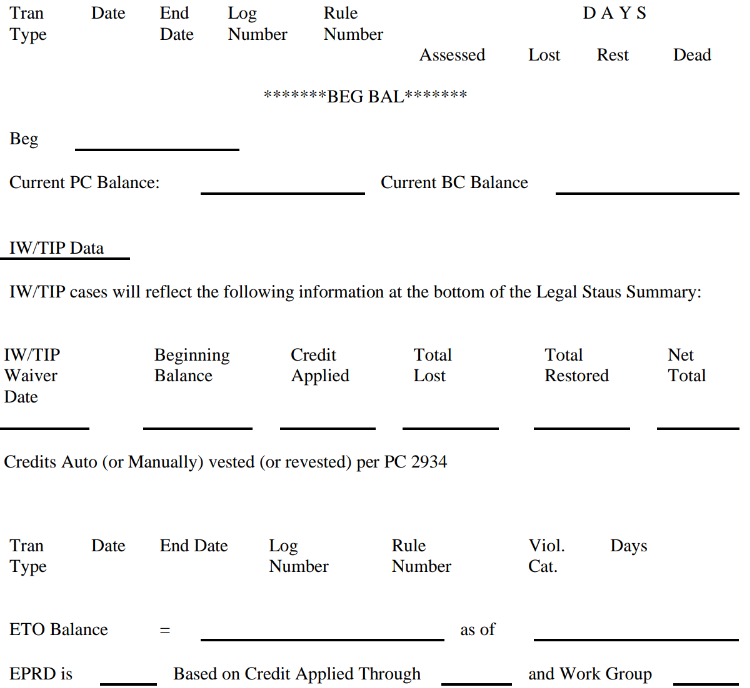
73010.7.3 Term Data
-
The face sheet shall reflect as the base term, the term for the controlling offense. The entry for this section shall reflect the term in years and months.
EXAMPLE:5 years = 05-00 1 year 4 months = 01-04 -
The face sheet shall reflect the total term for all enhancements included in the controlling total term.
73010.7.4 Parole Period
-
Based on the commitment data the OBISOffender Based Information System computer will determine the appropriate parole period. Credits pursuant to In re Sosa will be reflected in the section next to the parole period section.
73010.7.5 Preprison and Postsentence Credit
-
Refer to DOMDepartment Operations Manual 73010.6.5.
73010.7.6 Notification/Psychiatric Referral/Registration Required
-
Refer to DOMDepartment Operations Manual 73010.6.6.
73010.7.7 Offense Data
-
The offense data section is divided into three parts.
-
Controlling case. Offenses and enhancements in the case with the principal term which are included in the controlling term.
-
CSControl Services factors. Offenses and enhancements from other cases which are included in the controlling term.
-
Non-Controlling offenses. Offenses and enhancements which are not included in the controlling term.
-
-
Record
-
The following information will be recorded for each count:
-
Received date.
-
County of commitment.
-
Case number.
-
Sentence date.
-
Count.
-
Offense code.
-
Offense description.
-
Offense date.
-
-
-
EXAMPLE:
Controlling Principle And Consecutive (Including Enhancement) Offence
—–CONTROLLING CASE—–Date
Rec’dCounty
Case
NumberCt Code & Off Type
WPNDate
of
OffenseSentence
Date11-03-99 LA
A123456
PPT-V01 P667.5(A)
15-Life
P211 robbery
P12022(A)
ARM/ACSControl Services 10-27-99 07-21-99 —CONSECUTIVE FACTORS—- 08-08-99 RIV
1234501
02P211 Robbery
P211 RobberyCSControl Services 03-23-99
04-16-9907-19-99 —-NON-CONTR OLLING CASES– 08-08-99 SBD
5432101
02P211 Robbery
P211 Robbery03-22-99
04-10-9907-02-99
73010.7.8 Goodtime/Worktime Credit And DSL EPRD
-
Non-IW/TIP or non-vested IW/TIP cases will reflect the following information at the bottom of the Legal Status Summary:
73010.8 Circumstances of Offense
-
A PORProbation Officer Report is prepared by the probation officer in the county where the offense was committed and is considered the main body of the Case Summary. The circumstances of the offense are included in the PORProbation Officer Report.
-
The statements of views submitted pursuant to PCPenal Code 1203.01 by the sentencing judge, DA, defense attorney, and law enforcement agencies shall be included in the Case Summary if a PORProbation Officer Report is not available. A copy of the arrest report shall be requested and included in the Case Summary if the PORProbation Officer Report or statement of views does not contain circumstances of the offense.
73010.9 CI&I Report
-
This section is an actual reproduction of the CI&ICriminal Identification and Information SSCHState Summary - Criminal History.
-
PCPenal Code 11120-11126, relating to the SSCHState Summary - Criminal History Information maintained under a person’s name by DOJDepartment Of Justice, provide that any person desiring a copy of this record may make application to State DOJDepartment Of Justice for such record, and upon such request, State DOJDepartment Of Justice shall furnish that person with a copy.
-
Statutes prohibit the Department from providing an inmate with a copy of their SSCHState Summary - Criminal History. However, an inmate may retain a copy of the record which they obtained from State DOJDepartment Of Justice.
73010.9.1 Destruction of CI&I Arrest Records Pursuant to H&S Code 11361.5
-
H&SCHealth and Safety Code 11361.5(c) states: “Destruction of records of arrest and/or conviction pursuant to subdivision (a) or (b) of this section shall be accomplished by permanent obliteration of all entries or notations upon such records pertaining to the arrest or conviction, and the records shall be prepared again so that it appears that the arrest or conviction never occurred”.
-
Application for destruction of records as indicated above, must be submitted to and processed by State DOJDepartment Of Justice. Upon being advised by DOJDepartment Of Justice that an application has been approved, these procedures shall be followed in removing the information from all departmental records:
-
Upon receipt of the information from CI&ICriminal Identification and Information that an item(s) has been removed pursuant to H&SCHealth and Safety Code 11361.5, institution/region case records staff shall obliterate all references to the removed material from the Legal Section of the C-file. The new SSCHState Summary - Criminal History shall be inserted into all copies of the Case Summary.
-
Facility case records staff shall then forward the C-File to the assigned counselor. The counselor shall review the entire C-File and other Department records and remove all references to any arrest or conviction which has been removed from the SSCHState Summary - Criminal History pursuant to H&SCHealth and Safety Code 11361.5. Revisions to material in the Case Summary shall require complete redistribution of the corrected material.
-
Region case records staff shall forward the C-File to the regional “Olson” coordinator who shall review the entire C-File and other departmental records and remove all references to any arrest or conviction which has been removed from the SSCHState Summary - Criminal History pursuant to H&SCHealth and Safety Code 11361.5. Revisions to material in the Case Summary shall require complete redistribution of the corrected material. A corrected copy of the Case Summary shall be forwarded to the Parole Agent for placement in the field file.
-
73010.10 FBI Report
Revised June 16, 1995-
The FBIFederal Bureau of Investigation provides the Department with a reproduction of criminal history similar to the State criminal history with the addition of arrests and/or convictions which were reported in all and any other state and/or for federal offenses.
73010.11 Revision of Legal Status Sheet
Revised June 16, 1995-
Many cases are complicated by multiple commitments and/or amended judgments received while the individual is in the reception center, facility, or on parole. The receipt of a new commitment requires modification of the Legal Section as follows:
-
A new Legal Status Summary shall be prepared showing each additional commitment and/or modification.
-
A new CI&ICriminal Identification and Information report replaces the previous CI&ICriminal Identification and Information report.
-
A new FBIFederal Bureau of Investigation report replaces the previous FBIFederal Bureau of Investigation report.
-
-
An entry shall be recorded on the CDC Form 112, reciting the date of the change, the authority for the change, the county, and the case number (e.g., 3 Pfcs stricken; degree of Burg modified from 1st to 2nd).
73010.11.1 Appellate Court Decisions
Revised June 16, 1995-
In instances where the sentence is modified by the appellate court, the Legal Status Summary shall be changed in accordance with the decision of the appellate court upon receipt of a certified copy of a Remittitur from the appellate court.
-
Where the appellate court directs the case to the Superior Court for re-sentencing, and by opinion leaves open-ended the structure for re-sentencing, the Legal Status Summary shall be changed upon receipt of an amended Abstract of Judgment and/or Minute Order from the Superior Court. Information related to judgments on appeal is found in PCPenal Code 1258, et. al.
73010.12 Revisions
Revised June 16, 1995-
The Director, Division of Adult Institutions, or designee shall be responsible for ensuring that the contents of this Article are kept current and accurate.
73010.13 References
-
BPHBoard of Parole Hearings (formerly Board of Prison Terms) Rule 2273.
-
In re Sosa (102 Cal App 3d, 1980).
-
People v. McCarthy (32 Cal 3d 388, 1982).
-
In re Haygood (769 Cal 2d 1350, 1985).
-
H&SCHealth and Safety Code §§ 11361.5, 11370.2, 11370.4, 11379.8, and 11590.
-
PCPenal Code §§ 290, 290.2, 451, 453, 457.1, 669, 1170, 1170.1, 1170.2, 1203.01, 1203.03, 1258, 1375.5, 2900.1, 2900.5, 2931, 3002, 3046, 3058.6, 3058.8, 4019, 4532(a), 11120 – 11126, 11150, 12022, and 12022.2 – 12022.9.
-
Code of Civil Procedure Section 1279.5
Article 11 – Unassigned
Article 12 – Time Computations
73030.1 Policy
-
Time computations shall be completed in a uniform manner to ensure that release dates are true and correct.
73030.2 Purpose
-
This section sets forth uniform procedures for the computation of terms.
73030.3 Computation of Time
-
The phrase “Time Computation” describes the Department’s uniform method for determining and computing an inmate’s term, minimum and maximum release dates.
-
An inmate’s time is calculated and computed in years, months, and days.
73030.4 Sentencing and Credit LawsNon‑life Terms
-
The method of time computation and appropriate application of credit to a term of a sentenced felon is governed by whichever law or set of laws apply on the date a crime is committed.
-
The primary sentencing laws applicable to non-life terms are the:
-
Indeterminate Sentence Law (ISLIndeterminate Sentence Law) [PC1168(b) and 1170.2].
-
Crime committed prior to 7177.
-
-
Determinate Sentence Law (DSLDeterminate Sentence Law) [PCPenal Code 667.6(c), 1168(a), 1170, and 1170.1].
-
Crime committed on or after 7177.
-
-
-
The primary laws affecting credit on a term of imprisonment are:
-
PCPenal Code 2931 and 2934 (DSLDeterminate Sentence Law).
-
Crime committed on or after 7177 and prior to 1183.
-
-
PCPenal Code 2933 DSLDeterminate Sentence Law-IW/TIP.
-
Crime committed on or after 1183.
-
-
73030.5 Credit For Time Served/Pre‑prison Credit
-
Credit for the total of any time served prior to reception into departmental custody, and good time credit on those days is called “pre-prison credit.”
-
Pre-prison credits apply to the time period as if the time credited had been served in State prison.
-
All credits ordered by the sentencing court shall be applied when calculating the term(s).
73030.5.1 Pre‑sentence Credit and Good time
-
Pre-sentence credit, credit for prior time served in county jail or other county facilities pursuant to PCPenal Code 2900.5, and good time on those days pursuant to PCPenal Code 4019 is ordered by the court and will be reflected on the legal document.
73030.5.2 Credit For Time ServedOther Commitments
-
Credit for time served shall be granted and administratively applied if the credits are not reflected on legal documents for:
-
Prior time spent under indeterminate commitment as a mentally disordered offender (PCPenal Code 1600.5).
-
Commitment received on or after September 15, 1965, where there was prior confinement for diagnostic observation and recommendation (PCPenal Code 1203.03).
-
Prior time served under commitment pursuant to the W&I 3200.
-
CYASee Division of Juvenile Justice (DJJ) time in custody for the same offense (W&I 1782).
-
73030.5.3 Credit For Time ServedInvalid or Modified Judgment
-
Credit for time served under a judgment subsequently declared invalid or modified shall be granted and administratively applied if a person is recommitted for the same criminal act or acts and the credits are not reflected on the Abstract(s) of Judgment (PCPenal Code 2900.1).
73030.5.4 Post‑sentence Credit and Good time
Revised March 16, 1995-
Credit for the number of days between sentencing and actual delivery to departmental custody and good time on post-sentence credit shall be administratively granted and applied pursuant to PCPenal Code 2900.5(e).
-
Postsentence credit shall not apply to a term ordered to run consecutively to another term presently being served.
-
Postsentence credit shall not apply to the case of an inmate who returns from court with an additional commitment which occurs after/as a result of revocation of probation.
-
Postsentence credits shall not apply to a term if due to a plea bargain the court stipulates that PCPenal Code 2900.5 credits are not to be granted.
-
73030.5.5 Additional or Modified Pre‑prison Credits
-
Upon receipt of an amended Abstract of Judgment or Minute Order modifying credits, the CCRMCorrectional Case Records Manager shall re-compute the release date, minimum eligible parole date (MEPD), minimum term or maximum term, and make appropriate changes in all records.
-
On ISLIndeterminate Sentence Law cases, if the inmate has not appeared for an initial parole consideration hearing, place on appropriate calendar in accordance with BPT Rule 2304. If the inmate has had an Initial Parole Consideration Hearing, schedule for Subsequent or Progress Hearing on the next available calendar.
-
73030.5.6 Application of Pre‑prison Credit and Person Overdue For Release
-
Upon receipt of a judgment or an amended judgment or court order, if after application of pre-prison credit the inmate is overdue for release, the inmate shall be released within five working days.
-
Five working days are allowed to provide records staff sufficient time to correct and audit the records and to prepare necessary release documents.
-
Work time credits shall be entered only to the date calculated as the earliest possible release date (EPRDEarliest Possible Release Date). Credit from the calculated release date to the date of actual release will be entered into OBISOffender Based Information System as “Sosa Credit.” The entry on the CDC Form 112 shall read, “Parole period ____________ years minus ____________ days In re Sosa.”
73030.5.7 Resolution of Pre‑prison Credits Issues
-
People v Montalvo (2 Crim 38558 1982) stated that the matter of granting pre-sentence credit at time of sentencing is done in open court and any challenges to the amount of credit granted should be made by counsel at that time.
-
Only the following credit issues shall be referred to the sentencing court for resolution:
-
Any case that has credit granted which is prohibited by In re Rojas. This includes in-prison offenses, crimes committed while on escape, and consecutive cases sentenced after intial receipt in CDC which includes credit for time served after initial receipt.
-
Resentenced cases wherein the court has granted erroneous time spent in CDC.
-
Probation revocation cases that include more than 60 days custody credit that is also being given by the Department.
-
Cases that reflect differing amounts of credits on the legal documents.
-
Cases wherein the court has granted “day-for-day” PCPenal Code 4019 credit.
-
73030.5.8 Application of Pre‑prison Credit To DSL Term
-
The procedures set forth in this section shall apply to determinate sentence law terms and cases recalculated pursuant to PCPenal Code 1170.2(a)(b).
73030.5.8.1 Single DSL Term
-
All pre-prison credit shall be deducted from the DSLDeterminate Sentence Law term, including enhancements for use of weapons, possession of a weapon, or great bodily injury and enhancements for prior prison terms and any other enhancements.
73030.5.8.2 Concurrent DSL Term
-
Pre-prison credit is applicable only to the term to which it is attributable; i.e., court case number to that particular crime.
-
Concurrent terms are computed separately, applying the applicable pre-prison credit to each term.
73030.5.8.3 Consecutive DSL Terms
-
All pre-prison credit attributable to the DSLDeterminate Sentence Law principle term shall be deducted from that term only.
-
Pre-prison credit attributable to each consecutive case or count shall be applied only to the subordinate term to which it is attributable.
-
Any pre-prison credit attributable both to the principal term crime and to any subordinate term crime shall be deducted from the total term.
73030.5.9 Pre‑prison Credit in Excess of DSL Term
-
Any pre-prison credit in excess of the term assessed for a principal and/or subordinate term shall be used to reduce the maximum parole period (In re Sosa).
73030.5.10 Pre‑prison Credit Application — ISL Terms
-
Pre-prison credits do not change the statutory requirement for the minimum eligible parole date (MEPD), minimum term or maximum term, but apply to the time periods as if the time credited had been served in State prison.
-
Applicable pre-prison credit shall be applied to any parole date or term of imprisonment no later than one week after it has been established or fixed by the BPT. The total number of days to be credited shall be contained in the Abstract of Judgment or Minute Order as the commitment document.
-
No pre-prison credits shall be used to offset time assessed for prior prison terms.
-
Single offense. All pre-prison credit attributable to the base offense shall be deducted from the base period of confinement determined by the BPT.
-
Multiple offenses. Pre-prison credit shall be deducted from the base period of confinement and the multiple crime adjustment established by the BPT.
-
Pre-prison credit shall not be deducted from any other adjustment.
-
No overlapping pre-prison credit shall be applied.
-
Preprison credit attributable only to the base offense shall be deducted from the base period confinement.
-
Preprison credit attributable only to multiple crimes shall be deducted from the multiple crime adjustment.
-
Preprison credit attributable both to the base offense and to multiple crimes shall be deducted from the base period of confinement.
-
Any preprison credit in excess of the base period of confinement shall be deducted from the multiple crime adjustment for each multiple crime to which the preprison credit is attributable.
-
Preprison credit attributable to multiple crimes shall be deducted from the adjustment beginning with the adjustment for the earliest crime and deducting any remaining preprison credit from the adjustments following the chronological order of the crimes.
-
-
Pre-prison credit in excess of the base period of confinement or the multiple crime adjustment shall be deducted from the maximum period of parole (In re Sosa).
-
Time spent under outpatient status on an “N” commitment is not applicable to parole dates or secondary discharge date.
-
Time spent as a civil addict outpatient shall apply to ISLIndeterminate Sentence Law maximum terms.
-
CYASee Division of Juvenile Justice (DJJ) time in custody for the same offense is applicable to the parole date or secondary discharge date.
73030.5.10.1 Application of Pre‑prison Credit To Specific BPT Actions
-
A BPT action granting parole effective on a specific date is not affected by pre-prison credits.
-
A BPT action, fixing/re-fixing a term to discharge as of a specific date is not affected by pre-prison credits.
-
A discharge date fixed/re-fixed by a BPT action cannot fall beyond the expiration of the statutory maximum of the term less pre-prison credits, or occur prior to the statutory minimum term less pre-prison credits.
73030.6 Good time Credit Earning Capability
-
Good time credit earning capability after reception into departmental custody is the calculated number of days that can be deducted from a sentence for good behavior and for participation in a work/training program.
73030.6.1 Good time Credit DSL Term (PC 2931)
-
The determinate sentence law provides for a one-third reduction of sentence for inmates who function satisfactorily while incarcerated subject to the provisions of PCPenal Code 2931.
-
This one-third reduction is divided into behavior credits (BC) and participation credits (PCPenal Code), collectively called good time/work time credits.
-
Any case factors that cause the term of the inmate to be modified shall necessitate the recalculation of good time/work time credit.
73030.6.2 DSL Good Time Credit and ISL Recalculations
-
The provisions of PCPenal Code 2931 apply to any term that was sentenced pursuant to PCPenal Code 1170 for offenses committed between 7-1-77 and 12-31-82 or for all offenses if committed prior to 7-1-77 and recalculated pursuant to PCPenal Code 1170.2.
73030.6.3 DSL Work time Credits (PC 2933)
Revised December 24, 1992-
Inmates serving a sentence(s) for an offense committed on or after January 1, 1983, or on offenses committed prior to January 1, 1983 in which the inmate has exercised a waiver pursuant to PCPenal Code 2934 shall serve the entire or remaining portion of the sentence imposed by the court, except for a reduction in time served for performance of work, training, and/or education programs.
-
Earned work time for inmates in fulltime credit-qualifying programs is a reduction in sentence of one day for each day worked/participated in an education or training program. A minimum of six hours must be recorded each assigned workday to earn fulltime credit.
-
Worktime credit earned pursuant to PCPenal Code 2933 shall not apply to life terms with the following exceptions:
-
Sentences for attempted assassinations as specified in PCPenal Code 217.1(b).
-
Habitual offenders sentenced pursuant to PCPenal Code 667.7(a)(1) andPC 667.75.
-
-
Worktime credit earned pursuant to PCPenal Code 2933 shall not apply to terms where the court has found that the provisions of PCPenal Code 2933.5 apply.
-
-
The policy and procedures relating to the IW/TIP are contained in the CCRCalifornia Code of Regulations 3043, 3044, and 3045.
73030.6.4 Waiver of Good time Credits (PC 2934)
-
Those inmates whose commitment offenses occurred after 7-1-77 and prior to 1-1-83 and those whose terms were recalculated pursuant to PCPenal Code 1170.2, and are in full-time credit-qualifying work/training assignments, have the option to waive rights to good time credits under PCPenal Code 2931 and to earn work time credits pursuant to PCPenal Code 2933. (Inmates in less than full-time assignments will not benefit from waiving such rights.) See DOMDepartment Operations Manual 73030.8.11.
73030.6.5 Good Time/Work Time Credit Terminology
-
The recording and computing of good time/work time credits that are earned, forfeited, and restored are essential elements in the keeping of accurate inmate term information.
-
Credits earned are the recorded number of days that have been reported indicating the inmate’s daily participation in assigned work, training, and/or education programs.
-
Credit forfeited is the number of good time/work time days that are assessed for a disciplinary infraction(s).
-
Any person serving a SHUSecurity Housing Unit term as a result of any serious disciplinary infraction shall, in addition to any forfeiture of time credits, be ineligible to receive work time credits for the length of the credit loss or the SHUSecurity Housing Unit term, whichever is shorter.
-
Credit liens are those credits assessed by the disciplinary hearing officer/committee and confirmed by proper classification committee action that are in excess of credits already earned and will be recorded as a lien against credits to be earned.
-
Credits restored are those forfeited good time/work time credits that are:
-
Restored through the review or appeal process.
-
Reinstated by a classification committee to the inmate following a clean disciplinary period pursuant to PCPenal Code 2933 and DOMDepartment Operations Manual 52080.
-
73030.6.6 Automated Time Collection and Time Adjustment System
Revised March 16, 1995-
The IW/TIP Time Collection and Time Adjustment Systems for DSLDeterminate Sentence Law inmates are automated and are part of OBISOffender Based Information System.
-
Time collection for credit-earning lifer cases may be maintained in the computer; however, time adjustments for determining the MEPD shall be calculated manually.
-
The time collection and time adjustment systems permit direct input of IW/TIP work time, credit losses and restorations, and the scanning of the CDC Form 191, Inmate Timecard, using the DDPSDistributed Data Processing System.
-
The systems will not interface with the DSLDeterminate Sentence Law commitment and Good time Credit (GTC) systems until commitment data have been modified and GTC has been vested.
-
Classification chrono information relating to IW/TIP and inmate timecard data shall be entered or scanned into the system upon receipt in the case records office.
-
All timecards shall be filed on top of the general chronos. This shall eliminate the possibility of losing timecards prior to purge. See DOMDepartment Operations Manual 73030.10.2 and 73030.16.9 for purge requirements.
73030.7 Commitment Data and Sentencing Rules
-
Commitment data and the rules for sentencing as prescribed by statute are outlined in this section.
73030.7.1 Commitment Data and OBIS Entry
-
All commitment data will be entered into OBISOffender Based Information System as instructed in DOMDepartment Operations Manual 41020.
73030.7.2 Commitment Documents
-
When a judgment has been pronounced, the sentencing court directs forwarding of certified copies of the commitment documents (PCPenal Code 1216):
-
Abstract of Judgment and/or Minute Order pursuant to PCPenal Code 1213 and 1213.5.
-
Charging document/Information pursuant to PCPenal Code 1203.01.
-
Transcript of proceeding at time of plea, if the defendant pleaded guilty pursuant to PCPenal Code 1203.01.
-
Transcript of proceedings at time of sentencing pursuant to PCPenal Code 1203.01.
-
73030.7.3 Principal Term
-
The principal term consists of the greatest term of imprisonment imposed by the court for any of the crimes, including any enhancements imposed pursuant to PCPenal Code 667.8, 667.85, 12022, 12022.2, 12022.3, 12022.4, 12022.5, 12022.6, 12022.7, 12022.75, 12022.8, or 12022.9; and, H&SCHealth and Safety Code 11370.4 or 11379.8. (Refer to PCPenal Code 1170.1(a) for any additional enhancements.)
73030.7.4 Wholly Consecutive Terms
-
A full consecutive (CSControl Services) sentence is an enhancement (Cal Rules of Court, Rule 405(c)). Wholly consecutive terms include inprison offenses pursuant to PCPenal Code 1170.1(c), certain sex offenses as specified in PCPenal Code 667.6(c), multiple felony convictions as specified in PCPenal Code 1170.15, and any other offense fully CSControl Services by statute.
73030.7.5 Consecutive Subordinate Terms
-
The subordinate term for each consecutive offense shall consist of onethird of the middle term of imprisonment prescribed for which a CSControl Services term of imprisonment is imposed, except those subordinate terms for specific offenses as specified in PCPenal Code.
-
Subordinate terms for “Violent Felonies” defined in subsection(c) of PCPenal Code 667.5 shall include onethird of any enhancement imposed pursuant to those sections set forth in PCPenal Code 1170.1(a).
-
Subordinate terms for any offense not listed in subsection (c) of PCPenal Code 667.5 shall exclude any enhancements. (PCPenal Code 1170.1(a)).
-
The total term for subordinate non-violent felonies shall not exceed five years, except when a CSControl Services sentence is being imposed pursuant to PCPenal Code 1170.1(b) and (c)). PCPenal Code 1170.95 and other code sections providing exception.
-
The term of imprisonment shall not exceed twice the number of years imposed as the base term pursuant to PCPenal Code 1170(b) unless the person has been convicted of a felony listed in PCPenal Code 667.5(c) or enhancements are imposed pursuant to PCPenal Code 1170.1 (b), (c), and (g) or H&SCHealth and Safety Code 11370.4.
73030.7.6 Concurrent Terms
-
Concurrent (CCCorrectional Counselor) terms are terms for multiple cases or counts that are served simultaneously or terms which can be served at the same time.
-
When an additional commitment is received by mail or after an inmate is returned from court with additional commitment where the trial and conviction occurred prior to imprisonment, or the commitment is a concurrent probation revoked case, the additional commitment shall be considered as wholly concurrent.
-
Term starts as of the date the inmate initially was received on the original term.
73030.7.7 Partially Concurrent Terms
-
When an inmate is removed from prison for trial on an additional charge which was committed before his original receipt by the Department, and he/she is returned to prison with an additional commitment in which it is specified that the additional commitment is CCCorrectional Counselor with the preceding commitment(s), the additional commitment shall be considered a partially CCCorrectional Counselor term.
-
Time on the new term starts as of the date of return with the new CCCorrectional Counselor term.
73030.7.8 Computation of CC Terms
-
CCCorrectional Counselor terms require a separate computation for each term or count.
-
The term which retains the person in custody the longest shall be the controlling term.
73030.7.9 DSL Enhancements
-
In addition to the penalty imposed for crimes on a sentence, terms may be enhanced for:
-
Possession and/or use of weapons as specified in PCPenal Code 12022, 12022.2, 12022.3, 12022.4, and 12022.5.
-
A felony committed while released on bail pursuant to PCPenal Code 12022.1.
-
Felony taking, damaging, or destroying of property as specified in PCPenal Code 12022.6.
-
Infliction of great bodily injury (GBI) pursuant to PCPenal Code 12022.7, 12022.8, and 12022.9.
-
Felony offenses involving controlled substances as specified inH&SC §§ 11356.5, 11370.2, 11370.4, 11379.8, and PCPenal Code § 12022.75.
-
73030.7.10 EnhancementsPrior Prison Terms
-
Pursuant to PCPenal Code 667.5 (g), a prior prison term (PPT) is a prior felony conviction which resulted in a continuous completed period of prison incarceration imposed for a particular offense alone, or in combination with CCCorrectional Counselor or CSControl Services sentences received before release on parole or discharge, whichever occurs first.
-
If the person was returned to prison on revocation of parole, which is not accompanied by a new commitment to prison, the period shall count as a single PPT.
-
If any inprison offense is required by law to be served after completion of an earlier prison commitment, the original commitment and the inprison commitment count as separate PPT’s.
-
If the inmate was returned to prison from parole with a new term, the new term shall count as a second PPT.
-
A commitment to DMHDepartment of Mental Health (see Department of State Hospitals DSH) as a mentally disordered sex offender (MDSO) following a felony conviction is a PPT if the commitment exceeds one year. If the inmate subsequently is committed to prison for the same offense after termination of the MDSO commitment the time in DMHDepartment of Mental Health (see Department of State Hospitals DSH) and CDC shall count as a single PPT.
-
When an inmate subject to the custody, control, and discipline of the Director is incarcerated at a facility operated by the CYASee Division of Juvenile Justice (DJJ), that incarceration shall count as a prior prison term.
-
-
Time spent in any state or federal penal institution, including any time which is credited as service of prison time in that jurisdiction may count as a prior prison term. If served other than in California, the inmate must have actually served at least one year, and it must have been for a crime that is punishable by imprisonment in state prison in California.
-
A violent PPT with a violent commitment offense shall be enhanced by three years for each pled and proved PPT, unless the inmate remained free of both prison custody and the commission of an offense which results in a felony conviction for a period of 10 years immediately preceding the commission of the current commitment offense. (Violent felonies are defined in PCPenal Code 667.5(c).)
73030.7.11 Enhancement‑Prior Felony Convictions (Habitual Criminal)
-
Pursuant to PCPenal Code 667(a), any person convicted of a serious felony who has previously been convicted of a serious felony (as listed in PCPenal Code 1192.7(c)) in this state, or of any offense committed in another jurisdiction which includes all the elements of any serious felony shall receive a five year enhancement for each such prior conviction on charges brought and tried separately.
-
There is no requirement of prior incarceration or commitment for a prior felony conviction (PFC).
-
PCPenal Code 1385(b) prohibits a judge from striking any prior conviction of a serious felony for purposes of enhancement of a sentence under PCPenal Code 667 for any sentence for crimes committed on or after May 6, 1986. This was added to the PCPenal Code in 1986 which abrogates the holding in People v. Fritz.
-
There is no limit on the number of PFCs imposed under PCPenal Code 667(a).
73030.7.12 DSL Total Term
-
The total term shall be the aggregate term of imprisonment for all of the convictions and shall be the sum of the principal term, the subordinate term(s) and any additional term imposed for enhancements and/or prior prison terms.
73030.8 DSL Term Calculation
-
The procedures set forth in this section shall apply to DSLDeterminate Sentence Law terms and cases recalculated pursuant to PCPenal Code 1170.2(a)(b).
73030.8.1 Starting of Term
-
The term of imprisonment fixed by a judgment commences upon actual delivery of the inmate into the custody of the Director at a place designated for reception of convicted felons (PCPenal Code 2900).
-
The Director shall designate a facility of another jurisdiction as the place of reception:
-
When pursuant to the Interstate Agreement on Detainers, an inmate of another jurisdiction has been sentenced to a CCCorrectional Counselor California term.
-
When a person committed to a facility of another jurisdiction is subsequently ordered to serve a CCCorrectional Counselor California term.
-
-
-
The date of reception is included in its entirety regardless of the time of reception.
-
An inmate must serve the full 24-hour period to receive credit for any succeeding day.
73030.8.2 Received Date
-
The received date is the date of initial receipt into a facility of the Department, usually a reception center or a facility of another jurisdiction as designated by the Director.
-
The received date into a facility may be verified by checking the following documents:
-
CDC Form 123, Body Receipt.
-
Date and time stamped on the Abstract of Judgment or Minute Order.
-
73030.8.3 Time Served
-
Time served is the total time in years, months, and days from the date of receipt in the Department to a given date.
73030.8.4 Ceasing of Time
-
Time ceases to run as of the date of escape or parole suspension.
-
The date of the event is excluded in its entirety.
-
Time ceases to run when a person is released on bail or appeal bond pursuant to PCPenal Code 1272 or 1506 or any other provision of law permitting legal release and shall not be credited as service on the prison term. [PCPenal Code 2900 (c)(1).]
73030.8.5 Dead Time/at‑Large Time
Revised December 24, 1992-
Time which is not credited as time served.
-
Dead time or at-large time is accrued while on escape status [PCPenal Code 2900(c)(2)], while parole/release has been suspended, or while released on bail or appeal bond and shall be computed in total number of days.
-
The number of days of dead time shall be posted on the CDC Form 112 and entered into OBISOffender Based Information System.
-
Dead time or at-large time ceases upon:
-
Return to a departmental facility.
-
Date of arrest in California of an escapee.
-
Date available for return from out-of-state.
-
Date of arrest in state of parole jurisdiction.
-
Date bail is exonerated and inmate is remanded to custody.
-
73030.8.6 Escape or Parole Violators
-
PCPenal Code 2900(c)(2) states: “…the prisoner shall be deemed an escapee and fugitive from justice, until the prisoner is available to return to the custody of the Director or the State of California . . .” An escapee or parole violator is entitled to credit on their sentence for time in custody of another jurisdiction when they are held on “our Hold only” and are available for pickup by the Department’s agents.
-
An escapee or parole violator held in custody in another state on “our Hold only,” but who is not available because they are resisting extradition, is not entitled to credit (on the California term) served in jail while resisting extradition (In re Pearce 1974 40 Cal App 3d 399).
-
A parole violator in local confinement is deemed available on the date our hold was placed or, if previously declared at-large and suspended from parole supervision, on the date of arrest.
-
An escapee or parole violator in local confinement (California jail or DMHDepartment of Mental Health (see Department of State Hospitals DSH)) is deemed available to the Department except when they are serving a sentence in lieu of a fine or a sentence expressly ordered to run consecutively to the existing prior prison term.
73030.8.7 Maximum Release Date
-
The maximum release date is calculated by adding the term ordered by the court to the term starts date and subtracting applicable pre-prison credits.
73030.8.8 Minimum Release Dates
-
ISLIndeterminate Sentence Law (crime committed prior to 7177):
-
The minimum term is established by statute.
-
The MEPD is determined by adding the statutory minimum term of confinement or the result of computation of aggregate minimum terms to the received date and subtracting any applicable preprison credits.
-
-
DSLDeterminate Sentence Law (PCPenal Code 2931, crime committed on or after 7177):
-
The minimum DSLDeterminate Sentence Law (MINMinimum DSLDeterminate Sentence Law) release date is calculated by subtracting all applicable days of good time credit from the maximum release date.
-
This date shall be adjusted by any credits forfeited and/or restored in the disciplinary process.
-
-
-
DSLDeterminate Sentence Law IW/TIP (PCPenal Code 2933, crime committed on or after 1183):
-
The EPRDEarliest Possible Release Date is determined in these steps:
-
Subtract all earned worktime credit, adjusted by any loss/restoration, from the maximum release date, the result of which is the current release date.
-
Subtract from the current release date the date through which credit was applied.
-
Divide the remaining number of days eligible for credit based on credit earning status.
-
Subtract the resulting number of days from the current release date. That date is the EPRDEarliest Possible Release Date.
-
-
-
An EPRDEarliest Possible Release Date is a projected date contingent upon the inmate remaining in the same credit earning work group, having no unexcused absences, and no forfeited or restored credit.
73030.8.9 Calculation of Good time Credit (PC 2931)
-
To determine the total amount of good time credit to be applied to reduce a term pursuant to PCPenal Code 2931:
-
Add the term to the term start date for that particular case and subtract applicable presentence and postsentence credit. The resulting date is the maximum release date.
-
Determine the number of days eligible for goodtime credit by subtracting the term start date from the maximum release date and adding postsentence credit.
-
Divide the number of days by three. The resulting number is the total number of days of goodtime credit to be granted.
-
Fractions shall be increased to the next whole number.
-
-
Subtract the total goodtime from the maximum release date. The resulting date is the MINMinimum DSLDeterminate Sentence Law release date.
-
73030.8.10 Good Behavior and Participation Credit
-
The total good time credit shall be further divided into behavior credit and participation credit.
-
The amount of participation credit is determined by dividing the total amount of goodtime credit by four.
-
The remaining number of days of credit is behavior credit.
-
When calculating participation and behavior credits, fractions shall be changed to the closest whole number except when the fraction is onehalf. A fraction of onehalf shall increase beavior credits to the next whole number.
-
-
73030.8.11 Waiver Processing
-
Inmates electing to waive PCPenal Code 2931 credits shall be required to sign a CDC Form 916, irrevocable Time Credit Waiver Form, to be witnessed by their counselor. The effective date shall be documented on the CDC Form 916.
-
The waiver shall become effective when accepted by the Department.
-
A waiver shall not be accepted if the inmate is within 30 days of their current release date.
-
The counselor witnessing the waiver shall verify the inmate’s work status and current release date and shall fill in the date the waiver shall become effective. The counselor shall immediately forward the completed and signed waiver to the CCRMCorrectional Case Records Manager for processing.
-
Inmates who were assigned to less than a fullday assignment on January 1, 1983, and are subsequently reassigned to a fullday assignment shall be given the same option at the time of their reassignment.
73030.8.12 Vested Credit
-
Following acceptance of a waiver, the specialist shall compute the amount of good time credit already earned on the controlling term pursuant to PCPenal Code 2931 from the date of reception into the Department on or after 7177, to the effective date of waiver.
-
The credit earned, minus any credit previously forfeited and/or restored by classification action on disciplinaries received prior to the effective date of waiver, shall be vested and not subject to future loss.
-
Vested credit on cases sentenced pursuant to PCPenal Code 2933 (crime committed on or after 1183) is good time on post-sentence credit.
-
The application of vested credit will generate a new Legal Status Summary, a copy of which will be sent to the inmate.
73030.8.13 Calculation of Work time Credit (PC 2933)
-
The following steps shall be taken to determine the release date on a term eligible for work time credit:
-
Add the controlling term to the term start date on the controlling case and subtract applicable preprison credit. The resulting date is the maximum release date.
-
The maximum release and current release dates are the same until vested credit and/or worktime credits are applied to the term.
-
The adjusted maximum release date is arrived at by subtracting vested credit from the original maximum release date.
-
The current release date is changed as earned worktime credits are applied and/or credits are forfeited or restored.
-
The EPRDEarliest Possible Release Date is projected each time earned worktime credits or forfeited or restored credits are applied to the current release date or there is a change in credit earning status. The application of worktime credits, adjusted by any credits forfeited or restored, through any working month or portion thereof, results in a new current release date. Subtracting the date through which credit was applied from the new current release date determines the remaining number of days eligible for goodtime then divisable based on the inmate’s credit earning status. The resulting number of days subtracted from the new current release date is the EPRDEarliest Possible Release Date.
-
73030.9 Work Credit Gains
-
Work time credits shall be applied/gained at least once every six months.
-
The work credit gain will appear on subsequent work credit query computer screens.
73030.10 Legal Status Summary
-
This will generate a Legal Status Summary, a copy of which shall be given to the inmate. Staff other than case records staff shall have the inmate acknowledge receipt of the revised Legal Status Summary by signing a CDC 128B.
73030.10.1 Legal Status Summary Appeal
-
The contents of the Legal Status Summary may be appealed by the inmate through the Department’s appeal process and within the established time frames.
73030.10.2 Purging of Time Cards
-
If no appeal is taken by the inmate the action shall become final and all timecards for the time worked prior to the credit gain shall be purged from the C-File.
73030.11 OBIS Entry of 1983/Pre 1983 Mixed Cases
-
A computer program enables identification of 1983/pre1983 mixed cases and permits case records staff to set a “flag” to alert counseling staff that an IW/TIP Waiver is needed on the pre1983 case(s).
-
A line, “Eligible for PCPenal Code 2934 Waiver,” has been added to the auto or manual vesting computer screen.
-
When entering 1983/pre 1983 mixed cases at the time of initial processing, the operator shall enter “Y”.
-
This entry will set the flag, and a computer-generated notation “Eligible for PCPenal Code 2934 Waiver” shall be printed on the Legal Status Summary page.
-
In those cases in which a waiver has been processed, the operator shall remove the flag deleting the notation from the Legal Status Summary page.
73030.12 OBIS Entry Credit Loss
-
As CDC Form 115 credit losses are received, case records staff shall make a Work Credit Loss entry directly into the system.
-
The system will edit the entry to ensure that the log number has not been previously entered and the violation category and days lost are appropriate for the category and vice versa.
-
Should errors occur during the editing process, the error will be identified on the terminal screen.
-
The operator shall ensure any error is not an entry error.
-
If the error is not an entry error, the matter shall be referred to the chief disciplinary hearing officer for correction.
-
If no errors are found, the entry will be processed by the system resulting in a new Legal Status Summary being generated.
-
The credit loss will appear on subsequent work credit queries.
73030.13 OBIS Entry Credit Restoration
-
Modifications or reversals of a credit loss action by a classification committee or through an appeal review shall be reported immediately to the records staff. This shall be done in writing to alert staff of a pending modification of the inmate’s release date.
-
When a credit restoration chrono is received, case records staff shall make a Work Credit Restoration entry directly into the system.
-
When entered, the transaction shall be edited to ensure that the loss entry for which the time is being restored is in the system and the time restored does not exceed the original time loss.
-
Should errors occur during the editing process, the entry will not be accepted by the system and referral to the case records specialist for resolution and subsequent reentry is required.
-
If no errors are found, the entry will be processed by the system, resulting in a new Legal Status Summary being generated.
-
Credit restorations will appear on subsequent work credit queries.
73030.14 OBIS Entry Meritorious Credit
-
When a Meritorious Credit Grant (MCG) chrono is received, the operator shall make an MCG entry directly into the system.
-
Meritorious credit shall not be granted in an amount which, when applied, will make the inmate overdue for release.
-
This entry will be processed by the system and a revised Legal Status Summary generated.
-
Meritorious credit grants shall be reflected on the CDC Form 188, Legal Status Summary.
73030.15 Retention in Custody Past Scheduled Release Date
Revised December 24, 1992-
CCRCalifornia Code of Regulations 3323 provides that in some instances a person may be retained in custody beyond their scheduled release date because of a serious disciplinary infraction for which credit may be lost though the CDC Form 115 may ultimately be dismissed or reduced to an administrative infraction.
-
It is necessary that the C-File reflect the reason the person was retained in custody.
-
The following procedures are authorized by CCRCalifornia Code of Regulations 3323 and should be used to properly record this information:
-
On the scheduled release date, prepare a CDC Form 128-B chrono indicating “Subject being retained in custody pending disposition of CDC Form 115 Log #______ for which ______ days may be lost.”
-
Post entry on CDC Form 112, “Retained in custody pending disposition of CDC Form 115 Log #______.”
-
If the CDC Form 115 is dismissed, prepare another CDC Form 128-B indicating “CDC Form 115 of ( date ) dismissed. Subject released on parole.”
-
Post entry on CDC Form 112, “Disciplinary dismissed. Released on parole. Parole period starts (indicate scheduled release date).”
-
Any days attributed to time held past release date on a pending CDC Form 115 subsequently dismissed shall be deducted from the maximum parole period.
-
73030.15.1 Dismissed Disciplinary Reports
-
CCRCalifornia Code of Regulations 3326 provides that all references to dismissed CDC Form 115s must be removed from the records.
73030.16 Parole Violator Returned To Custody (PVRTC)
-
A parolee may be returned to custody in the following circumstances:
-
After revocation of parole by the BPT for violating a condition(s) of parole pursuant to PCPenal Code 3056 (PVRTCParole Violator Return To Custody).
-
Upon conviction for a new term of imprisonment (also known as PVWNTParole Violator Returned With New Term).
-
73030.16.1 PVRTC Work time Credits
-
Except for parolees specifically excluded in DOMDepartment Operations Manual 73030.16.3, any period of revocation time imposed by the BPT may be reduced by work time credits earned in accordance with the CCRCalifornia Code of Regulations 3044(b).
-
Work time credits for PVRTCs shall only be earned for time served on or after 9-30-1987.
73030.16.2 Work time Credits For PVRTC County Jail/Community Correctional Centers
-
PVRTCs detained and/or serving parole revocation time in a county jail or community correctional center are eligible to earn work time credits pursuant to PCPenal Code 2933 provided they qualify under criteria set forth in PCPenal Code 3057(d)(1).
73030.16.3 PVRTC Work time Credit Exclusion Criteria
-
Parolees serving a period of revocation time are not eligible to earn work time credits if:
-
Sentenced under PCPenal Code 1168 with a maximum term of life.
-
Found unsuitable by the BPT to earn worktime credits.
-
The condition of parole violation related to association with specified persons, entering prohibited areas, failure to attend POCParole Outpatient Clinics, or failure to obtain psychiatric attention.
-
Found guilty and revoked on parole violation charge(s) for conduct described in, or that could be prosecuted under, one or more of the offenses, attempted offenses, or enhancements listed in PCPenal Code 3057(d)(2)(C).
-
The current prison commitment, for which the parolee was serving a period of parole, was for one or more of the offenses, attempted offenses, or enhancements listed in PCPenal Code 3057(d)(2)(C).
-
73030.16.4 PVRTC Credit Forfeited
-
Work time credit earned by PVRTCs may be forfeited for disciplinary infractions as provided for in the CCRCalifornia Code of Regulations 323 [PCPenal Code 3057(d)(1)].
-
A PVRTCParole Violator Return To Custody who commits a disciplinary infraction for which credits may be forfeited is subject to a parole revocation extension hearing. At that hearing, the BPT will determine whether to suspend eligibility for work time credits for the number of days forfeited for the infraction, in addition to any extended period of revocation.
73030.16.5 PVRTC Credit Restoration
-
Work time credit forfeited by PVRTCs for disciplinary infractions shall not be restored (PCPenal Code 3057(d)(1)).
73030.16.6 PVRTC Meritorious Credit
-
PVRTCs are not eligible to be granted meritorious credit.
73030.16.7 Computation of PVRTC Release Date
Revised December 24, 1992-
Time on a revocation period starts on the date a parole violator is available for return to the custody of the Department. See DOMDepartment Operations Manual 73030.8.6 for availability criteria.
-
Computation of parole revocation release dates will be done manually.
-
Revocation release date (RRDRevocation Release Date)ineligible for PCPenal Code 2933 credit.
-
Add the assessed revocation period to the date of arrest/hold placed/ available for return to custody of the Department.
-
Pursuant to BPT Rule 2635.1, the revocation period for a parolee whose original crime was committed on or before 12-31-78 may not exceed six months. The revocation period for a parolee whose original crime was committed on or after 1-1-79 may not exceed one year.
-
-
Projected revocation release date (PRRDProjected Revocation Release Date)eligible for PCPenal Code 2933 credit.
-
The maximum revocation release date (MRRD) is determined by adding the assessed revocation time to the date of arrest/hold placed available to the Department. The MRRD is adjusted by credits forfeited and number of days during which eligibility was suspended.
-
The application of work time credits to the adjusted maximum, through any working month or portion thereof, results in the number of days left to serve, then divisible based on the inmate’s credit earning status. The resulting number of days is then subtracted from the date of application. That date is the PRRDProjected Revocation Release Date.
-
A projected revocation release date (PRRDProjected Revocation Release Date) is calculated each time earned work time credit and/or forfeited credit is applied or when there is a change in legal status or credit earning status.
73030.16.8 Parole Violators With New Terms
-
Separate computations of release dates for parole violators with new terms shall be completed on both the old and new term to determine the controlling release date.
-
If, after calculation of both cases, the release date on the new term controls, the previous case shall be discharged pursuant to BPT 2649.
-
If the release date (RRDRevocation Release Date, PRRDProjected Revocation Release Date) on the original term controls, the case will be referred to the BPT for determination of the controlling release date.
-
Prior terms of nonrevoked violators returning with new terms will be discharged without a revocation hearing if the new commitment resulted from behavior which occurred prior to the parole date on the prior term.
-
-
If the BPT decision is to retain the inmate on the original case, separate release dates will be maintained on both terms, and the inmate will be released on the case that retains them in custody for the longest period of time.
-
People v. Mitchell (244 Cal Rpt 803 1988).
-
The ruling in this case allows for consecutive sentencing of a new term to parole revocation time. If the court orders a new term to run CSControl Services to parole revocation, the term start date on the new commitment will be the RRDRevocation Release Date/PRRDProjected Revocation Release Date and the original case will not be discharged.
73030.16.9 OBIS Processing Parole Violators Work time
-
Parole violators, returned to custody or returned with new terms, and/or inmates receiving additional controlling CCCorrectional Counselor terms who have previous work incentive credit on the earlier term(s) cannot be accurately processed by the DSLDeterminate Sentence Law/GTC computer system since the previous work history/credit is incorrectly brought forward to the new term. Therefore, additional processing is required:
-
A parole violator returned to custody to serve a revocation period and eligible for credit pursuant to PCPenal Code 2933 is processed by entering work time credit on the revocation period, sequential to the existing credit history, beginning on the date of arrest/hold placed/available to CDC, whichever is appropriate.
-
A parole violator returned to custody with a new controlling term, whose previous term is discharging (BPT 2649), is processed by obtaining a hard copy printout from OBISOffender Based Information System of all previous work time credit history using the Timecard Query Screen and Work Credit Query Screen. The hard copy is filed in the C-File under the general chronos.
-
Telephone LPULegal Processing Unit at (916) 323-7373 or ATSS 473-7373 to request a deletion of previous worktime and credit history. Upon deletion, all entries will be eliminated from the computer.
-
-
A parole violator with a new non-controlling term, i.e., whose revocation period exceeds that of the new term, will be processed by obtaining a hard copy and deleting the previous credit history. Credit on the new term is then entered in the normal manner, but only to the date calculated as the EPRDEarliest Possible Release Date.
-
Timecards on revoked cases will be destroyed only after a hard copy of the previous history is obtained and previous credit history is deleted.
73030.16.10 PVRTC Controlling Discharge Date
Revised December 24, 1992-
Unless the BPT waives the parole period, inmates shall serve a period of parole as specified in PCPenal Code 3000(a) or (b).
-
Pursuant to PCPenal Code 3000(a), an inmate subject to three or five year parole periods may not be retained under parole supervision for longer than four or seven years, respectively, except for periods of suspension.
-
The maximum statutory period of parole shall be computed from the date of initial parole, or July 1, 1977, whichever is later, and shall be a period chronologically determined.
-
Time during which parole is suspended because the parolee has absconded or has been returned to custody as a parole violator will not be credited toward the period of parole unless he/she is found not guilty of the parole violation.
-
A period of return to custody for psychiatric treatment will not be added to the parole period unless so ordered by the BPT.
-
Calculate the projected controlling discharge date (PCDD) of a PVRTCParole Violator Return To Custody eligible for PCPenal Code 2933 credit by adding the applicable parole period, the actual time projected to be served on the revocation period, and any suspension to the parole period.
-
Calculate the controlling discharge date (CDDControlling Discharge Date) of a PVRTCParole Violator Return To Custody not eligible for PCPenal Code 2933 credit by adding the applicable parole period, the actual time served on the revocation period, and any suspension to the parole board.
-
In the event the maximum discharge date precedes the revocation release date, the inmate will be discharged from departmental custody on the maximum date.
-
73030.16.11 Waiver of Parole
Revised March 16, 1995-
Pursuant to PCPenal Code 3000, the parole authority may waive the parole period of inmates sentenced under PCPenal Code 1168, 1170, or at the expiration of a term reduced under PCPenal Code 2931 and/or 2933.
-
The C&PRClassification & Parole Representative shall submit any case, using the following criteria, staff deem acceptable for waiver of parole to the parole authority for consideration of waiver of parole.
-
Cases may be referred to the parole authority for consideration of waiver of parole unless the term consists of three or more offenses, or where the commitment offense(s) was committed while subject to youth or adult parole supervision, or if the commitment offense(s) included any of the following PCPenal Code: 187, 192, 203, 207, 209, 212.5(a), 214, 217, 217.1, 220, 236, 243, 245, 245.3, 261(2)(3)(4), 264, 264.1, 286(c), 286(d), 288, 288A(c), 288A(d), 288.5, 289, 452(a), 459/461.1, 4500, 4501, 4501.5, 4503, 4574(a), 12020, 12021, 12022, 12022.5, 12022.7, 12022.9, 12560, 23101, and 23153.
73030.16.12 Discharge Review
Revised March 16, 1995-
Pursuant to PCPenal Code 3001, the parole of any person who was not imprisoned for committing a violent felony as defined in PC667.5(c) and has been on parole continuously for one year since release from confinement, shall be discharged unless the Department determines that the person shall continue on parole. At the final pre-parole audit prior to either original release on parole or release after service of a revocation period, a discharge review date will be set at one year after the actual release date unless the maximum discharge date precedes the review date, in which case no date for further review will be set.
-
The discharge review date shall be posted to the CDC Form 112.
73030.17 ISL Terms
-
Terms for offenses committed prior to 7-1-77 under the Indeterminate Sentence Law pursuant to PCPenal Code 1168(b), where release was determined by the paroling authority are called ISLIndeterminate Sentence Law cases.
73030.17.1 Recalculation of ISL Terms
-
The majority of terms under the ISLIndeterminate Sentence Law require recalculation based on the Determinate Sentence Law (DSLDeterminate Sentence Law) pursuant to PCPenal Code 1170.2.
-
The DSLDeterminate Sentence Law provides several indeterminate sentences for specific crimes. Those crimes that remain indeterminate do not require recalculation.
-
Any case for which the statutory penalty is one-year-and-one-day, except as specified determinate in PCPenal Code, is an indeterminate sentence under this section. See DOMDepartment Operations Manual 73010.6.16 on DSLDeterminate Sentence Law indeterminate terms.
-
73030.17.2 ISL Primary Term Fix
-
In re Rodriguez (14 Cal 3d 639 1975) held that the paroling authority must determine the time of incarceration based on the severity of the crime(s).
73030.17.3 Extended Term Considerations
-
PCPenal Code 1170.2(b) gives the BPT authority to hold hearings for the purpose of possibly extending an inmate’s normally recalculated DSLDeterminate Sentence Law term. These are called Extended Term Hearings (ETH).
73030.17.3.1 First Screening
-
The CCRMCorrectional Case Records Manager (CCRMCorrectional Case Records Manager) is responsible for the first screening of an inmate’s case dynamics to determine if an ETH may be necessary. The CCRMCorrectional Case Records Manager shall be guided by the law in determining if the inmate fits the criteria for an ETH.
-
A CDC Form 678 shall be completed in all applicable cases even for those not meeting the criteria for an ETH. The CDC Form 678 shall accompany the C-File through the screening process.
73030.17.3.2 Criteria For Extended Term Hearings
-
The CCRMCorrectional Case Records Manager shall indicate an ETH is required if the inmate was convicted of any of the following crimes, or in the following circumstances, whether the count was stayed or resulted in a commitment to State prison:
-
PCPenal Code 187, Second degree murder.
-
PCPenal Code 192, Voluntary manslaughter.
-
PCPenal Code 203, Mayhem.
-
PCPenal Code 211/213, First degree robbery or robbery with great bodily injury.
-
PCPenal Code 217, Assault with intent to commit murder.
-
PCPenal Code 243, Battery with serious bodily injury.
-
PCPenal Code 245, Assault with a deadly weapon.
-
PCPenal Code 261(2), 261(3), and 261(4), Forcible rape.
-
PCPenal Code 261/264, Rape with great bodily injury.
-
PCPenal Code 286(c), Sodomy on child or by force.
-
PCPenal Code 286(d), Aid sodomy with force.
-
PCPenal Code 288, Lewd acts on a child under 14.
-
PCPenal Code 288a(C), Oral copulation with force.
-
PCPenal Code 288a(D), Aid oral copulation with force.
-
PCPenal Code 459/461, First degree burglary or burglary with great bodily injury.
-
PCPenal Code 4501, Assault by a prisoner.
-
PCPenal Code 4501.5, Battery on a prisoner.
-
CSControl Services sentences. Any case in which a CSControl Services sentence has been imposed.
-
Multiple convictions. Any case in which the person has suffered three or more felony convictions either in a single or separate proceeding for the crimes of robbery, first degree burglary, burglary with explosives, arson, assault with intent to commit murder, extortion, kidnapping, or escape from a state prison with force or violence; or, any case in which the person has suffered five or more felony convictions either in a single or separate proceeding.
-
PPTs. Any prisoner with two or more PPTs.
-
Arming, use of weapon, GBI. Any case in which the factual circumstances of any current crime indicate that the prisoner was armed with a deadly weapon, used a firearm, or inflicted or attempted to inflict GBI on the victim.
-
Early release. Any case in which the ISLIndeterminate Sentence Law parole date is more than one year later than the DSLDeterminate Sentence Law release date.
-
73030.17.3.3 Not an ETH Case, PC 1170.2(A)
-
The CDC Form 144, DSLDeterminate Sentence Law Control Card, shall be checked in the appropriate space to indicate it is not an ETH case and it will be filed with other CDC Form 144 cards in the normal manner, with earliest release dates first.
73030.17.3.4 Initially An ETH Case
-
If the CCRMCorrectional Case Records Manager, during the first screening, determines that the inmate meets ETH criteria, the CDC Form 144 card shall be marked to reflect it as a PCPenal Code 1170.2(b) case. The DSLDeterminate Sentence Law Control Card shall be filed with other ETH DSLDeterminate Sentence Law Control Cards.
73030.17.3.5 Subsequent Screening
-
The BPT may do second and third ETH screenings. Frequently, the third BPT screening will take place without second screening. The BPT can designate a case a PCPenal Code 1170.2(a) case at any point during the screening process.
-
If the BPT determines that an inmate is a PCPenal Code 1170.2(a) (no ETH necessary), then the CCRMCorrectional Case Records Manager shall update the CDC Form 144 to reflect that change.
-
The third BPT screening shall be reflected on BPT Form 1091. The original shall remain with the C-file with copies going to BPT Headquarters, Research, and the inmate.
-
If the case is an overdue PCPenal Code 1170.2(a) case, or scheduled for release within 60 days according to the DSLDeterminate Sentence Law calculation, the case shall be referred to P&CSDParole & Community Services Division (see DAPO) within five days of discovery. The CDC Form 611 shall be identified as a priority case.
73030.17.3.6 Extended Term Hearing
-
PCPenal Code 1170.2(b) and 3041.5 require that the inmate be notified within 90 days of receipt into the Department if he/she is scheduled for an ETH and the hearing must be held within 120 days of receipt. The 120 days is computed from the latest of the date:
-
Of reception.
-
Of return to prison from court.
-
On return to prison from another jurisdiction following service of a commitment to which a California term is ordered to be served consecutively.
-
An amended Abstract of Judgment is received by CDC.
-
-
The screenings will be expedited and submitted to the BPT within the time frames set forth in this section.
-
A BPT Form 1080, Notice of Date, Time and Place of Hearing, and BPT Form 1092, Extended Term Hearing Notice, shall be prepared in duplicate and forwarded to the inmate’s counselor who shall have the inmate acknowledge receipt of the forms and return the original to the C-File.
73030.17.3.7 PC 3022/3042 Notices
-
For those inmates who will have an ETH (after final determination is made by the BPT), notices shall be sent to the judge and DA only. The notice shall indicate that a hearing will be held “no earlier than 30 days after the date of this notice.” No ETH shall be held until the statutory 30 days have elapsed after mailing of the notice.
73030.18 Computation of ISL Terms
-
The following procedures and forms shall be used in determining the release date of inmates sentenced under the Indeterminate Sentence Law and recalculated pursuant to PCPenal Code 1170.2.
73030.18.1 CDC Form 679, ISL Computation Work Sheet For Retroactive Calculations
-
The CDC Form 679, Computation Worksheet, shall be used to determine the controlling count in retroactive calculations when multiple counts and/or commitments are present.
-
The form shall be completed in pencil. Doing one count at a time, enter all case and count numbers and the offense title(s) (Robb. 1st, Burg. 2nd, etc.) under the appropriate heading for each offense.
-
The middle base term for the offense shall be entered on the form. All time entries shall be written out in years-months-days. The PCPenal Code shall be used to determine the middle base term.
-
Add any enhancements for being armed, use of a weapon, or great bodily injury (GBI). See DOMDepartment Operations Manual 73030.18.2.1 for criteria on enhancements. If there is no enhancement, enter a zero.
-
Enter the pre-prison credits that are applicable to the individual count. The received date is listed next in year-month- day order.
-
Some computations are necessary to finish the process. First, add the middle base and the weapon enhancement, if any. From that total, subtract the net credit. To this figure, add the received date.
-
EXAMPLE:
Middle base, 3 years, recorded as
Weapons enhancement, 1 yr+
=02-11-30
01-00-00
03-11-30Net credit to be subtracted –
=00-01-18
03-10-12Received date +
=77-03-02
81-01-14 -
The date calculated (in the example, 81-01-14) is entered in the “Date” column. Any prior prison term enhancement(s) is added in the “CSControl Services Adj. w/Credits” column. Record that enhancement if appropriate. If the figure represents one-third of the middle base term (plus enhancements under certain circumstances) refer to the enhancements part of this section minus applicable pre-confinement credit for cases ordered to run consecutively with the count being computed. If there is any applicable “dead time,” that year-month-day figure is added. Reflect the proper and final date on the “Final Date” line.
-
EXAMPLE:
Date
Prior (Assuming non-violent)
+
=81-01-14
01-00-00
82-01-14(A) CSControl Services adjusted with credit
(assuming a three year middle base crime with
No prconfinement credits–
=01-00-00
83-10-14Dead Time
Final Date+
=00-01-01
83-02-15 -
This process shall be done for all counts, computing each case fully. When computation of all the counts is completed, the controlling principal count shall be the one with the latest expiring final date. After determining the controlling principal count, proceed to the CDC Form 678, Confinement Computation.
73030.18.2 Confinement Computation CDC Form 678
-
The CDC Form 678, after being signed by the BPT, shall be filed in the BPT Section of the C-file.
-
The top of the form (from the double horizontal lines upward) shall be completed legibly using black ink. The bottom portion of the form “Parole Board and DSLDeterminate Sentence Law Data Control Information” shall be completed in soft-lead pencil.
-
The required information shall be the case number, count number, offense, base term, and adjusted base term for the controlling count. The adjusted base term shall be the same as the base term.
73030.18.2.1 Enhancements – Part I – Weapons
-
Under DSLDeterminate Sentence Law provisions, an additional enhancement will be added to the base term in certain circumstances.
-
If a firearm was present during the commission or attempted commission of a felony, all principals in the crime receive an additional one-year enhancement, unless such arming is an element of the offense of which convicted.
-
A principal is defined as any person who assists, aids, or abets before or during the commission of the crime. The person does not have to be personally armed, and the weapon does not have to be separately pled and proved.
-
Any person who personally uses a deadly or dangerous weapon (all weapons other than a firearm) in the commission or attempted commission of a felony shall receive an additional one-year enhancement unless use of a deadly or dangerous weapon is an element of the offense of which convicted. The weapon does not need to be separately pled and proved. In this case “use” is defined as showing or displaying the weapon in a threatening or menacing manner.
-
EXAMPLES:
-
A man enters a market with a knife on his belt and states he wants the money or else and motions to the knife. This is a valid use. If the subject made a statement concerning using a deadly or dangerous weapon, but no weapon is observed, the subject’s declaration is accepted and the one-year enhancement applied.
-
Suspect A and Suspect B enter a store and commit a robbery. Suspect B had an axe and Suspect A was not armed. In this case Suspect B does get a one-year enhancement for personal use of a deadly or dangerous weapon and Suspect A does not because he did not personally use the weapon.
-
-
PCPenal Code 3024 and 12022. If the inmate had a separate court finding under PCPenal Code 3024 or 12022, the facts of the offense need to be reviewed.
-
If the finding was due to a firearm, a one-year enhancement shall be added to the terms of all principals in the felony.
-
If the finding was due to a deadly or dangerous weapon (all weapons except firearms), a one-year enhancement shall be added only if the weapon was personally used.
-
Use is defined as displaying or showing a weapon in a menacing or threatening manner.
-
Principal is defined as any person who assists, aids, or abets before or during the commission of the crime.
-
-
PCPenal Code 12022.5, Use of Firearm. If a prisoner has a separately pled and proved PCPenal Code 12022.5, a two-year enhancement shall be added unless use of a firearm is an element of the offense of which convicted. A finding of PCPenal Code 12022.5, of the commitment offense, makes the crime a violent felony. Violent felonies have different limitations.
-
Circle the appropriate PCPenal Code(s) and record the year-month-day enhancement on the double line provided. Record the enhancement on the corresponding line on the right side of the form.
-
73030.18.2.2 Enhancements‑ Part II – Great Bodily Injury
-
An enhancement of three-years must be added to the middle DSLDeterminate Sentence Law term for the underlying crime if the injury involved is GBI under PCPenal Code 12022.7, and the prisoner was convicted of:
-
First Degree Robbery by torture under former PCPenal Code 211(a) and 213.
-
Robbery with GBI under former PCPenal Code 211(a) and 213.
-
Rape with GBI under former PCPenal Code 264.
-
Burglary with GBI under former PCPenal Code 461.
-
-
A three-year enhancement must be added to any ISLIndeterminate Sentence Law case of robbery, burglary, or rape with GBI pled and proved.
-
When GBI is pled and proved and not an element of the offense of which convicted, an additional enhancement can be added if a PCPenal Code 12022 or 12022.5 was also pled and proved. If both PCPenal Code 12022.2 and 12022.5 are present in conjunction with GBI only the largest shall be used.
-
Circle the appropriate Penal Code Section(s) and record the year-month-day enhancement on the double line provided. Also record the enhancement on the corresponding line on the right side of the form.
73030.18.2.3 Enhancements – Part III – Prior Prison Terms – Violent
-
Record a PPT that is a violent felony PPT.
-
Refer to DOMDepartment Operations Manual 73030.7.10 for PPT information.
-
An enhancement shall be added for a violent PPT as follows:
-
Violent PPT with a violent commitment offense will be enhanced by three years for each pled and proved PPT. Violent felonies/priors are defined in PCPenal Code 667.5(c).
-
Violent PPT with a nonviolent commitment offense will be enhanced by one year for each pled and proved PPT.
-
-
On the line under “Date Last Released or Felony Conviction,” enter the appropriate notation.
-
EXAMPLE:
-
If a person was released from prison on July 12, 1969, and did not have a subsequent felony conviction, then the date last released, July 12, 1969, would be indicated.
-
If that same individual had a felony conviction on October 3, 1972, but did not go to prison, then the proper notation would be October 3, 1972 (the last conviction date).
-
If there are more priors than the CDC Form 678 will accommodate, write “See Attachment” and list them on the CDC Form 678-A. If more room is still needed, use additional CDC Form 678-As. There is no limit to violent PPT enhancements.
-
73030.18.2.4 Consecutive In‑Prison Sentences (Net) – Part III B
-
An offense which is committed while the inmate is housed in state prison, or subject to re-imprisonment for escape, and which is ordered to run CSControl Services with the original commitment offense(s), shall be placed in this portion of the CDC Form 678.
-
List the case and count number. Consult the Offense Edit Table or the Penal Code for the middle base term. Enter the middle term on this line.
-
If there are more CSControl Services cases than the CDC form will accommodate, write “See Attachment” and list the cases on the CDC Form 678-A. If more room is still needed, use additional attachments.
-
If there are two or more in-prison offenses and they are ordered to run CSControl Services to each other, then a principal and subordinate-type computation shall be required.
-
-
EXAMPLE:
-
An inmate is convicted on PCPenal Code 4502, Possession of a Weapon, and PCPenal Code 4530(a), Escape with Force, CSControl Services with each other and CSControl Services with the original term. The escape shall be considered the principal term with a middle base term of 48 months. The possession of the weapon shall be considered the subordinate term with one-third of the middle base term that totals eight months.
-
In such cases, record the principal or controlling in-prison case first, showing the middle base term, then the subordinate term showing the one-third figure. There is no limitation on the number of in-prison CSControl Services cases.
-
73030.18.2.5 Consecutive Violent Subordinates (Net) –
-
When the subordinate offenses are violent felonies, the term is one-third the middle base plus one-third of any enhancement for being armed with a deadly weapon, using a firearm, or inflicting GBI. There is no limitation on the number of CSControl Services violent subordinates.
-
If there are more CSControl Services cases than the CDC Form 678 will accommodate, write “See Attachment” and list the cases on the CDC Form 678-A.
-
If the inmate has CSControl Services sentences, but has different received dates, both the CSControl Services computation and the CCCorrectional Counselor computation are necessary to obtain the proper DSLDeterminate Sentence Law date.
-
The CSControl Services sentence shall be computed as outlined in this section.
-
CCCorrectional Counselor sentences or single counts shall be computed as outlined in this section.
-
The latest expiring release date under the CCCorrectional Counselor calculation is compared to the release date under the CSControl Services calculation. The calculation that resulted in the latest release date is the proper one to record on the CDC Form 678, irrespective of the CSControl Services order.
-
73030.18.2.6 Prior Prison Term – Other – Part III D
-
Record in this section any PPT that is not a violent felony PPT.
-
Refer to DOMDepartment Operations Manual 73030.7.10 for PPT information.
-
All valid nonviolent PPT’s carry an enhancement of one year. There are no limits on the actual number of PPTs that can be pled and proved as PFC, but the total years of enhancement cannot exceed the middle base term of the controlling or principal term.
-
The CDC Form 678-A is to be used if the CDC Form 678 does not have enough lines to accommodate the enhancements (see this section for information on the CDC Form 678-A).
-
If the PPT enhancement column exceeds the base, make a single large “X” over the year-month-day column and enter the middle base term of the principal/controlling term year-limitations.
-
On the line under “Date Last Released or Felony Conviction,” put the appropriate notation.
-
EXAMPLE:
-
A person was released from prison on June 12, 1973, and remained free of felony conviction and prison custody until the current difficulty. In this case, June 12, 1973, would be recorded on the line.
-
If that same person had a felony conviction on November 3, 1975, but did not go to prison, then the date November 3, 1975, would go on the line.
-
73030.18.2.7 CS Nonviolent Subordinates (Net) – Part III E
-
Nonviolent subordinate terms (those counts ordered to run CSControl Services with the principal term) are recorded in this area. Assuming that all have the same received date, the enhancement for the subordinate term is one-third of the middle DSLDeterminate Sentence Law sentence.
-
If the CSControl Services sentences have different received dates, both CSControl Services and CCCorrectional Counselor calculations are necessary to determine the proper method of recording.
-
No additional time can be added to nonviolent CSControl Services counts for arming. If the principal term is nonviolent with no arming, then the CSControl Services nonviolent subordinate terms cannot exceed the base. If the principal term is violent or has arming then the non-violent CSControl Services subordinate cannot exceed five years.
-
If more space is required to record the subordinate terms than provided for on the CDC Form 678, write “See Attachment” and record the counts on the CDC Form 678-A.
-
73030.18.2.8 Limitations – Part III F
-
Exceeds base.
-
Regardless of the number of pled and proved prior felony convictions and CSControl Services nonviolent sentences, the total of Items D and E cannot exceed twice the base term unless the term has an enhancement for: arming; use of weapon; GBI; or if the commitment offense is for a violent felony or the term includes a CSControl Services sentence for in-prison crimes.
-
More than five years.
-
The total enhancement for non-violent CSControl Services sentences cannot exceed five years.
73030.18.2.9 Total Section III
-
Total all enhancements (taking into consideration limitations) in Section III, Parts A, B, C, D, and E. The total is to be recorded on the space provided. That total figure is also to be recorded on the corresponding line on the right side of the form.
73030.18.2.10 Term Enhancements Computation and Date
-
Total all terms and enhancements and compute the actual dates.
73030.18.2.11 Total Confinement Time – Line 1
-
The total year-month-day figure arrived at by adding the adjusted base term with the enhancement totals is recorded on the right side of the form.
73030.18.2.12 Original Received Date – Line 2
-
Record the appropriate received date in year-month-day order (if consecutive cases are involved, the earliest reception date is used).
73030.18.2.13 Unadjusted Maximum DSL – Line 3
-
Record the received date plus the total confinement time minus pre-prison credits.
73030.18.2.14 At‑Large Time – Line 4
-
If the inmate has any at-large time, the number of days of at-large time are added to the unadjusted maximum DSLDeterminate Sentence Law to reflect the adjusted maximum DSLDeterminate Sentence Law. If no at-large time is involved, place a zero.
73030.18.2.15 Adjusted Maximum DSL Date – Line 5
-
This date reflects the maximum DSLDeterminate Sentence Law date with application of at-large time. If there is no at-large time, Lines 3 and 5 will read the same. If there is at-large time, Line 4 added to Line 3 will produce the answer for Line 5.
73030.18.2.16 Good time Credits Available – Line 6
-
Inmates earn good time credits from July 1, 1977 or from the received date if after July 1, 1977. A one-third reduction of sentence is allowed. To compute this reduction of sentence with a calculator the following formula is used:
-
Enter the unadjusted maximum DSLDeterminate Sentence Law date.
-
Subtract the received date, or July 1, 1977, whichever is later.
-
Add the number of days granted as post-sentence credit if the post-sentence credit is for time in custody on/after July 1, 1977.
-
Divide by 3 = total goodtime/worktime credits available. This calculation may result in a fraction of either one-third or two-thirds. When this happens, the prisoner is given a full day (the fractional number is raised to the next whole number.)
-
Enter into memory of the calculator.
-
Divide by 4 = days of participation credit (round off to the nearest whole number).
-
Multiply PCPenal Code x 3 = days of goodtime credit (round off to the nearest whole number).
-
Record this figure in the “Goodtime Credits Available” space.
-
73030.18.2.17 Minimum DSL Date – Line 7
-
Subtracting the good time/work time from the adjusted maximum DSLDeterminate Sentence Law will provide the minimum DSLDeterminate Sentence Law date. Occasionally, when computing a case, the inmate will have an overdue maximum DSLDeterminate Sentence Law date (the DSLDeterminate Sentence Law date is earlier than the date the computation is done). In these cases, it is not necessary to compute the minimum DSLDeterminate Sentence Law date.
73030.18.2.18 Minimum Term – ISL Computation
-
Minimum term is computed as follows:
-
Single commitment, not aggravated. Same as specified for offenses in the Penal Code and records chart, e.g., five years, three years, six months, etc. (PCPenal Code 3023). EXCEPTION: If the court specifies a six-month minimum term under PCPenal Code 1202(b) (prior to 7-1-77), the minimum term will be recorded at “6 months (PCPenal Code 1202(b)” even for Robb. 1st or CSControl Services cts. On a mandatory life, minimum term is life.
-
Single commitment, Aggravated. Prior Felony (PCPenal Code 3024). If a PFC is charged and proved, the minimum term is aggravated to two years. EXCEPTION: (PCPenal Code 667) Petty Theft w/ PFC; (PCPenal Code 663(3)) Petty Theft with prior Petty Theft; (PCPenal Code 12025) Carrying Firearm Without License; and (PCPenal Code 12021) Ex-Felon with a Gun; the minimum term remains six months.
-
H&SCHealth and Safety Code Priors. If the instant offense is a violation of the H&SCHealth and Safety Code, a prior narcotic conviction (PNC) may be charged and proved. This may be either a felony or misdemeanor conviction.
-
Refer to the H&SCHealth and Safety Code section(s) to determine if the PNC aggravates the sentence. If it does, record the prior conviction as a PNC instead of a PFC.
-
-
If the instant offense is NSF Checks (PCPenal Code 476a), record only the prior felony convictions which are charged and proved but do not record a prior misdemeanor (check) conviction, even if it is charged and proved.
-
Deadly Weapon. If deadly (as distinguished from dangerous) weapon is charged and proved, the minimum term is two years (PCPenal Code 3024(a).
-
Prior and deadly weapon (PCPenal Code 3024(b). If both a PFC and a deadly weapon are charged and proved, the minimum term is four years (exceptions noted as applicable). The PFC and/or deadly weapon must be first charged in the accusatory pleading (information, indictment, etc.) and subsequently proved or admitted in court per PCPenal Code 969, 969c, 1158, and 3024. The minimum term may exceed the maximum sentence by reason of weapons enhancements and priors being charged and proved.
-
If the Abstract of Judgment is unclear, correspondence shall be directed to the committing court asking for clarification.
-
Multiple Commitments CSControl Services counts (Aggregate Legal Minimums).
-
Consecutive sentences are one continuous term.
-
The BPT has the authority to refix an earlier consecutive sentence(s) even though the statutory maximum has passed on the earlier sentence(s).
-
The first of two consecutive sentences shall not be set to expire prior to the date the person was received for the second sentence.
-
-
EXAMPLE:
-
Inmate received from Los Angeles County for Ct. 1, Forgery W/PFC and Ct. 2, Forgery (Prob. Rev.). Show method used to arrive at minimum term: (Ct. 1: 2 years) + (Ct. 2: 6 months) = 2 1/2 years.
-
When all felonies of which the inmate was convicted have minimum terms of ten years or less, and the aggregate of such minimums exceeds ten years, the minimum will be recorded as ten years (PCPenal Code 3024(d). The only exception is where a mandatory CSControl Services sentence is imposed by statute such as PCPenal Code 12022.5.
-
When one or more of the sentences imposed has a statutory minimum term exceeding ten years, the minimum term will be set at the longest minimum term imposed.
-
-
-
The only exception is where a mandatory CSControl Services sentence is imposed, such as PCPenal Code 12022.5.
-
Where an additional consecutive sentence is imposed, such as PCPenal Code 12022.5, such penalty will be in addition to the minimum term as indicated in subsection above.
-
-
CSControl Services Terms (Post-Imprisonment Offenses).
-
EXAMPLE:
-
Inmate received from Los Angeles County on 10-1-50 for Robb. 1st, 2 cts. CSControl Services, and went out-to-court and returned from San Francisco County 12-1-50 for Robb. 1st, 2 cts. CSControl Services with present term: Minimum term in this instance is ten years, CSControl Services with present term. (Los Angeles County term must expire before San Francisco County term commences because this is a post-imprisonment offense.) In re Cowan (1946, 27 C2d 637, 166 P2d 279). In re Byrnes (1948, 32 C2d 843, P2d 685).
-
-
Additional Penalties.
-
Additional penalties pled and proved under PCPenal Code 12022 and 12022.5 are CSControl Services by statute with the crime of which they are a part. Unless specifically ordered otherwise, the additional penalties are CCCorrectional Counselor with any other offense. It is important that the judgment be followed in recording the terms and computing the minimum term.
-
73030.18.2.19 Minimum Eligible Parole Date – ISL
-
Computation.
-
Show the minimum eligible parole date (in years and/or months) and the actual date computed with benefit of preimprisonment credits BPT can legally impose by law.
-
When a person has been at-large or CDC time stops after commencement of the term but prior to reaching the minimum eligible parole date, the MEPD must be recomputed immediately after his/her return to CDC to include the time lost. The legal status will show a footnote: e.g., “MEPD includes 122 days time lost on escape.”
-
When differing credits are involved in multiple count (or old multiple case) commitments, it is important that each MEPD be computed, using appropriate credits, and that the controlling (or longest) MEPD be shown. These are: CSControl Services counts; two years or 1/3 of aggregate minimum terms, whichever is the greatest (PCPenal Code 3049).
-
-
Exceptions.
-
The provisions of PCPenal Code 3049 do not apply to increase the MEPD in cases where an additional penalty under PCPenal Code 12022 or 12022.5 established the CSControl Services nature of the terms (e.g., Ct. 1, Attempted Robb. 1st W/Use of Firearm, 6 mos. 20 yrs., CSControl Services W/5-Life: minimum term 5-1/2 yrs.: MEPD: Ct. 1: 1 yr. 10 months).
-
Minimum term in excess of 1 year: 1/3 of minimum term (PCPenal Code 3049).
EXAMPLE: (Assume arrival date 1-1-90)Min Term MEPD 6 Months 6 mos. 7-01-90 6 months and 6 month CSControl Services or 1 year 2 yrs. 1-1-92 1 year 1-1-91 2 yrs. (if CSControl Services are not involved) 8 mos. 9-1-90 5 yrs. 1 yr. 8 mos. 9-1-91 5 yrs and 5 yrs CSControl Services 3 yrs. 4 mos. 5-1-93 Life w / possibility of parole 7 Cal. Yrs. 1-1-97 Habitual Criminal (PCPenal Code 644a) 9 yrs. 1-1-99 Habitual Criminal (PCPenal Code 644b) 12 yrs. 1-1-2002
-
-
H&SCHealth and Safety Code violations. Following changes to the Code in 1961, most violations carried a specified minimum period of confinement prior to release on parole and the provisions of the Penal Code were not applicable to reduce that time (except PCPenal Code 1202B).
-
Since 1974, a series of court rulings resulted in modifications to those minimum parole dates and were fully retroactive.
-
H&SCHealth and Safety Code statutes effective 1-1-76 eliminated mandatory minimum periods of parole for persons sentenced on or after 1-1-76 under H&SCHealth and Safety Code 11350, 11351 and 11352, thus making provisions of the Penal Code regarding minimum terms and MEPDs applicable to those sections only.
-
73030.18.2.20 Parole Board and DSL Date Control Information
-
The lower portion of the form “Parole Board and DSLDeterminate Sentence Law Date Control Information” shall be filled in. This part of the CDC Form 678 is to be done in pencil only. The information on the left side, current calendar, parole date, etc., refers to ISLIndeterminate Sentence Law data. Enter the minimum term, maximum term, maximum controlling discharge date and current calendar year. As the inmate proceeds through his/her departmental incarceration, the ISLIndeterminate Sentence Law date will change as he/she appears before the BPT.
73030.18.2.21 Initial Board Appearance
-
Enter month and year of first BPT calendar unless inmate must be seen within 120 days, then enter actual date the 120 days expires; e.g., by 6-6-75 (PCPenal Code 3041).
73030.18.2.22 Change in Parole Board and DSL Date Control Information
-
As case dynamics change, reflect the change(s) on the form:
-
On the right side of the box is “Minimum DSLDeterminate Sentence Law Date Adjusted by Credits Lost _________.” If an inmate loses good time/work time credits, the adjusted date is to be placed in the space provided.
-
After the computation has been completed, if the inmate has an overdue DSLDeterminate Sentence Law date, check the “As soon as possible after Board 1170.2(a) PCPenal Code decision” space on the form.
-
If the prisoner is not overdue, then either the ISLIndeterminate Sentence Law or DSLDeterminate Sentence Law date controls, and the “Controlling Release Date ______” box is to be checked (controlling release date means the date that releases the prisoner from prison earliest). Enter the controlling release date on the line.
-
On the “(as of ______)” line, enter the date the computation was made or the date of the subsequent change of the controlling date.
-
Occasionally, the controlling release date will change.
-
An ISLIndeterminate Sentence Law parole hearing may result in a change in a previous ISLIndeterminate Sentence Law parole date. For example, if the minimum DSLDeterminate Sentence Law date controls and an inmate loses good time/work time credits, the minimum DSLDeterminate Sentence Law date may pass the ISLIndeterminate Sentence Law date. At the time the DSLDeterminate Sentence Law date passes up the ISLIndeterminate Sentence Law date then the ISLIndeterminate Sentence Law date will be the controlling.
-
Whichever date releases the inmate from prison the earliest is the controlling date.
73030.18.2.23 Confinement Computation CDC Form 678‑A
-
This form is used when the CDC Form 678 is not adequate to list multiple PPT or CSControl Services cases. It shall be computed the same as outlined in this section.
73030.18.2.24 Subsequent Changes on Computed CDC Form 678/678‑A
-
From time to time a CDC Form 678/CDC Form 678-A will need to be changed for various reasons. The CDC Form is an official document, and if changes are necessary, a new form shall be prepared.
-
Upon receipt of court ordered pre-confinement credits received after the BPT has signed the form, it is necessary to re-compute the DSLDeterminate Sentence Law dates on a new CDC Form 678. Indicate “Refer to signed CDC Form 678 dated __________” on the new form, attach to corrected copy and file in permanent addenda.
-
Should the application of such credit change the base term, return the case to the BPT for re-review and signature.
-
The new CDC Form 678 is to be labeled “recalculated” above the CCRMCorrectional Case Records Manager signature block.
-
-
Whenever the controlling release date changes that change will need to be reflected on the “Controlling Release Date __________” line.
-
Additionally, the “(as of __________)” will be recorded as of the date the change is made.
-
When the CDC Form 678 is found to have an error, a new form shall be prepared and marked “corrected copy” above the CCRMCorrectional Case Records Manager signature block.
-
Send a copy to the inmate.
-
Amend the information in OBISOffender Based Information System to reflect the change(s).
-
-
If the BPT takes an action that changes the ISLIndeterminate Sentence Law data on the CDC Form 678, it is necessary to update the original CDC Form 678. When updating the ISLIndeterminate Sentence Law data, change the “as of __________” date to the date the change is made. If the controlling release date changes due to a BPT action, only the inmate needs to be given a copy of the updated CDC Form 678.
73030.18.2.25 CDC Form 678 Distribution
-
After the BPT signs the form, a photocopy shall go to OBISOffender Based Information System and the inmate. The original shall be filed in the BPT Section of the C-file.
73030.19 Life Terms
-
Those terms for which the statutory maximum penalty is life in prison with the possibility of parole, terms for which the maximum is life and the minimum is 15 or 25 years and habitual offenders sentenced pursuant to PCPenal Code 667.7 and PCPenal Code 667.75 are calculated in this section.
73030.19.1 Parole Consideration
-
The BPT shall conduct hearings for consideration for parole of life prisoners pursuant to PCPenal Code 5076.1 and PCPenal Code 5076.2. Specialists shall schedule hearings based on calculations of minimum eligible parole dates.
73030.19.2 Good time/Work time Credit – Life Terms
-
Work time credit pursuant to PCPenal Code 2933 shall be applied to reduce the minimum term of life prisoners sentenced only under PCPenal Code 217.1(b) and habitual offenders sentenced under PCPenal Code 667.7(a)(1) and PCPenal Code 667.75.
-
Good time/work time credit pursuant only to PCPenal Code 2931 shall be applied to reduce the minimum term of all other life prisoners on terms with 15 or 25 year minimums, except those convictions for second degree Murder where the victim was a peace officer (PCPenal Code 190(b)).
-
Work time credit pursuant to PCPenal Code 2933 shall apply to DSLDeterminate Sentence Law enhancements and DSLDeterminate Sentence Law consecutive cases on all life terms.
-
Goodtime credit shall be administratively granted for time in custody after 7-1-77 on first degree Murder and Kidnap offenses committed prior to 11-8-78 if the commitment is subsequently ruled invalid and the inmate is recommitted on a lesser offense arising from the same case.
-
73030.19.3 “7‑Year” Life Terms
-
Pursuant to PCPenal Code 3046, persons sentenced to life terms with the possibility of parole must serve at least seven calendar years without benefit of good time. The MEPD for these cases is calculated by adding seven years to the life term start date and subtracting pre-prison credit ordered by the court and post-sentence credit.
-
The initial Parole Consideration Hearing (PCH) will be scheduled 13 months prior to the MEPD (BPT 2268).
-
If parole is denied at the initial PCH, a Subsequent Parole Hearing will be scheduled annually thereafter, or as determined by the BPT pursuant to PCPenal Code 3041.5, until parole is granted (a parole date is set).
-
Following any hearing at which parole is granted, Progress Hearings will be scheduled as specified in BPT 2269.
-
73030.19.4 Computation of MEPD 15 and 25 to Life Terms
-
Life term only
-
If the life term is the only commitment offense and has no DSLDeterminate Sentence Law enhancements or DSLDeterminate Sentence Law consecutive cases, calculate the MEPD as follows:
-
Add the minimum term to the date received into the Department (the term start date).
-
Subtract presentence and postsentence credit.
-
Determine the number of days eligible for goodtime credit by subtracting the received date from the date obtained after application of preprison credit and adding postsentence credit.
-
Divide the result by three (fractions shall be increased to the next whole number).
-
Subtract the total goodtime from the date obtained after application of preprison credit. The resulting date is the minimum eligible parole date.
-
-
-
Life Terms With DSLDeterminate Sentence Law Enhancements/DSLDeterminate Sentence Law CSControl Services Cases
-
If the life term has DSLDeterminate Sentence Law enhancements or a consecutive DSLDeterminate Sentence Law term(s) with the same received date as specified in PCPenal Code 669, the enhancements/CSControl Services term(s) must be served before the life term. Calculate the DSLDeterminate Sentence Law enhancement/term(s) to determine the life term start date for the purpose of scheduling a documentation hearing on the life term.
-
Calculate the MEPD in these steps:
-
Calculate the DSLDeterminate Sentence Law release date on the DSLDeterminate Sentence Law enhancement(s)/CSControl Services Case(s) in the normal manner, applying appropriate goodtime/worktime credit.
-
Using the resulting DSLDeterminate Sentence Law release date as the term start date for the life case, calculate the MEPD by proceeding with the steps previously described for the life term only computation.
-
-
If the life term has a consecutive post-imprisonment offense(s), the life term will not be interrupted and the DSLDeterminate Sentence Law case shall be served consecutively to the life term. In re Thompson, 172 Cal. App. 3d 256, 218 Cal.Rptr. 192 (11-8-85).
-
-
Concurrent Non-Life Terms
-
Non-life terms concurrent to life terms shall be computed on a CDC Form 679.
-
73030.19.5 BPT Hearings – 15 and 25 Year Minimums
-
A BPT Documentation Hearing will be scheduled for prisoners serving life terms with 15 or 25 year minimums three years after the life term starts, and subsequently at three year intervals until the initial Parole Consideration Hearing (BPT 2269.1). Initial, subsequent and progress parole consideration hearings will be scheduled as outlined in DOMDepartment Operations Manual 73010.6.6.3.
73030.19.6 Life Terms Legal Status CDC Form 188‑C
-
A Legal Status Summary, CDC Form 188-C, will be manually prepared by the LPULegal Processing Unit on all life cases as described in DOMDepartment Operations Manual 73010.6.
73030.19.7 Life Term Time Collection
-
Time collection data on life terms will be entered in OBISOffender Based Information System in the same manner as for DSLDeterminate Sentence Law cases for use in the manual calculation of minimum eligible parole dates.
73030.19.8 Disciplinary Actions and Life Terms
-
Completed disciplinary reports received by inmates serving life terms will be forwarded by custody staff for screening by C&PRClassification & Parole Representative to determine whether referral to the BPT will be required.
-
If a parole date had previously been granted by the BPT, the disciplinary will be reported to the BPT who will determine whether to initiate rescission proceeding which may result in postponement or rescission of the release date (BPT 2451).
-
-
Completed disciplinary reports with credit losses on credit eligible life cases will be forwarded to case records staff who will re-compute the MEPD and reschedule hearing dates based on the recalculation.
-
If a documentation hearing preceded the disciplinary action, only the initial parole consideration hearing date will be changed.
-
73030.20 Posting The Chronological History CDC Form 112
-
All entries on the CDC Form 112 will be dated in the left-hand column.
-
Entries of any legal status change, BPT decisions, BPT hearing dates, or classification actions effecting a change in release dates will be entered and briefly described in the “Chronological Listings” column.
-
The number of days forfeited or restored and any dead/at-large time will be entered in the appropriate column.
-
Release dates, minimum eligible dates, discharge dates, maximum revocation dates, and discharge review dates will be posted in the right-hand column.
-
Release dates/minimum eligible release dates: EPRDEarliest Possible Release Date, MINMinimum DSLDeterminate Sentence Law, ISLIndeterminate Sentence Law PD, RRDRevocation Release Date, PRRDProjected Revocation Release Date, MEPD.
-
Maximum revocation dates: MRRD.
-
Discharge dates: DD, CDDControlling Discharge Date, PCDD.
-
Discharge review dates: DRDDischarge Review Date.
-
-
All entries on the CDC Form 112 will be posted in black ink with the exception of the MEPD, which will be posted in pencil. See DOMDepartment Operations Manual 72040 and 72060 for instructions on other postings.
73030.21 Revisions
Revised June 16, 1995-
The Deputy Director, Institutions Division, is responsible to prepare revisions and ensure that this section is current.
73030.22 References
Revised June 16, 1995-
CCRCalifornia Code of Regulations (15)
-
California Rules of Court.
-
PCPenal Code §§ 667; 1203.03; 3001; 5076.2; 667.5; 1213; 3022; 12022; 667.51; 1213.5; 2023; 12022.1; 667.7; 1216; 3024; 12022.2; 969; 2635.1; 3041; 12022.3; 1158; 2900; 3041.5; 12022.4; 1168; 2900.1; 3042; 12022.5; 1170; 2900.5; 3046; 12022.6; 1170.1; 2931; 3049; 12022.7; 1170.15; 2932; 3056; 12022.75; 1170.2; 2933; 3057; 12022.9; 1202; 2934; 4019; 1203.01; 3000; 5076.1 W&I §§ 1782 and 3200.
-
H&SCHealth and Safety Code §§ 11350; 11370.2; 11351; 11370.4; 11352; 11370.8; and 11356.5 Case Laws:
-
In re Cowan (27 Cal App 2d 637, 166 Cal App 2d 279 (1946)).
-
In re Byrnes (32 Cal App 2d 685 (1948)).
-
In re Pearce (40 Cal App 3d 399 (1974)).
-
In re Rodriguez (14 Cal App 3d 639 (1975)).
-
In re Sosa (102 Cal App 3d 1002 (1980)).
-
People v Montalvo (2 Crim 38558 (1982)).
-
In re Thompson (172 Cal. App. 3d 256, 218 Cal. Rptr. (1985)). People v Fritz (40 Cal App 3d 277 (1986)).
-
People v Mitchell (244 Cal Rpt 803 (1988)).
-
In re Rojas (23 Cal App 3d 152).
-
-
AGAttorney General’s Opinions: AGAttorney General 86-1102 on life terms eligible for PCPenal Code § 2933 credit.
Article 13 – Court Decisions, Orders, and Releases
73040.1 Policy
-
Court decisions and court orders shall be processed in a uniform manner to ensure proper disposition.
73040.2 Purpose
-
This article sets forth uniform directives for handling and processing court orders and court decisions.
73040.3 Decisions and Orders General Directives
-
Unless otherwise stated in the opinion or order, decisions of the Court of Appeal in criminal matters are generally final 60 days after filed. The Court of Appeal is one court and is divided into six geographic districts.
-
Decisions of the Supreme Court are generally final 30 days after filed.
-
A copy of unpublished Appellate or Supreme Court opinion received in headquarters shall be reviewed by a Correctional Case Records Administrator, and provided to the facility or Parole Case Records (PCR) as applicable, for appropriate disposition or follow-up with the trial court (superior court) or Court of Appeal until the opinion is final.
-
Published opinions become case law and shall be evaluated by Case Records Services, which, if needed, shall update instructions by an Administrative Bulletin, revision to this manual or regulation change.
-
A Court of Appeal decision that reverses a “judgment” on appeal is remitted (jurisdiction returned) to the superior court on the date the Court of Appeal’s decision becomes final.
-
A reversal of “judgment” on appeal in a criminal case is deemed an order for new trial, unless otherwise directed [reference: Penal Code (PCPenal Code) section 1262]. The District Attorney (DA) will usually bring the case to trial within 60 days after the reversal is final (PCPenal Code section 1382).
-
Removal of an incarcerated person from departmental custody by the sheriff after reversal on appeal does not act as a discharge from departmental records until confirmation from the court or Attorney General’s (AGAttorney General’s) Office is received.
-
If a defendant is on parole, departmental jurisdiction ceases on the date the decision of reversal is final. If the defendant is returned from court with a new commitment, issue a new CDCRCalifornia Department of Corrections and Rehabilitation number. The old departmental CDCRCalifornia Department of Corrections and Rehabilitation numbers can be reactivated upon approval of the Chief, Case Records Services.
-
A judgment may be reversed in whole or in part and the order of reversal may include specific instructions to the trial court. Judgments may be affirmed and the matter remanded to the superior court for the limited purpose of re-sentencing.
-
In those instances where a person is removed from departmental custody and the superior court order or Appellate Court opinion reflects that the judgment is affirmed but the sentence is reversed for the limited purpose of re-sentencing, the case will remain under departmental jurisdiction as out-to-court (OTCOut To Court).
-
The Correctional Case Records Manager (CCRMCorrectional Case Records Manager), or designee, shall contact the trial court the day after the scheduled court hearing to determine the status of the case if the defendant has not been returned to departmental custody. If the court order does not list the scheduled court hearing date, the initial follow-up contact shall be completed one week after the date of release to the Sheriff’s Office. If an incarcerated person is returned from OTCOut To Court, Case Records staff shall contact the court as necessary, ascertain case disposition, and obtain required certified documents.
-
The Court of Appeal may modify a judgment by striking a count per PCPenal Code section 654 or striking an improper penalty or enhancement.
-
In these instances, where a trial court can do nothing about the sentence as modified by the Court of Appeal, the legal status shall be changed in accordance with the opinion upon receipt of a certified copy of the remittitur from the Court of Appeal.
73040.4 Habeas Corpus
-
An order in Habeas Corpus proceeding may vacate the judgment in whole or in part or grant other relief including discharge from custody. A petition for writ of habeas corpus is different in purpose and scope than appeals to the Court of Appeal or the California Supreme Court. Such actions would generally be confined to whether the incarcerated person is illegally held, portions of the judgment are defective, or whether the department administrative handling of the case is proper under law.
-
The superior court of the county where a facility is located has jurisdiction to consider petitions filed by incarcerated persons of that facility regardless of the commitment county. An incarcerated person may also file a petition for a writ of habeas corpus with the Court of Appeal or the California Supreme Court.
-
The department must comply with resulting orders when those orders are final.
-
These orders shall be immediately reviewed by the Office of Legal Affairs (OLAOffice of Legal Affairs) to determine such questions as proper procedures or whether to appeal, etc.
-
The case may be ordered back to the trial court for further proceedings to correct or modify the judgment or sentence.
-
Where removal of an incarcerated person occurs for return to the trial court pursuant to a Court of Appeal’s order to reverse or vacate the judgment, this acts to discharge the case from departmental records.
-
Where the judgment and sentence remain valid, but the removal is pursuant to an order for further proceedings, time on the sentence continues to run and the case remains under departmental jurisdiction as OTCOut To Court.
-
As provided in PCPenal Code section 2620, the order for removal shall state the purpose for which the person is to be brought before the court.
-
When this information is not included and there is not sufficient time or information on hand to resolve the question as to the purpose for removal, the incarcerated person shall be noted as “OTCOut To Court for further proceedings.” The case records can be corrected later when the purpose for removal has been conclusively determined.
-
Sources for information include:
-
Clerk of the Court of Appeal.
-
DA.
-
OLAOffice of Legal Affairs.
-
Chief, Case Records Services.
-
The Deputy AGAttorney General who handled the case at the Court of Appeal level.
-
Superior court.
-
-
Superior court orders usually do not establish precedents or rules of general application but are limited in application to the specific case ruled upon.
-
Differences and conflicts between superior court orders in different counties may only be resolved by a higher court.
73040.5 Published Decisions
-
Published Court of Appeal decisions are effective the date they become final and have the same application on all cases with the same or very similar circumstances. Whether to apply these decisions to other incarcerated persons is decided by Case Records Services in consultation with OLAOffice of Legal Affairs.
-
These published decisions only apply prospectively unless the decision specifies it is to be applied retroactively.
-
Unpublished Court of Appeal decisions apply only to the individual case considered.
73040.6 State Court Removal Orders
Revised November 13, 2023-
A state superior court order requiring the physical appearance of an incarcerated person in court (a removal order) shall be signed by a judge, bear the seal of the court, and be certified by the court clerk (two of the three requirements will suffice). For federal court orders, see DOMDepartment Operations Manual section 73040.14.3.
-
PCPenal Code sections 2620, 2621, and 2625 require court orders must include the reason for removal.
-
Compliance with orders issued under PCPenal Code sections 2620, 2621, and 2625 is mandatory, unless the order is successfully challenged and vacated by a court. Case Records Services works with OLAOffice of Legal Affairs to hire the Attorney General to challenge these removal orders.
-
A PCPenal Code section 2620 order requires the appearance of an incarcerated person who is a defendant in a criminal case.
-
A PCPenal Code section 2621 order requires the appearance of an incarcerated person who is a witness in a criminal case.
-
A PCPenal Code section 2625 order requires the appearance of an incarcerated person who is a parent or spouse in a family law case.
-
The order under PCPenal Code sections 2620, 2621, and 2625 shall recite a specific date and may include language the order applies to future hearing dates.
-
For trials in civil cases, the California Supreme Court held in Payne v. Superior Court, in certain circumstances an incarcerated person may be removed from prison to attend trials.
-
Facility Administrator Authorization to Attend Civil Matters pursuant to PCPenal Code section 2690:
-
Facility administrators are authorized to grant temporary community releases to appropriate incarcerated persons to appear in civil matters when the following conditions are met:
-
The incarcerated person must be eligible for an escorted release to the community.
-
The incarcerated person must be willing to accept such release.
-
The incarcerated person must return within 72 hours of release.
-
-
-
For situations not meeting (h) above, a court order is necessary under subsection (k) or (l) below.
-
The order must be in substantially the following form:
* County of _______________. The people the State California to the Warden of ______________ and to the Sheriff of _________________ County. An order having been made this day by me that ________________ be produced in court as a party in the case of _______________, the Warden is commanded deliver into the custody of the Sheriff of _______________ County, and the Sheriff is commanded to deliver that person to the court for the purpose of ____________ (recite_purposes) _______ , and to return that person upon the conclusion of the court proceedings. Dated this ____________ day of _______________, 20, ______________ .
* The Correctional Case Records Manager (CCRMCorrectional Case Records Manager) shall consult with the Classification and Parole Representative (C&PRClassification & Parole Representative), or designee, to determine if there are any safety, security or other concerns regarding the removal or transport of the incarcerated person. If concerns exist, the removal order shall be forwarded to OLAOffice of Legal Affairs via Case Records Services. If no concerns exist, the institution shall follow the order for the appearance.
* If the removal order requires CDCRCalifornia Department of Corrections and Rehabilitation to do the transport, it shall be forwarded to OLAOffice of Legal Affairs via Case Records Services. -
PCPenal Code section 2690.5 permits a court to issue an order for an incarcerated person to be removed from an institution for a legitimate law enforcement purpose. These orders are often “filed under seal” and have strict redaction requirements and requirements for inclusion into the Central File (C-File). Contact the CCRMCorrectional Case Records Manager for these requirements.
-
State Supreme Court or Court of Appeal orders must bear the seal of the court and certification by the clerk of said court.
73040.6.1 Court Orders for Audio‑Video Hearings
Revised April 17, 2025-
A court order for a two-way electronic audio-video hearing must be obtained from the court, in substantially the following form:
Good cause appearing, it is hereby ordered the California Department of Corrections and Rehabilitation (CDCRCalifornia Department of Corrections and Rehabilitation) and the Warden of (enter prison name here), shall arrange for (enter incarcerated person’s name and CDCRCalifornia Department of Corrections and Rehabilitation # here) to appear via video conference on (enter date and time here), (enter department and superior court here), as a (enter here) Defendant (Penal Code section 977.2) (enter here) Witness (Penal Code section 2624) (enter here) Parental/Marital (Penal Code section 2625). In the case of People v. (enter here), Case No. (enter here). -
A minute order is acceptable if signed by a judge and bears the seal of the court or is certified by the court clerk.
-
If the court will not issue an order meeting these requirements, the CCRMCorrectional Case Records Manager should contact Case Records Services.
73040.6.2 Two‑Way Audio‑Video Communication
Revised April 17, 2025-
When an incarcerated person is charged with a misdemeanor or felony, CDCRCalifornia Department of Corrections and Rehabilitation may arrange for all court appearances in superior court, except for the preliminary hearing and trial, to be conducted by two-way electronic audio-video communication between the incarcerated person and the courtroom as an alternative to the physical presence of the incarcerated person in the courtroom. The preliminary hearing and trial may be held by two-way electronic audio-video communication if the incarcerated person waives their right to be physically or remotely present, with leave of court and with approval by defendant’s counsel. The court can issue an order requiring the incarcerated person to be physically present in the courtroom.
-
In the event of an audio-video appearance, the department shall:
-
Arrange for two-way electronic audio-video communication between the court and state prison for all appearances conducted by two-way electronic audio-video communication.
-
Provide properly maintained equipment; a Video Conferencing Scheduler with a back-up assigned to schedule court hearings; staff to facilitate the court hearings; custody staff to monitor the incarcerated persons; and appropriate training for court staff to ensure consistent effective two-way electronic audio-video communication is provided between the prison and the courtroom for all appearances conducted by two-way electronic audio-video communication.
-
-
The Video Conferencing Scheduler is responsible for scheduling the following audio-video appointment types:
-
Video Court Hearings-criminal, civil, witness, parental, and marital
-
Risk Assessment Interviews
-
Attorney-Client Interviews
-
Office of Internal Affairs Interviews
-
Office of the Attorney General Interviews
-
Hearings and Consultations by the Board of Parole Hearings
-
Board of Parole Hearing Attorney-Client Interviews
-
All other appointments requiring the use of video conferencing equipment
-
-
Counsel for the incarcerated person shall not be required to be physically present at the institution during any court appearance conducted via two-way electronic audio-video communication. This section shall not be construed to prohibit defense counsel’s physical presence at the institution. If defense counsel physically appears in court, the court and the department shall establish a confidential telephone line to allow for confidential communication between defense counsel and the incarcerated person.
73040.7 Referrals to the AG’s Office
-
Any referrals that may require advice, review, or representation by the AGAttorney General shall be forwarded to OLAOffice of Legal Affairs via Case Records Services.
73040.8 Stay of Execution of Judgment
-
In all cases where a sentence of death has been imposed (capital cases), an appeal to the Supreme Court or to the Court of Appeal from a judgment of conviction automatically stays the execution of the judgment under PCPenal Code section 1243. In these cases, if the person is already in CDCRCalifornia Department of Corrections and Rehabilitation custody, the incarcerated person stays in CDCRCalifornia Department of Corrections and Rehabilitation custody during the appeal, pursuant to PCPenal Code section 1217.
-
In non-capital cases, an appeal to the Supreme Court or the Court of Appeal only stays execution of the judgment if the court orders a stay of execution of the judgment. In these cases, the court clerk must issue a certificate under PCPenal Code section 1245 stating that the court has issued an order staying execution of the judgment. When the sheriff’s office serves CDCRCalifornia Department of Corrections and Rehabilitation with a copy of this certificate, CDCRCalifornia Department of Corrections and Rehabilitation must release the incarcerated person to the sheriff, pursuant to PCPenal Code section 1245. In these non-capital cases, CDCRCalifornia Department of Corrections and Rehabilitation shall discharge the incarcerated person from departmental records upon presentation of the certificate.
-
The Supreme Court or Court of Appeal may instead issue a Writ of Supersedeas. The Writ should be forwarded to Case Records Services for consultation with OLAOffice of Legal Affairs.
73040.9 Release on Bail
-
All court orders for the release of an incarcerated person on bail received from an individual other than a deputy sheriff, and bail bond orders received by mail, shall be confirmed before the incarcerated person is released by contacting the clerk of the issuing court.
-
Court orders releasing an incarcerated person on bail pending appeal serve as a suspension of judgment. The release shall not be recorded as a discharge on departmental records.
-
When an incarcerated person is released on bail pending appeal, the CCRMCorrectional Case Records Manager shall contact the superior court of the committing county on a semiannual basis to determine the status of the case.
-
If a copy of a Court of Appeal or Supreme Court opinion is received, which specifies the judgment is reversed and is final, the CCRMCorrectional Case Records Manager shall discharge the case. Utilizing a departmentally approved method, the decision and discharge shall be recorded in the C-File as: “subject discharged by Court of Appeal (or Supreme Court) decision reversing judgment while free on bail.”
-
If an incarcerated person is returned to departmental custody after posting bail pending appeal, the period of time the incarcerated person was released on bail shall be dead time on departmental records.
73040.10 Removal for a Hearing on a Petition for a Writ of Habeas Corpus and Orders Granting Relief on a Petition for Writ of Habeas Corpus
-
A court may issue a Writ of Habeas Corpus directing that an incarcerated person be removed from a facility for a hearing on a Petition for a Writ of Habeas Corpus. These hearings may be before a judge or before a referee who has been appointed by the judge.
-
An order granting relief on a Petition for Writ of Habeas Corpus and ordering discharge from custody serves to release an incarcerated person from custody.
-
The AGAttorney General has 60 days to file an appeal in a non-capital case; if OLAOffice of Legal Affairs confirms that the AGAttorney General will not appeal, the incarcerated person may be released at once and discharged.
-
When a release order is received, the CCRMCorrectional Case Records Manager shall contact the Case Records Services. Case Records Services shall contact OLAOffice of Legal Affairs to consult with the AGAttorney General’s Office to determine if an appeal is to be filed. If so, OLAOffice of Legal Affairs shall ask the AGAttorney General to immediately file a request with the court to stay the release order.
-
Any order for the return of an incarcerated person to the county of commitment resulting in the discharge of the incarcerated person must be executed by the sheriff. Departmental case records shall reflect a “discharge” on the commitment effective the date the sheriff assumed custody.
73040.11 Removal for a Hearing Under PC Section 2625 Parental or Marital Rights
-
When an action is pending in a superior court in which an incarcerated person’s parental or marital rights are subject to adjudication, the superior court may issue an order for the production of the incarcerated person as specified in PCPenal Code section 2625.
-
For cases in which the court is considering terminating the parental rights of the incarcerated person or the court is considering declaring the child a dependent child of the court, there will be two Judicial Council forms issued by the court – Form JV-450 (Order for Prisoner’s Appearance at Hearing Affecting Parental Rights) and Form JV-451 (Prisoner’s Statement regarding Appearance at Hearing Affecting Parental Rights).
-
For all other cases regarding parental rights or marital rights, the court will issue an order for removal and not include the Judicial Council forms.
-
A copy of the order for removal (either a regular order for removal or the Judicial Council forms) shall be transmitted to the Warden of the facility where the incarcerated person is confined not less than 15 days before the date of the hearing. The order shall be executed by the sheriff of the county in which the order was issued (sheriff provides transportation).
-
Any removal order must be signed by a superior court judge.
-
When Form JV-450 and Form JV-451 are received, appropriate facility personnel must present them to the incarcerated person. The incarcerated person must sign the Form JV-451 and check boxes regarding their right to be represented, their right to be present at the hearing, and whether they want to be present. When an incarcerated person refuses to sign the Form JV-451 but clearly indicates they are waiving their appearance, facility personnel shall fill out the part of the “Declaration of Official” section of the Form JV-451 regarding the incarcerated person’s statement or conduct showing they are waiving or are not waiving their appearance.
-
When Form JV-450 and Form JV-451 are received, appropriate facility personnel shall fill out the part of the “Declaration of Official” regarding videoconferencing and telephonic technology.
-
Two copies of the Form JV-450 and Form JV-451 are made; one for retention in the incarcerated person’s C-File and one for the incarcerated person. The original order shall be returned by mail or to the court via a departmentally approved method.
-
If the court order does not include the Form JV-451 or if a notice of proceedings and request for removal for out-to-court are made by telephone and the incarcerated person refuses to appear, a CDC Form 1750, Waiver of Court Appearance Form, shall be completed. Case Records staff shall utilize a departmentally approved method to include, mailing the top copy of the completed CDC Form 1750 and court order, if provided, to the court. The second copy shall be filed in the incarcerated person’s C-File and the third copy forwarded to the incarcerated person.
-
In cases with close pick-up dates, Case Records staff shall telephone the sheriff to advise the incarcerated person has waived their appearance.
73040.12 California Justice Court Appearance
-
Incarcerated person may be removed by the order of a justice court to appear as a witness in a case that involves an offense which is triable only in a justice court.
-
An incarcerated person may also properly be removed under PCPenal Code section 1567 with a proper order from a justice court for further court action if they were previously tried for a misdemeanor but failed to appear for their probation/sentencing hearing.
73040.13 Federal Writ Ad Prosequendum (Criminal Case)
-
Federal Writ of Habeas Corpus Ad Prosequendum orders are issued for the incarcerated person to appear as a defendant and may recite a specific date plus “at such other times as may be ordered by the said court”; and such incarcerated persons may properly be released for court more than once on the same court order.
-
A federal court has the legal authority to issue a Writ of Habeas Corpus Ad Prosequendum for an incarcerated person outside of its territorial jurisdiction.
-
If the court hearing is out-of-state or if the court hearing is in-state and there are safety concerns, the CCRMCorrectional Case Records Manager shall contact Case Records Services which will consult with OLAOffice of Legal Affairs.
-
If the judge does not order the U.S.United States Marshal to transport, then the department shall incur the total costs and responsibility of transporting.
-
Federal court orders shall bear the seal of the court and certification by the clerk of the court. An electronically filed copy is certified if the stamp across the top is in blue ink. If the CCRMCorrectional Case Records Manager has questions about the authenticity of the blue ink stamp, the CCRMCorrectional Case Records Manager shall contact Case Records Services which will consult with OLAOffice of Legal Affairs.
73040.13.1 Federal Writ Ad Testificandum (Criminal Case)
-
A federal Writ of Habeas Corpus Ad Testificandum in a criminal case directs the removal of an incarcerated person to the temporary custody of the U.S.United States Marshal to testify as a witness in a criminal matter.
-
A federal court has the legal authority to issue a Writ of Habeas Corpus Ad Testificandum for an incarcerated person outside of its territorial jurisdiction.
-
If the court hearing is out-of-state or if the court hearing is in-state and there are safety concerns, the CCRMCorrectional Case Records Manager shall contact Case Records Services which will consult with OLAOffice of Legal Affairs.
-
If the judge does not order the U.S.United States Marshal to transport, then the department shall incur the total costs and responsibility of transporting.
-
Federal court orders shall bear the seal of the court and certification by the clerk of the court. An electronically filed copy is certified if the stamp across the top is in blue ink. If the CCRMCorrectional Case Records Manager has questions about the authenticity of the blue ink stamp, the CCRMCorrectional Case Records Manager shall contact Case Records Services which will consult with OLAOffice of Legal Affairs.
73040.13.2 Federal Writ Ad Testificandum (Civil Case)
-
If a federal Writ of Habeas Corpus Ad Testificandum orders an incarcerated person into court in a civil case, and either the incarcerated person is the plaintiff in the case or the incarcerated person is a witness, the CCRMCorrectional Case Records Manager shall refer the matter to Case Records Services which will consult with OLAOffice of Legal Affairs. When the writ is for a case out-of-state, OLAOffice of Legal Affairs will confer with the Attorney General’s (AGAttorney General) Office.
-
Federal court orders shall bear the seal of the court and certification by the clerk of the court. An electronically filed copy is certified if the stamp across the top is in blue ink. If the CCRMCorrectional Case Records Manager has questions about the authenticity of the blue ink stamp, the CCRMCorrectional Case Records Manager shall contact Case Records Services which will consult with OLAOffice of Legal Affairs.
73040.13.3 Transportation, Custodial Supervision, and Removal to Court
-
Incarcerated persons picked up by the U.S.United States Marshal or a Deputy Marshal are transported by the U.S.United States Marshal at no expense to the State.
-
The department shall transport incarcerated persons in all federal civil rights cases.
-
Periodically the U.S.United States Marshal’s office or a sheriff’s office may request that an incarcerated person be released to the U.S.United States Marshal or sheriff’s office without service of the court order to the releasing facility.
-
These are normally in instances when a transporting agent is in the area of a facility, but the court order is in the marshal’s or sheriff’s office some distance away.
-
-
Such releases are to be authorized by the Chief, Case Records Services. Telephone approval may be given after it has been ascertained that a valid court order does exist and shall be confirmed utilizing a departmentally approved method.
-
The U.S.United States Marshal shall be responsible for the incarcerated person while they are in the federal courthouse or local jail.
73040.14 Witness in Out‑of‑State Criminal Cases (Other State’s Courts)
-
Out-of-state removal of an incarcerated person as a witness in a criminal case is authorized per PCPenal Code sections 1334 through 1334.6, the Uniform Act to Secure the Attendance of Witnesses from Without the State in Criminal Cases.
-
The other state delivers a certificate to the superior court in the county in which the incarcerated person’s facility is located.
-
The superior court may issue a removal order per PCPenal Code section 2621 authorizing the incarcerated person’s release to the local sheriff for a hearing in the superior court.
-
At the hearing, the superior court makes findings and if it decides that the incarcerated person must go testify out-of-state, issues either a court order or a subpoena for the incarcerated person to testify out-of-state.
-
The other state arranges transportation. The incarcerated person shall be returned to the facility with no expense to the State of California.
73040.14.1 Federal Writ Ad Testificandum
-
A federal Writ of Habeas Corpus Ad Testificandum directs the release of an inmate to the temporary custody of the U.S.United States Marshal to testify as a witness in a criminal matter, at a civil court proceeding, or non-judicial matter such as a legislative committee hearing.
-
When a federal Writ of Habeas Corpus is received, the Writ shall be reviewed carefully, as it is at the discretion of the federal judge as to whether the U.S.United States Marshal shall provide any of the transportation. In some orders, the responsibility of the Department to transport may be only to jail, in others, it may be to the courthouse. The U.S.United States Marshal shall be responsible for the inmate while they are in the federal courthouse or local jail. If the judge does not exercise their discretion to order the transportation and costs shared, then the Department shall incur the total costs and responsibility of transporting.
-
73040.14.2 Federal Writ Civil Case
-
If a federal Writ of Habeas Corpus orders an inmate into court in a civil case, the Department shall transport the inmate to court, keeping a record of all costs incurred. The facility’s business manager shall send a bill to the person who requested the inmate’s appearance.
73040.14.3 Federal Court Jurisdictions Validity of Orders
-
The writ may be honored only when served on a facility within the issuing court’s territorial jurisdiction directing the production of the inmate within that territorial jurisdiction.
-
When an order that extends outside the territorial jurisdiction of the issuing court is served, the matter shall be referred to the LADLegal Affairs Division (see OLA) for consultation with the Attorney General’s staff prior to honoring the writ.
-
Federal court orders shall bear the seal of the court and certification by the clerk of the court.
73040.14.4 Transportation and Release
-
Inmates released to the custody of the U.S.United States Marshal or a Deputy Marshal are transported by the U.S.United States Marshal at no expense to the State.
-
The Department shall transport inmates in all federal civil rights cases.
-
Periodically the U.S.United States Marshal’s office or a sheriff’s office may request that an inmate be released without service of the court order to the releasing facility.
-
These are normally in instances when a transporting agent is in the area of a facility but the court order is in the marshal’s or sheriff’s office some distance away.
-
-
Such releases are to be authorized by the Chief, Correctional Case Records Services. Telephone approval may be given after it has been ascertained that a valid court order does exist and shall be confirmed by FAX.
73040.15 Trial on Criminal Charges (Other States)
-
The removal of an incarcerated person to an agent of another state for trial on pending criminal charges is authorized under the Interstate Agreement on Detainers, PCPenal Code sections 1389 through 1389.8.
-
The process sometimes starts with a California superior court issuing a removal order for the incarcerated person to be brought to court for a hearing.
-
Removal of an incarcerated person by an agent of another state for trial on pending criminal charges is authorized upon receipt of an executive agreement between the Governor of California and the Governor of the other state pursuant to PCPenal Code section 1549.
73040.16 Follow‑Up for OTC Incarcerated Persons
-
A departmentally approved method to record follow-up for out-to-court incarcerated persons established by the Chief, Case Records Services, shall be utilized and maintained for each incarcerated person on OTCOut To Court status.
-
Case Records staff shall contact the court the day after the scheduled court hearing to ascertain the incarcerated person’s status. If the court order does not list the scheduled court hearing date, the initial follow-up contact shall be completed one week after the date of release to the Sheriff’s Office. The information developed by the contact shall be recorded utilizing the departmentally approved method and procedure established by the Chief, Case Records Services.
-
If the court orders the incarcerated person released from custody while OTCOut To Court, Case Records staff shall immediately obtain the necessary certified court documents.
-
Upon receipt of these documents, appropriate entries shall be made in the C-File.
-
If an incarcerated person is returned from OTCOut To Court, Case Records staff shall contact the court as necessary, ascertain case disposition, and obtain required certified documents.
73040.17 Revisions
-
The Director, Division of Adult Institutions, or designee shall be responsible for ensuring the contents of this article are kept current and accurate.
References
-
Cal. Rules of Court, rules 8.264, 8.272, 8.366, 8.490, and 8.532.
-
Pen. Code sections 977, 977.2, 1243, 1262, 1334-1334.6, 1382, 1389-1389.8, 1549, 1567, 2620, 2621, 2624, 2625, and 2690.5.
-
28 U.S.C. sections 1651 and 2241.
-
Payne v. Superior Court (1976) 17 Cal.3d 908.
-
DOMDepartment Operations Manual section 71020.
Revision History
-
Revised: March 16, 1995.
-
Revised Sections 73040.6 and 73040.18 and effective Sections 73040.6.1 and 73040.6.2: November 13, 2023.
-
Revised: April 17, 2025.
Article 14 – Releasing Authorities
74010.1 Policy
-
The Department shall cooperate and communicate with, and provide necessary services to the BPT (BPT, Board) and the NAEANarcotic Addiction Evaluation Authority .
74010.2 Purpose
-
This section sets forth the responsibilities of the BPT and NAEANarcotic Addiction Evaluation Authority and the procedures for communication to and from the boards.
74010.3 Authority – BPT
-
The BPT consists of nine commissioners appointed by the Governor, with advice and consent of the Senate.
-
By statute and practice there is a cooperative relationship between The Director and the BPT. Each is empowered to advise and make recommendations to the other on specific policies and procedures relating to the duties of the other.
-
BPT Functions
-
The function of the BPT consists of term decisions, parole releases, parole supervision, (delegated to the Department) parole revocation, and executive clemency.
-
-
Deputy Comissioner Functions
-
The BPT employs deputy commissioners, to whom it assigns appropriate functions not restricted by law; only to commissioners of the BPT.
-
Such functions include but are not limited to:
-
Determine PCPenal Code 1170.2(a) sentence for ISLIndeterminate Sentence Law prisoners;
-
Conducting the initial disparate sentence review screening;
-
Conducting documentation hearings and making recommendations;
-
Requesting that a life, non-life PCPenal Code 1168 or ISLIndeterminate Sentence Law prisoner be transferred for diagnosis and treatment;
-
Reviewing the Department’s denial of time credits;
-
Waiving parole and reconsidering the length and conditions of parole;
-
Suspending parole;
-
Conducting rescission hearing on life prisoner, revocation and revocation extension hearings [CCRCalifornia Code of Regulations (15)(2)].
-
-
-
74010.4 NAEA
-
Functions
-
The NAEANarcotic Addiction Evaluation Authority consists of seven members appointed by the Governor, with advice and consent of the Senate.
-
The NAEANarcotic Addiction Evaluation Authority is responsible for granting release of residents, establishing conditions and terms of release and returning the releasees from outpatient status/parole.
-
74010.5 Policy
-
Wardens and designated staff within institutions or Headquarters shall communicate with the BPT or the NAEANarcotic Addiction Evaluation Authority about problems or scheduling as they affect areas of operations or institutions.
74010.6 Correspondence Addressed to BPT/NAEA
-
Letters requesting information and addressed to BPT in an institution shall be answered using the BPT letterhead and shall include the signature line of the board; countersigned by the C&PRClassification & Parole Representative of the institution, followed by the name, address, and telephone number of the institution.
-
Letters addressed to the NAEANarcotic Addiction Evaluation Authority shall be forwarded to the Administrative Officer of the Board for response.
-
Correspondence received at an institution regarding term-fixing and/or parole granting functions of the Board, which is addressed to other than the Board officials, shall be referred to the C&PRClassification & Parole Representative for reply.
-
Communications received by the BPT concerning parolees are screened by the Executive Officer of the Board. The Executive Officer shall be responsible for the response.
-
Correspondence pertaining to inmates in reception centers and addressed to the BPT shall be answered over the signature of the AWAssociate Warden in charge of the reception center.
-
The appropriate Board letterhead shall be used for such correspondence if the request for information concerns a board’s action or function. The name, address, and public telephone number of the institution where the reception center is located shall follow the signature.
-
All correspondence addressed to institutions which concerns policies and overall functions of a paroling board shall be referred to the appropriate board’s headquarters office for reply.
74010.7 BPT Rules
-
The rules and policies of the BPT are contained in the CCRCalifornia Code of Regulations (15) (2).
-
To ensure that the inmate population has knowledge of the rules and regulations of the Board, responsibility for the receipt, storage, accountability and distribution is assigned to the institution’s C&PRClassification & Parole Representative.
-
All inquiries relating to the BPT rules shall be made through the designated C&PRClassification & Parole Representative to the Chief Deputy Commissioner or to the Chief Legal Counsel, BPT.
-
Prior to the bulk shipment of the board rules the legal counsel of the BPT shall send a notice to the designated C&PRClassification & Parole Representative advising of the pending arrival.
-
Assigned staff shall provide prompt distribution of notices of intent, to change the rules, hold public hearings, etc.
-
A copy of current BPT rules and any revision thereto shall be sent to the inmate law library or libraries for inmate review.
-
Parole Regional Administrators shall distribute the Board rules to staff and parolees of their respective region.
74010.8 NAEA Rules
-
The rules and policies of the NAEANarcotic Addiction Evaluation Authority are found in the CCRCalifornia Code of Regulations (15) (5).
-
In addition, the NAEANarcotic Addiction Evaluation Authority prepares Administrative Directives that govern NAEANarcotic Addiction Evaluation Authority policy. These directives are published from time to time as policy changes.
-
The distribution of NAEANarcotic Addiction Evaluation Authority rules is made by the administrative office of the NAEANarcotic Addiction Evaluation Authority.
-
Inquiries concerning NAEANarcotic Addiction Evaluation Authority rules should be directed to the administrative office of the NAEANarcotic Addiction Evaluation Authority.
74010.9 BPT/NAEA Rules Proposed Changes
-
Notice of proposed changes in the rules of the BPT or the NAEANarcotic Addiction Evaluation Authority shall be submitted to the Board liaison person in Headquarters for review and dissemination to affected institutions and parole regions on policy matters.
-
Wardens and RPAs shall submit their responses to such proposed changes to the Director through the appropriate Deputy Director.
-
After review at the Deputy Director’s level, and with any significant comment or suggestions, the administrator’s response(s) shall then be referred to the Headquarters staff member designated as the Department’s liaison officer for the Board.
-
The liaison officer shall prepare a letter requesting changes or modification of proposed rules, directed to the Board chairman, for the Director’s signature.
-
A copy of the Director’s letter shall be routed to the Regulation and Policy Management Section. Headquarters staff who receive notices of proposed changes in the rules of a paroling board are expected to review the proposal(s) and submit any comments to the liaison officer for consideration.
-
Nothing in this section is intended to prevent any employee of the Department from submitting their personal comments, suggestions, or arguments directly to the BPT or NAEANarcotic Addiction Evaluation Authority in response to the Board’s public notice of intent to change its rules.
74010.10 Executive Officer BPT/ Administrative Officer NAEA
-
The BPT Executive Officer is the official custodian of records relating to the BPT and as such is empowered under statutory provisions to attest and certify all actions and documents.
-
The NAEANarcotic Addiction Evaluation Authority Administrative Officer is the official custodian of records relating to the NAEANarcotic Addiction Evaluation Authority.
74010.11 Institutional Recording/General Considerations
-
Institutional recording is a continuance of the reception center study and provides additional information for management and evaluation of each inmate.
-
Setting of release dates and the length of time an offender may serve can be influenced by institutional reports when an individual has been received under the ISLIndeterminate Sentence Law or the Determinate Sentence Law (DSLDeterminate Sentence Law). Staff shall ensure that the information reported is accurate and that only relevant facts are reported.
-
Reports shall be objective and unemotional.
74010.12 Objectives of Institutional Recordings
-
There are three main objectives for institutional recordings:
-
To present a summarized statement of essential information indicating adjustments and accomplishments which can be used to make classification and management decisions.
-
To provide the BPT with information needed for release and other BPT decisions.
-
To provide information required for prerelease and release processes.
-
-
The reports prepared by the institution become a permanent part of the Cumulative Case Summary.
74010.13 Revisions
-
The Deputy Director, Institutions Division, or designee shall ensure that the contents of this section are current and accurate.
74010.14 References
-
CCRCalifornia Code of Regulations (15) (2).
-
CCRCalifornia Code of Regulations (15) (5).
Article 15 – Unassigned
Article 16 – Scheduling Appearances
74030.1 Policy
-
BPT hearings shall be scheduled pursuant to BPT regulations.
74030.2 Purpose
-
This section sets forth procedures for scheduling hearings as mandated by the BPT.
74030.3 Individual Case Decisions
-
The Chairperson of the BPT shall assign commissioners or deputy commissioners to make individual case decisions. A hearing panel is comprised of one or more (usually three) of these members.
74030.4 Institution Hearing Decisions
-
The BPT will make individual case decisions affecting release or parole and postponement or recision of parole release dates at hearings conducted at the institutions. The Board may also hold hearings on Department denial of good time/work time credit (BPT Rule 2120).
-
Other matters which do not require a hearing, including reviewing the case of an inmate who does not participate in a program recommended by the BPT, shall be placed on the Miscellaneous Proceedings Calendar for review by the BPT when a panel convenes for a regularly scheduled hearings at an institution.
74030.5 BPT Headquarters Decisions
-
Individual case decisions regarding disparate sentence review and review of inmate or parolee behavior to determine the need to order the scheduling of postponement, rescission, revocation or revocation extension hearings, shall be made by the BPT at the Headquarters Calendar.
74030.6 Community Decisions
-
Individual case decisions regarding revocation of parole shall be made by the BPT at hearings normally conducted in the community near where the alleged violation occurred.
74030.7 Official Decisions Individual Cases
-
If two of the three BPT members on a life parole consideration hearing panel agree to grant or deny a parole date that is “a proposed decision”.
-
Any proposed decision setting or denying a parole date for a life prisoner shall become effective 60 days after the decision unless the provisions of BPT Rule 2041 occur (BPT 2043).
-
All other decisions shall become effective 15 days after signed by the panel member(s) making the decision unless the order states a different effective date for the decision (BPT 2043).
74030.8 En Banc Meeting of the Board
-
When one member on a hearing panel dissents from a decision setting or denying a parole date, at the time of the decision, that the full BPT meet to consider the case.
-
Such a request shall be reviewed by the full Board within 45 days of the hearing at which the dissenting decision occurred.
-
The case shall be referred to the Executive Officer or Chief Deputy Commissioner of the BPT for any preparation that is necessary prior to the En Banc meeting (BPT 2044).
-
The majority opinion at the En Banc meeting will determine whether the original decision remains in effect. If the full BPT disagrees with the hearing panel’s majority opinion, they shall order a new hearing, the result of which will become the decision in the case.
74030.9 Decision Review Committee
-
The BPT decision review committee is composed of three commissioners designated by the Chairperson or Vice-Chairperson.
-
The committee shall review cases to assure complete, accurate, consistent and uniform decisions.
-
The review committee is authorized to order a new hearing or to make any decision that does not require a hearing (BPT 2042).
74030.10 Initial Parole Hearing
-
At an initial parole consideration hearing an inmate shall be considered for parole for the first time.
-
The hearing panel shall first determine whether the inmate is suitable for parole.
-
If the inmate is found unsuitable, parole shall be denied, and a written statement of the specific factual reasons for the denial shall be given to the inmate.
-
The hearing panel may recommend to the inmate certain steps that may be undertaken to enhance the possibility of a grant of parole at a future hearing.
-
If an inmate is found suitable for parole, a tentative parole date shall be set.
74030.10.1 Initial Parole Hearing – ISL Cases
-
The Initial Parole Consideration Hearing for a non-life ISLIndeterminate Sentence Law case shall be scheduled pursuant to BPT 2304 as follows:
-
Within 120 days of reception if the Minimum Eligible Parole Date (MEPD) is within 120 days.
-
One month prior to the MEPD if the MEPD is more than 120 days after reception.
-
-
The Initial Parole Consideration Hearing for non-life PCPenal Code 1168 inmates shall be no later than 60 days after reception (BPT 2271). These hearings are conducted by a panel consisting of two deputy commissioners.
74030.10.2 Initial Parole Hearing – Life Cases
-
The Initial Parole Consideration Hearing for life cases shall be held during the 13th month prior to the prisoner’s MEPD.
-
The MEPD for inmates with 15- and 25-to-life terms may change depending on credit earned or lost.
-
-
Any changes in an inmate’s MEPD, which occur within six months of the scheduled hearing date, shall not change the scheduled hearing date.
74030.11 Subsequent Parole Hearings
-
An inmate who was previously denied parole shall be reconsidered for parole in the same manner as at the Initial Parole Hearing. The hearing panel shall consider the information developed since the last hearing.
-
This hearing shall be scheduled as provided by PCPenal Code 3041.5 and maybe 12, 24, or 36 months after the most recent hearing as determined by the BPT.
-
If the inmate has a confirmed Determinate Sentencing Law (DSLDeterminate Sentence Law) release date within 60 days of a scheduled Indeterminate Sentencing Law (ISLIndeterminate Sentence Law) hearing, the parole hearing shall be cancelled and the inmate will be released on the DSLDeterminate Sentence Law date.
74030.12 Progress Hearings Non‑Life Cases
-
Following any parole consideration hearing at which parole has been granted, progress hearings will be scheduled.
-
During the fourth month prior to the parole date if parole date is between 10 and 14 months from the date of the last parole consideration hearing.
-
On the twelfth month after the hearing at which a parole date was set if the parole date is 15 months or more from the date of the last parole consideration hearing.
-
Any time department staff feels an earlier parole date would be appropriate. Staff shall refer the case to the C&PRClassification & Parole Representative to place the case on the institutional Miscellaneous Proceeding Calendar with documentation of the reasons for requesting the progress hearing. The Board may deny the department request or may order a Progress Hearing scheduled.
-
-
If the parole date is within 9 months from the date of the last parole consideration hearing, no progress hearing shall be scheduled.
-
A Progress Hearing shall not be scheduled for an inmate with an ISLIndeterminate Sentence Law parole date which is later than a confirmed DSLDeterminate Sentence Law date if the maximum advancement that could be granted at the progress hearing (four months per year) plus a 60-day advancement would not result in advancing the ISLIndeterminate Sentence Law parole date to a date earlier than the DSLDeterminate Sentence Law date (BPT 2305).
74030.12.1 Progress Hearings – Life Cases
-
Following any parole consideration hearing, on a life case, at which parole has been granted:
-
If the parole date is less than 10 months from the date of the last parole consideration hearing, no Progress Hearing shall be scheduled.
-
If the parole date is between 10 and 14 months from the date of the last parole consideration hearing, a Progress Hearing shall be scheduled during the sixth month after the parole hearing.
-
If the parole date is between 14 and 18 months from the date of the last parole consideration hearing, a Progress Hearing shall be scheduled during the ninth month after the parole consideration hearing.
-
If the parole date is between 18 and 26 months from the date of the last parole consideration hearing, a Progress Hearing shall be scheduled during the twelfth month after the parole consideration hearing.
-
If the parole date is between 26 and 34 months from the date of the last parole consideration hearing, a Progress Hearing shall be scheduled during the eighteenth month after the parole consideration hearing.
-
If the parole date is between 34 and 50 months from the date of the last parole consideration hearing, a Progress Hearing shall be scheduled during the twenty-fourth month after the parole consideration hearing.
-
If the parole date is 50 months or more from the date of the last parole consideration hearing, a Progress Hearing shall be scheduled during the thirty-sixth month after the parole consideration hearing.
-
-
Any time department or board staff believes an earlier parole date would be appropriate the case may be placed on the Miscellaneous Proceedings Calendar with documentation of the reasons for requesting a Progress Hearing. The Board may deny the request or order a Progress Hearing scheduled (BPT 2269).
74030.13 Initial/Subsequent Hearings New Criminal or Disciplinary Charges – Life Cases
-
A life inmate with new criminal or disciplinary charges pending prior to an Initial or Subsequent Parole Hearing shall be scheduled for that hearing. If it is determined during the course of the hearing that a decision cannot be made because of the pending charges, the hearing panel shall discontinue the hearing (BPT 2272).
-
Department staff shall then place the case on the Miscellaneous Proceedings Calendar every 90 days from the date of the originally scheduled hearing and include a report of the status on the case. Following conclusion of the criminal or disciplinary charges, the case shall be scheduled for the next regular calendar.
74030.13.1 Non‑Life Cases
-
A non-life or PCPenal Code 1168 inmate with new criminal or disciplinary charges pending immediately prior to a scheduled hearing shall be removed from the calendar (BPT 2307).
-
Department staff shall place the case on the Miscellaneous Proceeding Calendar every 90 days from the date of the originally scheduled hearing and include a report of the status on the case.
-
Following conclusion of the criminal or disciplinary charges, the case shall be scheduled for the next regular calendar.
74030.14 Progress Hearings New Criminal or Disciplinary Charges
-
Staff shall postpone the Progress Hearing of any inmate who has new criminal or serious disciplinary charges pending immediately prior to a regularly scheduled hearing.
-
Department staff shall place the case on the Miscellaneous Proceedings Calendar every 90 days from the date of the originally scheduled hearing and include a report of the status of the case.
-
Following conclusion of the criminal or disciplinary charges, the case shall be scheduled for the next regular calendar.
74030.15 Hearings For Prisoners With Changes in Legal Status
-
Changes in legal status include:
-
A final court decision altering the inmate’s commitment status.
-
Modification of the judgment or Abstract of Judgement.
-
New commitments.
-
-
Before an Initial ISLIndeterminate Sentence Law Parole Hearings, if an inmate’s legal status changes, the change in legal status shall be considered at the initial parole hearing as regularly scheduled after considering the change in legal status.
-
If an inmate’s legal status changes after an Initial ISLIndeterminate Sentence Law Parole Hearing, staff shall immediately schedule the prisoner for a progress or subsequent ISLIndeterminate Sentence Law parole hearing as appropriate.
74030.16 Postponement or Rescission of Release
-
The ISLIndeterminate Sentence Law parole date of an Indeterminate Sentence Law inmate or the parole date of a life or non-life PCPenal Code 1168 inmate may be postponed or rescinded for good cause at a rescission hearing.
-
Rescission proceedings refer to any proceedings that may result in the postponement or recision of a release date.
-
The C&PRClassification & Parole Representative shall report to the BPT Headquarters Calendar, any conduct that may result in recision proceedings. The BPT shall determine whether to initiate rescission proceedings.
-
Conduct that must be reported to the BPT includes:
-
Assault with a weapon.
-
Escape.
-
Physically assaultive Behavior.
-
Possession of a weapon without permission.
-
Possession of controlled substances without a prescription.
-
Attempt to escape.
-
Urging others by words or acts, with the intent to cause a riot, at a time and place under circumstances which produce and present an immediate danger of a riot which results in acts of force or violence.
-
Active participation in a riot that results in acts of force or violence.
-
Intentional destruction of state property valued in excess of $50.00.
-
Falsification of a significant record or document.
-
Possession of escape tools without permission.
-
Manufacture or sale of intoxicants.
-
Unauthorized possession or use of alcoholic beverages or any substance which, when inhaled, ingested or breathed, can cause a person to be under the influence of or intoxicated from such substance.
-
Urging others by words or acts, with the intent to precipitate a riot, at a time and place under circumstances which present a clear and present and immediate danger of a riot.
-
Any inmate whose mental state deteriorates to the point that there is a substantial likelihood that the inmate would pose a danger to himself or others when released and who is within 90 days of release.
-
Any new information which indicates that parole should not occur.
-
An inability to meet a special condition of parole, such as failure of another state to approve an interstate parole.
-
Information significant to original grant of parole was fraudulently withheld from the Board.
-
Fundamental errors occurred resulting in the improvident granting of a parole date.
-
-
If an inmate with a previously established parole date (life, ISLIndeterminate Sentence Law, non-life PCPenal Code 1168) receives a new commitment to state prison, the parole date shall be rescinded; no hearing or other BPT action is required.
-
The inmate may appeal the rescission only on the grounds that he/she is not the person sentenced to state prison by the new judgment.
-
The CCRMCorrectional Case Records Manager, when processing the new commitment, shall post an entry onto the CDC Form 112, Chronological History Page, indicating the parole date has been rescinded.
-
The CDC Form 112 posting shall read:
-
“(Indicate date of posting) Parole date of (indicate date of parole) rescinded per BPT Rule (indicate applicable BPT Rule number)”.
-
BPT Rule 2273 will be cited in the case of life prisoners; and
-
BPT Rule 2308 for ISLIndeterminate Sentence Law and non-life PCPenal Code 1168 prisoners.
-
-
-
The inmate shall be scheduled for a new Parole Consideration Hearing.
-
If the new commitment is for a determinate term, the Parole Consideration Hearing shall be conducted within 60 days of receipt of the new commitment.
-
74030.17 Procedures For Reporting Disciplinary Behavior To BPT
-
The C&PRClassification & Parole Representative shall report serious disciplinary behavior to the BPT Headquarters Calendar, for any life, non-life PCPenal Code 1168 or ISLIndeterminate Sentence Law inmate, pursuant to BPT 2451.
-
All cases shall be reported to the BPT prior to the inmate’s scheduled parole date.
-
If a case has not been referred to the DA for prosecution, the case shall be reported within 15 days.
-
-
If the case has been referred to the DA for prosecution, the case shall not be reported to the BPT until:
-
Within 15 days after the DA has refused to prosecute; or
-
Within 15 days after the criminal prosecution has terminated; or
-
The prisoner is within 60 days of his/her parole date.
-
-
The BPT, Headquarters Calendar, shall either note the report and take no action or shall order the matter scheduled for recession proceedings.
-
The date and title of any reports relied on in making the decision shall be noted.
-
The decision shall be documented by the BPT, Headquarters Calendar, and a copy shall be sent to the institution.
74030.18 Pre‑Rescission Hearing
-
If the inmate is scheduled to be released within 20 days, a criminal prosecution is pending, and the criminal prosecution will not terminate before the scheduled release date, department staff shall schedule a Pre-recession Hearing. The inmate may waive the Pre-rescission Hearing.
-
An inmate who has had or has waived a Pre-rescission Hearing on any one charge that alone is sufficiently serious to postpone or rescind the release date is not entitled to a Pre-rescission Hearing on any other charges.
-
Pre-rescission Hearings should occur before the scheduled release date. Any delay beyond the scheduled release date must be authorized by the BPT, normally at the Headquarters Calendar.
74030.19 Scheduling Rescission Hearing
-
If no criminal prosecution is pending, the inmate shall be scheduled for a Rescission Hearing prior to the parole date or within 60 days of the incident or discovery of the information.
-
When a criminal prosecution is pending, a Rescission Hearing shall be scheduled within 60 days of the termination of the criminal prosecution.
-
The C&PRClassification & Parole Representative shall notify the BPT Headquarters Calendar anytime an inmate submits a written demand for a rescission hearing.
-
The BPT may order a hearing as appropriate.
-
The decision to order, or not to order, a hearing scheduled shall be documented and reported to the institution.
-
Each case shall be referred to the institutional hearing coordinator, with appropriate reports, who shall telephone the Headquarters Calendar to secure appropriate actions.
-
Such actions shall be recorded on a BPT form and forwarded immediately to the institution. All normal postings, duplicating and distribution shall be handled by the case records office staff.
74030.20 Extended Term Hearings PC 1170.2(B)
-
CCRMCorrectional Case Records Manager shall identify and recalculate an ISLIndeterminate Sentence Law term as if sentenced under the DSLDeterminate Sentence Law. The case shall then be referred to the BPT Headquarters for determination of whether the case should be scheduled for an Extended Term Hearing.
-
Extended Term Hearings shall be heard within 120 days of reception by the department or the date the department received a new or amended abstract, or any court order which modifies the original commitment.
74030.21 Parole Hearing For Cases With ISL and DSL Terms
-
An inmate serving concurrent ISLIndeterminate Sentence Law and DSLDeterminate Sentence Law terms shall be scheduled for an ISLIndeterminate Sentence Law parole consideration only if the minimum recalculated DSLDeterminate Sentence Law release date on the ISLIndeterminate Sentence Law term is:
-
Later than the release date on the DSLDeterminate Sentence Law term, and earliest eligible release date (EERD). (See BPT 2310.)
-
More than 60 days later than the MEPD on the ISLIndeterminate Sentence Law term.
-
-
An inmate serving consecutive ISLIndeterminate Sentence Law and DSLDeterminate Sentence Law terms shall be scheduled for an ISLIndeterminate Sentence Law Parole Consideration Hearing only if the minimum DSLDeterminate Sentence Law release date on the combined recalculated ISLIndeterminate Sentence Law and DSLDeterminate Sentence Law term is:
-
Later than the release date on the DSLDeterminate Sentence Law term considered alone [as if it were concurrent (CCCorrectional Counselor)], and
-
More than 60 days later than the earliest eligible parole date computed by adding the ISLIndeterminate Sentence Law MEPD and the minimum DSLDeterminate Sentence Law release date on the DSLDeterminate Sentence Law term standing alone.
-
74030.22 Previously Calculated Retroactive Term
-
All legal status changes that might require a recomputation of a previously calculated retroactive term under PCPenal Code 1170.2(a) or 1170.2(b)) shall be referred to a BPT panel for review and disposition.
-
Changes to retroactive PCPenal Code 1170.2(a) or (b) terms include:
-
Change in the base term for the base offense used in the calculation.
-
Change in the enhancements on the principle offense used.
-
Changes in consecutive (CSControl Services) offense or their enhancements used in the calculations.
-
Additional commitments whether CCCorrectional Counselor or CSControl Services.
-
-
Changes that do not affect retroactive term include:
-
Certification or changes in PCPenal Code 2900.5 credit or other such credit.
-
Changes in CCCorrectional Counselor terms which are not part of the previously approved PCPenal Code 1170.2(a) recalculated term.
-
-
The legal status changes which may affect the term shall be set forth in the “facts” section of BPT Form 1135, Miscellaneous Decision.
-
The Recommendation Section shall contain the recommended action.
-
The BPT Form 1135 and related material shall be presented to a BPT panel for consideration and action.
-
The determination made by the hearing panel shall be recomputed by case records staff using a BPT Form 1094, Serious Offender Decision Face Sheet.
-
The Miscellaneous Section of the Face Sheet shall be used by case records staff to explain the method of computation. Full distribution of the computation must be completed. BPT Forms 1094 and 1135 shall be stapled together and filed in the Permanent Addenda.
74030.23 Life Without Possibility of Parole
-
All inmate’s serving sentences of life without possibility of parole (LWO) shall be scheduled for BPT “review” 30 years after reception by the Department and every fifth year thereafter (BPT 2817).
74030.24 Lifer Documentation Hearings
-
Cases with 25-life or 15-life terms: During the 36th month following receipt in the Department, without regard for pre-prison credit.
-
Cases with 25-life or 15-life terms consecutive to enhancements and/or a DSLDeterminate Sentence Law term: During the 36th month after commencement of the life term. In those cases in which the pre-prison credit exceeds the terms for the enhancement and/or the DSLDeterminate Sentence Law term, the Documentation Hearing will be scheduled as above (BPT 2269.1).
-
Inmates committed as habitual offenders under PCPenal Code 667.7 shall be scheduled for Documentation Hearings in accordance with BPT 2269.1. The initial Documentation Hearing shall be held during the 36th month after the life term begins.
-
Subsequent Documentation Hearings shall be held at three-year intervals until the Initial Parole Consideration Hearing.
-
If the latest Documentation Hearing falls within one year of the scheduled Initial Parole Consideration Hearing, then the Documentation Hearing shall not be required. This may in some cases require the Initial Parole Consideration Hearing panel to consider a four-year in-prison conduct review instead of the normal three-year span of time for Documentation Hearing reviews.
74030.25 Community Revocation Hearings
-
Revocation Hearings are normally held in the community near where the alleged violation occurred, except in the case of institutions operating Parole Violator processing units, unless the parolee has been transferred to an institution for custodial reasons or because of county jail overcrowding.
74030.25.1 Revocation Procedures
-
Revocation Hearings shall be held within court mandated time frames from date of arrest or date of hold. Pre-revocation Hearings may be held as provided in BPT 2646.
-
Upon receipt of the violation report, case records staff shall determine if the case must be forwarded to the Revocation Screening Calendar.
74030.25.2 Waiver of Revocation Hearing
-
Parolees, except those scheduled for psychiatric attention and return, are permitted to waive the Revocation Hearing.
74030.25.3 Unconditional Waiver of Revocation Hearing
-
An Unconditional Waiver includes a waiver of any right to a personal appearance before the BPT to contest the charges against the parolee but shall not be an admission of guilt. The parolee shall not later request a hearing, but may appeal the amount of time assessed by the BPT.
74030.25.4 Optional Waiver of Revocation Hearing
Revised December 24, 1992-
A parolee who is undergoing criminal prosecution may conditionally waive the Revocation Hearing, but retains the option to later request a hearing.
-
Upon receipt of a signed Optional Waiver, the BPT shall determine whether there is good cause to revoke parole. This determination shall be made without a hearing or personal appearance by the parolee.
-
If the BPT orders parole revoked and the parolee returned to custody, the parolee then may request a Revocation Hearing following adjudication of criminal charges.
-
A hearing request shall be submitted no later than two months before expiration of the revocation period.
74030.25.5 Post Revocation Hearing Procedures
Revised December 24, 1992-
Upon receipt of the BPT Form 1103, case records staff shall review the action including eligibility/ineligibility to earn applicable credit for accuracy and post it to CDC Form 112.
-
The Revocation Release Date (RRDRevocation Release Date), Projected Release Date (PRRDProjected Revocation Release Date), Discharge Review Date (DRDDischarge Review Date), Controlling Discharge Date (CDDControlling Discharge Date), and the Projected Controlling Discharge Date (PCDD) shall be computed and posted to the CDC Form 112, BPT Form 1103, and the CDC Form 144.
-
One copy of the BPT Form 1103 and one copy of the first page of the BPT Form 1103 shall be sent to the Parole Agent. The Parole Agent shall provide a copy of the first page of the BPT Form 1103 to the affected parolee.
-
One copy of the BPT Form 1103 and a copy of the violation report shall be sent to research. The canary copy of the BPT Form 1103 shall be sent to the BPT.
-
Once any action is taken by the BPT, case records staff shall post the action to the CDC Form 112. The PRRDProjected Revocation Release Date, RRDRevocation Release Date, DRDDischarge Review Date, and the CDDControlling Discharge Date shall be computed and posted to the CDC Form 112, the BPT Form 1104, and the CDC Form 144.
-
Two copies of the BPT Form 1104 shall be sent to the Parole Agent, one copy of the BPT Form 1104 shall be sent to the BPT, and one copy of the BPT Form 1104 and one copy of the violation report shall be sent to research.
74030.25.6 Revocation Screening Calendar
Revised December 24, 1992-
If the BPT takes action to schedule the matter for revocation, post the action to the CDC Form 112 and wait for the revocation results (BPT Form 1103).
-
If the BPT revokes parole for a specified amount of time, hold the BPTForm1104 until a signed Unconditional Waiver is received.
-
Upon receipt of the BPT Form 1101 and if parolee accepts offer, then post the action to the CDC Form 112.
-
Compute the RRDRevocation Release Date, PRRDProjected Revocation Release Date, DRDDischarge Review Date, PCDD, and the CDDControlling Discharge Date and post to the CDC Form 112, BPT Form 1104, and CDC Form 144.
-
If parolee rejects the offer, post the date of the rejection and the schedule for revocation proceedings on the CDC Form 112.
-
Dates shall be recomputed upon receipt of the BPT Form 1103.
74030.26 The Call Sheet
Revised December 24, 1992-
Approximately three days prior to the scheduled meeting of the BPT, a final Call Sheet shall be prepared showing the order of calendar appearance of each inmate.
-
Distribution shall be as follows:
-
Original to AWAssociate Warden, Custody.
-
Balance as required by local procedures.
-
-
The Call Sheet, listing the order of calendar appearance, psychiatric referral cases, caseload identification, and other related data is used as an administrative tool by both the BPT and facility staff.
74030.27 Removal of Cases From Calendar
Revised December 24, 1992-
If a calendared case does not appear as scheduled due to an emergency transfer, hospitalization, refusal to appear, etc., the name shall be lined out on the panel’s copy and the reason for the nonappearance listed.
-
In such cases, the Cumulative Case Summary shall be removed to preclude its unnecessary review by the panel.
-
However, if an “absentia determination” is to be made, the Cumulative Case Summary will be left for that purpose. (Specific information pertaining to the case may be obtained from the C-File if required.)
74030.28 Absence of Inmate at Hearing
-
The C&PRClassification & Parole Representative shall inform the officers handling the BPT line to inform the panel whenever an inmate may not be able to appear in regular calendar order.
-
This notification shall be given to the panel at least one case in advance of the absent inmate’s scheduled appearance in order to prevent an unnecessary review of the case.
74030.29 Inmate Refusal to Appear For Hearing
Revised December 24, 1992-
In all cases where an inmate refuses to appear on a BPT Calendar, a CDC Form 110–A, Waiver of Release Consideration, shall be prepared. Whether or not signed by the inmate, this form shall provide the inmate’s stated refusal to appear and the reason if known.
-
If signed by a staff member, it shall denote the fact that the inmate has been contacted in person and has refused to appear, stating the reason if known.
-
This form shall be presented to the BPT panel before any determination is made and shall be subsequently filed in the inmate’s C-File.
74030.30 Revisions
Revised December 24, 1992-
The Deputy Director, Institutions Division, or designee shall be responsible for ensuring that the contents of this article are kept current and accurate.
74030.31 References
Revised December 24, 1992-
PCPenal Code §§ 1170.2 and 3041.
-
CCRCalifornia Code of Regulations (15) (2).
Article 17 ‑Preparation of Calendars
74040.1 Policy
-
Department records shall be made available to the Board of Parole Hearings (BPHBoard of Parole Hearings (formerly Board of Prison Terms)) at such times and in such form as the BPHBoard of Parole Hearings (formerly Board of Prison Terms) may prescribe.
74040.2 Purpose
-
This Section sets forth procedures for scheduling, case preparation, and processing of cases for BPHBoard of Parole Hearings (formerly Board of Prison Terms) hearings.
74040.3 Preparation
-
Preparation of a hearing calendar begins months in advance of the hearings. The processes shall be completed within the specified time frames.
74040.3.1 90‑to‑120 Days before Month of Hearing
-
A tentative computer listing shall be furnished to facilities by the BPHBoard of Parole Hearings (formerly Board of Prison Terms) of life prisoners who should be scheduled for a hearing during a two-month period.
-
The BPHBoard of Parole Hearings (formerly Board of Prison Terms) shall continue to provide new and updated printouts every two months.
-
-
Facility staff shall review the listings and advise the BPHBoard of Parole Hearings (formerly Board of Prison Terms) of the names and departmental identification numbers (CDC numbers) of prisoners who are:
-
Entitled to a hearing during the period, but not included on the list.
-
In need of rescheduling from previous months.
-
On the list, but facility records reflect the inmate should not be scheduled.
-
Ordered by the BPHBoard of Parole Hearings (formerly Board of Prison Terms) to have an extended term hearing.
-
74040.3.2 90 Days Prior to Hearing
-
Prepare a tentative BPHBoard of Parole Hearings (formerly Board of Prison Terms) calendar of those persons scheduled for hearings. The calendar shall include:
-
Inmate’s name.
-
CDC number.
-
Type of hearing.
-
Psychiatric report designation (when appropriate).
-
-
The tentative calendar shall be widely distributed throughout the facility.
-
The C&PRClassification & Parole Representative’s copy of the calendar shall contain the following information:
-
County of commitment.
-
Minimum Eligible Parole Date (MEPD).
-
-
A request for preparation of the appropriate report to the BPHBoard of Parole Hearings (formerly Board of Prison Terms) shall be sent to the caseworker of each inmate.
74040.3.3 30‑to‑60 Days Prior to Hearing
-
The Correctional Counselor shall interview the life term inmate prior to the hearing and shall:
-
Prepare a BPHBoard of Parole Hearings (formerly Board of Prison Terms) report.
-
Advise the inmate of hearing rights.
-
Advise the inmate of the right to request an attorney. The BPHBoard of Parole Hearings (formerly Board of Prison Terms) shall appoint an attorney if the inmate is indigent.
-
Advise the inmate of their right to waive a hearing or ask for a continuance.
-
-
For life term cases, records staff shall prepare a BPT Form 1002, Life Prisoner: Parole Consideration Hearing Notice, and send an original and one copy for the inmate’s signature.
-
The caseworker shall verify the trust fund balance to determine if the inmate is indigent or able to pay for an attorney. (See BPHBoard of Parole Hearings (formerly Board of Prison Terms) Rule 2256.) If the inmate declines representation, the inmate shall complete a BPT Form 1003, Life Prisoner: Waiver of Attorney or Withdrawal of Request.
-
If the inmate has a private attorney or had a private or State-appointed attorney at the previous hearing, the caseworker shall verify the attorney’s availability for the hearing.
74040.3.4 45 Days Prior to the Hearing
-
The C&PRClassification & Parole Representative or designee shall prepare and transmit a FAX, or mail a copy of the calendar to the BPHBoard of Parole Hearings (formerly Board of Prison Terms) scheduling unit containing the following information:
-
Inmate’s full name.
-
CDC number.
-
Attorney designation.
-
Attorney’s name and telephone number.
-
Previous attorney (if applicable).
-
County of commitment.
-
-
Hearings shall be scheduled according to the proximity of the counties from which the inmate has been sentenced.
-
Schedule inmates from the same county in succession. This shall accommodate the DAs who plan to attend.
-
-
Restrictions
-
The following restrictions shall be considered:
-
Microfiche cases shall not be scheduled on Mondays or Fridays.
-
The Executive Officer or Chairman shall approve the scheduling of three subsequent hearings in one day.
-
If three hearings are scheduled, ensure that none are microfiche cases.
-
No more than one initial, rescission, or extended term hearing or any combination of the three shall be scheduled in one day.
-
Normal starting times for hearings are as follows:
-
9:00 a.m. and 2:00 p.m. (two hearings).
-
8:30 a.m., 10:45 a.m., and 2:30 p.m. (three hearings).
-
-
-
-
The inmate shall be given copies of BPT Forms 1002, 1003, if applicable, and 1080, Notice of Date, Time, and Place of Hearing.
-
Records staff shall make five photocopies of each form to be included in hearing packets.
-
-
Crime partner information shall be photocopied and placed in the miscellaneous section of each packet.
74040.3.5 35 Days Prior to Hearing
Revised September 25, 2007-
Pull the C-File and prepare PCPenal Code 3042 and 3043 notices. Mail notices to the following persons prior to any parole consideration or rescission hearing on a life prisoner:
-
The judge who presided at the trial and conviction of the inmate.
-
Complete BPT Form 1087-A, Notice of Hearing Judge (If the judge is retired, deceased, etc., send the notice to the presiding judge of the committing county.)
-
-
The DA’s office which prosecuted the case.
-
Complete BPT Form 1087-B, Notice of Hearing DA, and mail to the DA of the county of commitment.
-
Fill in the exact date and time of the hearing in the space provided should the DA wish to attend.
-
-
The law enforcement agency which investigated the offense.
-
Complete BPT Form 1087-C, Notice of Hearing. Include the location of the offense on the form.
-
-
The attorney who defended the inmate at the time of trial.
-
Complete BPT Form 1087-C.
-
-
The AGAttorney General’s Office.
-
Complete BPT Form 1087-C. Include the county case number and victim(s) name. Indicate any change of venue cases.
-
-
The law enforcement agency which employed the murder victim if the victim was a peace officer.
-
Complete BPT Form 1087-C.
-
-
Victim, next of kin, immediate family member as defined in Section 3000 of the Title 15, support person, or counsel who has requested notice and has provided a current address. (Does not apply to rescission hearing.)
-
Complete BPT Form 1087-D, Victims Notice of Hearing.
-
-
BPT Form 1006, Advance Information Sheet, shall be attached and sent with the BPT Form 1087-D.
-
-
BPHBoard of Parole Hearings (formerly Board of Prison Terms) and C&PRClassification & Parole Representative Responsibilities
-
The BPHBoard of Parole Hearings (formerly Board of Prison Terms) shall notify the Office of Victim and Survivor Rights and Services (OVSS) of the authorization for the victim next of kin, immediate family member as defined in Section 3000 of the Title 15, support person, or counsel to attend the hearing.
-
The OVSS shall notify the respective C&PRClassification & Parole Representative of the authorization and provide the necessary information to process a clearance for the scheduled attendee.
-
Upon notification, the C&PRClassification & Parole Representative shall initiate a gate clearance per institution/facility procedures.
-
A scheduled attendee shall only be excluded from attending a hearing based upon the criteria established in Title 15, Section 3176.3.
-
The Warden/Designee shall immediately notify the Director, Division of Adult Operations, whenever a determination is made to exclude a scheduled attendee.
-
Should a scheduled attendee be denied access, the Victim Services Representative (VSR) shall make personal contact and provide an explanation as to the denial. The VSR shall also provide a written notice to the denied attendee detailing the reasons for denial and the process for appealing the denial.
-
The C&PRClassification & Parole Representative shall be designated as the institution/facility’s VSR, with the Assistant C&PRClassification & Parole Representative as the back-up to the VSR. The Warden may identify additional staff to act as a designee for the VSR.
-
-
Reports
-
Psychiatric reports from the medical department and board reports from the caseworker are due for completion.
-
C&PRClassification & Parole Representative is to be advised of any board reports not completed.
-
Photocopy six copies, one of each to the inmate and one in each of the five hearing packets.
-
-
Schedule a C-File review upon the request of the inmate’s attorney.
-
Schedule the inmate to review their C-File prior to the attorney review if requested.
-
-
If the inmate waived the right to an attorney, the caseworker shall arrange a C-File review upon request of the inmate.
-
Remove confidential folder from the C-File and check contents.
-
Complete CDC Form 819, Personal Information Disclosure Log.
-
Place a copy of the form in the confidential section of the C-File.
-
Original to the C-File.
-
-
Records staff shall review all hearing packets for completeness.
-
Forward one packet each to the DA and the inmate’s attorney by certified mail.
-
When returned, file the certified receipt in the inmate’s C-File.
-
-
-
74040.3.6 10 Days Prior to Hearing
Revised November 18, 2008-
Ten days prior to the hearing is the deadline for incorporating or sending material to the DA or the inmate’s attorney for inclusion in the hearing packet.
-
Any material received after this date shall be placed in an envelope to be given to both attorneys on the date of the hearing.
-
The BPHBoard of Parole Hearings (formerly Board of Prison Terms) Forensic Assessment Division’s (FAD) evaluations must be delivered to the inmate whether or not it is received within ten (10) days of the hearing. (When available, the BPHBoard of Parole Hearings (formerly Board of Prison Terms) FAD evaluation is delivered with the board report by the correctional counselor.)
-
Immediately upon notification from BPHBoard of Parole Hearings (formerly Board of Prison Terms) FAD that the evaluation has been completed, records staff will print the report from LSTS, attach the CDC Form 128-B, General Chrono, with the inmate name and number already included, and forward to the mail room for priority legal mail service.
-
Staff serving the BPHBoard of Parole Hearings (formerly Board of Prison Terms) FAD evaluation via the legal mail process will have the inmate sign the CDC Form 128-B and return it to the mail room for delivery to the Case Records Board Desk.
-
Mail Room staff will deliver the CDC Form 128-B within 24 hours to Case Records Board Desk staff for priority filing.
-
Upon receipt of the CDC Form 128-B, the Board Desk staff will immediately file it in the Central File.
-
74040.3.7 5‑to‑7 Days Prior to the Hearing
-
Review hearing packets for completeness. Sign and date the BPT Form 1008, Life Prisoner Parole Consideration Hearing Checklist.
-
Update the master calendar with the names of attorneys who will attend the hearings.
74040.4 Documentation Hearing
-
The documentation hearing is conducted for the purpose of monitoring and recording the inmate’s conduct, adjustment, and progress while incarcerated and occurs prior to the initial parole consideration hearing.
74040.4.1 Panel Composition
-
The documentation hearing shall be conducted by one deputy commissioner. A facility staff representative, knowledgeable about the individual case and facility programs, shall be available to advise and assist the panel in its evaluation and documentation of the inmate’s progress.
74040.4.2 BPH Hearing – Victim Escort Procedures
Revised September 25, 2007-
Victims, next of kin, immediate family members as defined in Section 3000 of the Title 15, support person, or counsel upon arrival at the correctional facility shall be processed and escorted to the hearing in accordance with the Department Operations Manual Chapter 6, Article 13, BPHBoard of Parole Hearings (formerly Board of Prison Terms).
74040.4.3 Inmate Hearing Rights
-
The inmate shall have the rights enumerated in BPHBoard of Parole Hearings (formerly Board of Prison Terms) Rules 2246 through 2254.
74040.4.4 Documents Required
-
The material to be presented at these hearings shall consist of the:
-
C-File.
-
BPT Form 1009, Life Prisoner: Documentation Hearing, with the inmate’s name, number, facility, sentence information, maximum term, and MEPD typed on the form.
-
Parole documentation hearing board report.
-
Psychiatric reports.
-
74040.4.5 Post Hearing Procedures
-
The CCRMCorrectional Case Records Manager shall schedule the inmate for a subsequent documentation hearing or parole consideration hearing as appropriate. Documentation hearing results shall be posted to the CDC Form 112, Chronological Inmate History.
-
The BPT Form 1009 shall be completed by the panel at the time of the hearing and shall be effective at that time.
-
A copy shall be given to the inmate.
-
The BPT Form 1004, Life Prisoner: Post-conviction Progress Report, the BPT Form 1009, the psychiatric evaluation, and any other documents designated by the panel shall be incorporated as a part of the “Board Addenda” to ensure availability to the initial parole consideration hearing panel.
74040.5 Initial and Subsequent Parole Consideration Hearings
-
If the inmate is found unsuitable, parole shall be denied and a written statement of the specific factual reasons for the denial shall be given to the inmate.
-
At the subsequent hearings, the panel shall consider the information developed since the last hearing.
-
The hearing panel may recommend to the inmate certain steps that may be undertaken to enhance the possibility of a grant of parole at a future hearing.
-
If an inmate is found suitable for parole, a tentative parole date shall be set.
74040.5.1 Panel Composition
-
Life
-
The panel shall be composed of three BPHBoard of Parole Hearings (formerly Board of Prison Terms) staff, two of whom shall be commissioners.
-
-
Nonlife
-
The panel shall be composed of three BPHBoard of Parole Hearings (formerly Board of Prison Terms) staff, two of whom shall be deputy commissioners.
-
74040.5.2 Inmate Hearing Rights
-
Life
-
The inmate shall have the rights enumerated in BPHBoard of Parole Hearings (formerly Board of Prison Terms) Rules 2245 through 2256.
-
Nonlife
-
The inmate shall have the rights enumerated in BPHBoard of Parole Hearings (formerly Board of Prison Terms) Rules 2245 through 2252, 2254, and 2255.
74040.5.3 Required BPT Forms (Life Cases)
-
The following forms shall be available for use for life cases:
-
BPT Form 1000, Life Prisoner Parole Consideration Worksheet.
-
BPT Form 1000(a), Setting a Term-Life Prisoner Parole Denied.
-
BPT Form 1000(b), Setting a Term-Life Prisoner Parole Granted.
-
BPT Form 1001, Life Prisoner Decision Face Sheet.
-
BPT Form 1001-A, Life Prisoner Hearing-Extraordinary Action and Decision.
-
BPT Form 1002.
-
BPT Form 1003.
-
BPT Form 1004.
-
BPT Form 1005, Life Prisoner: Parole Consideration Proposed Decision (BPHBoard of Parole Hearings (formerly Board of Prison Terms) 2041).
-
Life Prisoner: Parole Consideration Proposed Decision.
-
BPT Form 1008.
-
BPT Form 1080.
-
BPT Form 1082, Continuation Sheet.
-
BPT Form 1087-A, B, C, and D.
-
74040.5.4 Hearing Package Preparation
-
Three packages plus the original hearing material listed on the CDC Form 822 shall be prepared for use during the parole consideration hearing for non-life cases.
-
Four packages plus the original hearing material as listed on BPT Form 1008 shall be prepared for use during the parole consideration hearing for life cases.
-
Lifer and non-lifer packages shall contain letter-size dividers with side index tabs, divided into categories. Within each category, documents shall be filed together in reverse chronological order, beginning with the most recent dated document. The packages shall be divided into the following categories:
-
Case Summary.
-
BPHBoard of Parole Hearings (formerly Board of Prison Terms) report(s) (all).
-
Psychiatric report(s) (all).
-
Prior BPHBoard of Parole Hearings (formerly Board of Prison Terms) decisions (Adult Authority, Community Release Board [CRB], BPHBoard of Parole Hearings (formerly Board of Prison Terms)).
-
Notices and responses (current hearing) including official letters, fearful letters, and supporting letters.
-
Legal documents:
-
PORProbation Officer Report.
-
Crime report(s).
-
Abstracts of judgment/Minute orders.
-
Charging documents.
-
Appellate court decisions.
-
Sentencing transcripts.
-
-
Miscellaneous:
-
Crime partner decision forms, if any.
-
Notice of hearing rights.
-
Disciplinary reports since last hearing.
-
Other pertinent information developed since the last hearing.
-
Photographic evidence.
-
-
For subsequent hearings include the last hearing transcript, not indexed.
-
-
Prior to Hearing
-
Prior to the hearing, the case records staff shall prepare the following forms:
-
BPT Form 1000.
-
BPT Form 1000(a).
-
BPT Form 1000(b).
-
BPT Form 1001.
-
BPT Form 1004.
-
BPT Form 1005.
-
BPT Form 1081, if applicable.
-
BPT Form 1082.
-
-
74040.5.5 Distribution of Packages
-
The following distribution is mandatory:
-
One for each commissioner.
-
One for the inmate’s attorney.
-
One for the representative of the DA’s office.
-
74040.6 Parole Board Rules Hearings (In re Stanworth)
-
The California Supreme Court held that life prisoners who committed their offenses prior to July 1, 1977, are entitled to have parole dates established under the guidelines in effect prior to July 1, 1977.
-
The court further held that denial of the establishment of parole dates of these prisoners under the earlier guidelines violated the constitutional prohibitions against ex post facto laws.
74040.6.1 Eligibility
-
A life-term inmate is entitled to a parole consideration hearing under Parole Board Rules (PBR) if:
-
The offense was committed on or before June 30, 1977, and
-
The inmate presently has a parole date that was granted under BPHBoard of Parole Hearings (formerly Board of Prison Terms) or CRB Rules, but has not received a parole date under PBR.
-
74040.6.2 Hearing Guidelines
-
The BPHBoard of Parole Hearings (formerly Board of Prison Terms) shall use the parole consideration guidelines in the PBR 2200 through 2360 (CCRCalifornia Code of Regulations (15) (2) Reg 76, No. 21, 5/22/76).
74040.6.3 Panel Composition
-
The hearing shall be conducted by two deputy commissioners.
74040.6.4 Inmate Hearing Rights
-
The inmate shall have the rights specified in PBR C 2110 through 2119 [CCRCalifornia Code of Regulations (15) (2) Reg 76, No. 21, 5/22/76].
74040.6.5 Hearing Packets
-
Two hearing packets detailed in DOMDepartment Operations Manual 74040.3.7 shall be prepared for these hearings.
74040.7 Progress Hearings
-
A progress hearing shall be scheduled periodically after a life-term inmate has had a parole date established.
-
The panel shall determine whether a previously set parole date should be advanced because of the inmate’s positive conduct in prison or whether there are changes in circumstances that might lead to an earlier parole date.
74040.7.1 Panel Composition for Progress Hearings
-
Progress hearings shall be conducted by a panel of three, two of whom shall be commissioners.
74040.7.2 Hearing Procedures
-
The inmate is not entitled to an attorney.
-
A representative from the DA’s office of the committing county shall not attend.
-
No PCPenal Code 3042 notices are required.
-
Progress hearings are scheduled as “trailers” to the regular lifer calendar or they may be formally scheduled.
74040.7.3 Procedures Prior to the Hearing
-
Reports required:
-
BPHBoard of Parole Hearings (formerly Board of Prison Terms) reports.
-
Psychiatric report (when a previous panel has requested one for this hearing).
-
-
Completion of the report and disclosure to the inmate shall occur 30 days prior to the hearing.
-
Three hearing packets shall be prepared and include the documents listed on the CDC Form 823, Indeterminate Sentencing Law (ISLIndeterminate Sentence Law) Progress Hearing Checklist.
-
Complete the information required on the BPT Form 1007, Life Prisoner Progress Hearing Decision Face Sheet.
-
Complete the required information on the BPT Form 1004.
74040.8 Postponement or Rescission of Release
-
The parole date of an ISLIndeterminate Sentence Law inmate or of a life or nonlife PCPenal Code 1168 inmate may be postponed or rescinded for good cause at a rescission hearing.
-
The BPHBoard of Parole Hearings (formerly Board of Prison Terms) shall determine whether to initiate rescission proceedings.
74040.8.1 Procedures for Reporting
-
Staff shall report serious disciplinary behavior to the BPHBoard of Parole Hearings (formerly Board of Prison Terms), headquarters calendar, pursuant to BPHBoard of Parole Hearings (formerly Board of Prison Terms) Rule 2451.
-
Cases shall be reported prior to the inmate’s scheduled parole date.
-
If a case has not been referred to the DA for prosecution, the case shall be reported within 15 days.
-
-
If the case has been referred to the DA, the case shall not be reported to the BPHBoard of Parole Hearings (formerly Board of Prison Terms) until:
-
Within 15 days after refusal to prosecute.
-
Within 15 days after the criminal prosecution has terminated.
-
The inmate is within 60 days of their scheduled release date.
-
-
The BPHBoard of Parole Hearings (formerly Board of Prison Terms) shall note the report, take no action, or order the matter placed on calendar.
-
The decision shall be documented by the BPHBoard of Parole Hearings (formerly Board of Prison Terms), headquarters calendar, and a copy sent to the facility.
74040.8.2 Postponement or Rescission of Release Date
-
If an inmate with a previously established parole date receives a new commitment to prison, the parole date shall be rescinded and no hearing by the BPHBoard of Parole Hearings (formerly Board of Prison Terms) is required.
-
The inmate may appeal the rescission only on the grounds that they are not the person sentenced by the new judgment.
-
The CCRMCorrectional Case Records Manager shall process the new commitment, post the CDC Form 112 indicating the parole date has been rescinded.
-
The CDC Form 112 posting shall read: __________ (Date of posting) parole date of (date of parole) rescinded per BPHBoard of Parole Hearings (formerly Board of Prison Terms) Rule ________ (indicate applicable BPHBoard of Parole Hearings (formerly Board of Prison Terms) Rule number).
-
BPHBoard of Parole Hearings (formerly Board of Prison Terms) Rule 2273 in the case of life inmates.
-
BPHBoard of Parole Hearings (formerly Board of Prison Terms) Rule 2308 for ISLIndeterminate Sentence Law and nonlife PCPenal Code 1168 inmates.
-
74040.9 Hearings for Inmates with Changes in Legal Status
-
The inmate shall be scheduled for a parole consideration hearing pursuant to BPHBoard of Parole Hearings (formerly Board of Prison Terms) Rule 2308(c).
-
If the new term is for a determinate term, the parole consideration hearing shall be conducted within 60 days of the receipt of the new commitment.
-
The legal status change shall be considered at the initial parole hearing as regularly scheduled or as would be scheduled considering the change in the legal status.
-
-
After the initial ISLIndeterminate Sentence Law parole hearing if a legal status change occurs, the inmate shall be scheduled immediately for a progress or subsequent hearing as appropriate.
74040.9.1 Pre‑hearing Procedures
-
An inmate shall have the right to request the presence of friendly and/or adverse witnesses at a rescission hearing, BPT Form 1015, Notice of Right to Rescission Hearing.
-
The witnesses shall be called unless the hearing panel has specified reasons to deny the request.
-
Witnesses shall be screened under the procedures of BPHBoard of Parole Hearings (formerly Board of Prison Terms) Rule 2668.
-
An inmate may request, subpoena, or subpoena duces tecum witnesses as provided in BPHBoard of Parole Hearings (formerly Board of Prison Terms) Rules 2675 through 2682. If denied, the specific reason(s) for the denial shall be documented and a copy given to the inmate.
-
During the hearing, the inmate has the right under the direction of the hearing panel to question all witnesses.
-
An inmate is entitled to an attorney and may request assistance (BPT Form 1015).
-
PCPenal Code 3042 notices shall be sent according to procedures outlined in DOMDepartment Operations Manual 74040.3.5.
74040.9.2 Documents Required
-
Prepare five hearing packets containing the following:
-
A cover sheet with the following information:
-
Inmate’s name.
-
CDC number.
-
Reception date.
-
Offense.
-
MEPD.
-
BPHBoard of Parole Hearings (formerly Board of Prison Terms) parole date granted and parole date.
-
PBR parole date granted, if applicable, and parole date.
-
Dates of progress hearings, if applicable, and new parole dates.
-
-
Copies of CDC Form 115s and Department investigative reports only.
-
-
If the basis for the rescission hearing is psychiatric deterioration, include copies of recent psychiatric chronos or other necessary information.
-
Copies of BPT Form 1080 and CDC Form 833, Record Information Release Authorization, shall be included.
-
Prepare BPT Form 1016, Summary of Rescission Hearing and Decision, with name and CDC number on the bottom of the form.
-
The C-File shall be available in the hearing room.
74040.9.3 Panel Composition
-
The rescission hearing for life prisoners shall be conducted by a panel of three, at least two of whom shall be commissioners.
-
For ISLIndeterminate Sentence Law inmates, the hearing shall be conducted by two deputy commissioners.
74040.10 Extended Term Hearings
-
The CCRMCorrectional Case Records Manager shall refer the case of any inmate for screening as ordered by the BPHBoard of Parole Hearings (formerly Board of Prison Terms).
-
The second screening shall be conducted by deputy commissioners who shall review the case including the retroactive calculation, CDC Form 678, Cumulative Case Summary Confinement Computation.
-
If the panel determines that the inmate shall receive PCPenal Code 1170.2(a) recalculated Determinant Sentencing Law (DSLDeterminate Sentence Law) release date that shall be the decision and the inmate shall be notified in writing of the decision, CRB Form 1091, Third Screening Decision.
-
The cases referred for extended term hearings shall be reviewed by two commissioners within 90 days of reception by the Department.
-
Extended term hearings shall be conducted within 120 days of reception by the Department or 120 days from the date the Department received a new or amended abstract or any court order which modifies the original commitment.
-
A prisoner scheduled for an extended term hearing has the rights enumerated in BPHBoard of Parole Hearings (formerly Board of Prison Terms) Rules 2245 through 2256.
-
The panel shall be composed of three BPHBoard of Parole Hearings (formerly Board of Prison Terms) staff, two of whom shall be commissioners.
74040.10.1 Previously Retroactively Calculated
-
All legal status changes that might require a re-computation of a previously recalculated term shall be referred to a BPHBoard of Parole Hearings (formerly Board of Prison Terms) panel for review.
-
Changes to retroactive PCPenal Code 1170.2(a) or (b) terms include:
-
Change in the base term used for the calculation.
-
Change in the enhancements on the principal term used.
-
Changes in consecutive (CSControl Services) offenses or their enhancements used in the calculation.
-
Additional commitments, whether concurrent (CCCorrectional Counselor) or CSControl Services.
-
-
Changes that do not affect retroactive term(s) include:
-
Certification or changes in preprison credits.
-
Changes in CCCorrectional Counselor terms which are not part of the previously approved PCPenal Code 1170.2(a) calculation.
-
-
Legal status changes which may affect the term shall be set forth in the “facts” section of BPT Form 1135, Miscellaneous Decisions.
-
The recommendation section shall contain the recommended action.
-
The BPT Form 1135 and related material shall be presented to a BPHBoard of Parole Hearings (formerly Board of Prison Terms) panel for consideration action.
-
The determination of the hearing panel shall be computed by case records staff using CRB Form 1089, Serious Offender Face Sheet.
-
The miscellaneous section of the face sheet shall be used by case records staff to explain the method of computation.
-
Full distribution of the computation shall be completed.
-
The CRB Form 1094, Serious Offender Decision Face Sheet, and BPT Form 1135 shall be stapled together and filed in the addenda.
74040.11 Parole Hearing for Inmates Serving Life Terms
-
All inmates serving sentences of life without possibility of parole shall be scheduled for BPHBoard of Parole Hearings (formerly Board of Prison Terms) review 30 years after reception by the Department and every fifth year thereafter (BPHBoard of Parole Hearings (formerly Board of Prison Terms) 2817).
74040.12 Revisions
-
The Director, Division of Adult Institutions, or designee shall be responsible for ensuring that the contents of this Article are kept current and accurate.
74040.13 References
-
CCRCalifornia Code of Regulations (15) (2) Reg 76, No. 21, 5/22/76.
-
PCPenal Code §§ 1168, 1170.2(a), 1170.2(b), 3042, and 3043.
-
BPHBoard of Parole Hearings (formerly Board of Prison Terms) Rule 2041, 2246 – 2256, 2273, 2308, 2451, 2668, 2675 through 2682, and 2817.
-
PBR §§ 2110 – 2119 and 2200 – 2360.
Article 18 – Unassigned
Article 19 – Pre‑Release Referrals
74060.1 Policy
Revised June 16, 1995-
Prerelease referrals shall be processed within established time frames to assure timely reentry screening and assignment to Parole Agents.
-
PCPenal Code 6264 requires that each inmate be reviewed for work furlough consideration at least 120 days prior to their scheduled parole date.
74060.2 Purpose
Revised June 16, 1995-
This section sets forth the time frames and procedures for processing prerelease referrals.
74060.3 Release Defined
Revised June 16, 1995-
Release on parole is the legal and physical transfer of an inmate from confinement in an institution to the supervision of a Parole Agent of the P&CSDParole & Community Services Division (see DAPO).
-
Discharge is the termination of custody of any person committed to the Department accomplished either by expiration of the maximum sentence prescribed by law, official BPT/Narcotics Addict Evaluation Authority (BPT/NAEANarcotic Addiction Evaluation Authority) action or court order.
74060.4 Time Frames for Referral to P&CSD
Revised June 16, 1995-
An inmate’s case shall be scheduled for a prerelease referral to the appropriate parole region nine months prior to the anticipated release date.
-
Regular Cases
-
Cases having less than seven months remaining prior to the anticipated release date shall be processed as soon as possible.
-
-
Imminent Release
-
Where a calculated release date indicates release on parole must occur in the immediate future the procedures in DOMDepartment Operations Manual 82010 shall be followed.
-
A CDC Form 611, Release Program Study (RPSRelease Program Study) is an informational document which specifies the inmate’s:
-
Proposed residence.
-
Employment.
-
Available resources.
-
Interest in reentry/work furlough.
-
Institutional adjustment.
-
Prognosis for parole adjustment.
-
-
The completed RPSRelease Program Study shall be returned to the facility case records office within the time frames established in DOMDepartment Operations Manual 81010.
-
-
Counselor
-
The counselor shall interview the inmate and prepare the RPSRelease Program Study including:
-
Special information pertinent to parole.
-
Boldly document in the “C&PRClassification & Parole Representative Comments” section whether or not the inmate is subject to PCPenal Code 2933 credit earnings and current work group assignment.
-
-
-
C&PRClassification & Parole Representative
-
After completing the RPSRelease Program Study, the counselor shall forward the RPSRelease Program Study to the C&PRClassification & Parole Representative by their supervisor.
-
-
Public Interest Case
-
The C&PRClassification & Parole Representative shall ensure that the RPSRelease Program Study reflects the inmate’s status. If the inmate is designated a “Public Interest Case” by Classification Services pursuant to DOMDepartment Operations Manual 62010.4.3.3, a copy of the RPSRelease Program Study and any supporting documentation shall be forwarded to the:
-
Assistant Director, Comminications California Department of Corrections P.O. Box 942883 Sacramento, CACorrectional Administrators 94283-0001
-
-
-
Case Records Staff
-
Case Records staff shall forward the RPSRelease Program Study and other material pursuant to DOMDepartment Operations Manual 74060.4.2 and 74060.4.3 to the parole region of the county of commitment at least 210 days prior to the scheduled release date.
-
While preparing the prerelease lists, Case Records staff shall identify and notify the CMOChief Medical Officer of those inmates who are required to provide blood and saliva samples pursuant to PCPenal Code 290.2 and who have not yet complied with the requirement.
-
-
Dual Referral for Out-of-State
-
Dual referral prerelease packages for inmates referred for out-of-state placement shall be forwarded to both the parole region of the county of commitment and the Interstate Unit pursuant to DOMDepartment Operations Manual 74060.9.
-
74060.4.1 Location for Referral
Revised June 16, 1995-
Pursuant to PCPenal Code 3003, all inmates shall be paroled to the county of commitment as defined in DOMDepartment Operations Manual 81010 unless the case complies with the exception criteria in that section.
-
County of Commitment
-
Exceptions to placement in the county of commitment may be permitted in very unusual cases by P&CSDParole & Community Services Division (see DAPO) staff.
-
-
Counselor
-
When a pre-parole case is referred or re-referred to the county of commitment contrary to the inmate’s expressed desires, the counselor shall include detailed information in the RPSRelease Program Study as to the inmate’s alternative release program.
-
If a RPSRelease Program Study is returned to the facility and the inmate is not satisfied with the decision to release to a county other than that preferred by the inmate, the inmate may appeal that decision. See DOMDepartment Operations Manual 54100.
-
-
74060.4.2 Material Forwarded
Revised June 16, 1995-
Case records staff shall forward the material specified in DOMDepartment Operations Manual 83000 to the appropriate parole region.
-
POCParole Outpatient Clinics
-
If attendance at the POCParole Outpatient Clinics is a special condition of parole or the case is referred “to be evaluated by POCParole Outpatient Clinics,” one completed and stamped “POCParole Outpatient Clinics” copy of CDC Form 611, one inmate photo, and one copy of the Case Summary shall be sent to the region office.
-
74060.4.3 Photos
Revised June 16, 1995-
Case records staff shall forward three inmate photos with the prerelease referral material sent to the parole region.
74060.5 Retention in the Department for Another Jurisdiction
Revised June 16, 1995-
Occasionally, a California inmate may be paroled on their departmental term and retained within a Department facility under contract with another jurisdiction.
-
The following procedures have been developed to provide a uniform method of recording such transactions:
-
The C-File shall be retained at the facility.
-
A dummy file shall be forwarded to the Region I Records Office, including copies of:
-
CDC Form 112.
-
Case Summary.
-
Abstract/Minute Order.
-
Fingerprint Card.
-
Photograph.
-
-
A Field File shall be forwarded to the Interstate Unit Office in accordance with established procedures.
-
Under no circumstances shall the inmate/parolee be assigned an additional departmental identification number.
-
The Daily Report of Arrivals and Departures will show the following entry under “Notices:”
-
B-12345 Doe, John Paroled 12-5-77 and retained on Oregon commitment pursuant to WICCWestern Interstate Corrections Compact/IC Federal Contract. Parole period:________________. DD:_____________. CI&ICriminal Identification and Information:_____________.
-
-
CDC Form 112 shall be posted as follows:
-
(Date) Paroled-Interstate and remains under Oregon commitment per PCPenal Code 11190 parole period _________________ discharge date _______________.
-
-
Should the inmate/parolee be transferred, transfer information shall be forwarded to the Region I case records office for inclusion in the dummy file.
-
Upon parole from custody under the other state’s commitment, standard parole transfer procedures shall be initiated.
-
Should an active parolee be accepted and received in a departmental facility on a contract basis, facility staff shall contact the appropriate region’s case records office and request the C-File.
-
The region’s case records office shall have the responsibility of preparing the dummy file for their use prior to shipping the C-File.
-
Upon discharge from parole on California term and remaining on contract case only, refer to DOMDepartment Operations Manual 72020 for procedures to be followed for processing the case.
-
74060.6 Parolees Released From Institution Subsequent To Revocation or Limited Placement
Revised June 16, 1995-
Parolees may be released to parole subsequent to revocation or limited placement as follows:
-
When a parolee is serving time in local custody, the Parole Agent shall aid the parolee to return to the previous parole program or develop a different program.
-
When a parolee has been returned to a departmental facility for revocation, facility staff shall inform the agent-of-record at least 15 days prior to the scheduled release date of the inmate’s proposed residence and other significant program information.
-
74060.7 Reentry Referral of Direct Discharge Cases
Revised June 16, 1995-
To ensure that direct discharge cases are referred to the P&CSDParole & Community Services Division (see DAPO) for reentry screening, facilities shall:
-
Identify inmates under PCPenal Code 1170 commitments where the period of parole has been waived by the BPT.
-
Complete Section A of the RPSRelease Program Study on these cases and refer them to the parole region.
-
-
Inmates with direct discharge dates may request reentry consideration. Direct discharge cases shall be referred to P&CSDParole & Community Services Division (see DAPO) in the same manner as pre-parole referrals.
-
As a means of distinguishing direct discharge cases from pre-parole referrals, institution staff shall ensure that the parole date block of Section A of the RPSRelease Program Study includes the word “DISCHARGE” in capital letters after the release date. Additionally, the C&PRClassification & Parole Representative comment section shall include the notation “Direct Discharge.” Attachments to the RPSRelease Program Study shall be the same as pre-parole referrals. Direct discharge cases shall not be referred to the parole units.
74060.8 Referral of Cases With Detainers
Revised June 16, 1995-
Prior to prerelease referral case records staff shall ascertain the status of any detainer and the agency’s intent.
-
If a detainer is to be exercised by a California agency, referral shall be made in accordance with procedures in DOMDepartment Operations Manual 74060.4. The RPSRelease Program Study shall contain information that the inmate is scheduled for release to a detainer. When the release is imminent, the reentry coordinator of the region shall be contacted and advised of the status.
-
Case Records
-
If a detainer is to be exercised by an out-of-state or federal agency, referral shall be made to the appropriate region as determined in DOMDepartment Operations Manual 74060.4.1. The region shall be kept informed of the status of the detainer and/or pending release.
-
Files of inmates released to detainers shall be forwarded pursuant to DOMDepartment Operations Manual 74070.
-
74060.9 Referrals For out‑of‑state Placement
Revised June 16, 1995-
The Interstate Probation and Parole Compact permits the placement of parolees out-of-state. Certain criteria are involved:
-
The parolee was a resident of the receiving state.
-
Has family ties in that state.
-
Is able to obtain employment there.
-
74060.9.1 Transmittal Documents
Revised June 16, 1995-
Pre-parole material shall be sent to the region designated according to the guidelines in DOMDepartment Operations Manual 74060.4.1. The additional documents specified in DOMDepartment Operations Manual 81010 for out-of-state parole referrals shall be forwarded to the Interstate Unit not more than 90 days prior to the scheduled release date.
-
Note: Forms must be complete and include necessary signatures.
-
-
Signatures
-
It is important that the signature element of the form carry the names of the California “Deputy Compact Administrator, Paroles” and “Supervisor, Interstate Unit” to ensure that the replies from out-of-state are directed to the Interstate Unit for appropriate follow-up. In the event the administrator of the out-of-state facility fails to reply on the date in closest proximity of the release date, the Interstate Unit shall attempt to expedite the matter and shall notify the institution accordingly. Practices differ among states and, therefore, the referral shall specifically indicate whether the parolee has a home, an offer of employment and legal residence in the proposed receiving state.
-
74060.9.2 Acceptance
-
Case Records Staff
-
If the proposed out-of-state placement is accepted by the receiving state, the Interstate Unit shall advise the institution, provide reporting instructions and authorize release to the out-of-state program. At the time of release, prepare a CDC Form 1532, Probation Form II-Report of Sending State Upon Probation and/or Parole Being Sent to Another Jurisdiction in quadruplicate; original to the C-File, three copies to the Interstate Unit (one copy for the receiving state and one copy for the inmate/parolee).
-
74060.9.3 Rejection
-
Counselor
-
If the proposed out-of-state placement is rejected, the Interstate Unit shall advise institutional staff of the rejection. A copy of the rejection form shall be forwarded to the institution. The counselor shall share the reason for the rejection of supervision out-of-state with the inmate unless restricted from doing so by the other state.
-
74060.10 BPT Investigation and Program Development Requests on ISL Cases
-
Occasionally the BPT will require additional information concerning a particular case because the information either was not available or was not included in the Case Summary at the time it was prepared.
-
In general, a request for a special investigation and/or program development shall be made when direct contact with an outside party or agency appears necessary.
-
When such a report is requested, the information furnished shall include:
-
The background and purpose of the referral.
-
Suggested or required deadline for completion (unless there are extenuating circumstances, at least 30 to 60 days shall ordinarily be allowed for the completion of the report).
-
Commissioner or Deputy Commissioner requesting the investigation.
-
The general and specific areas to be included in the report.
-
-
If a specific agency, official, or person is involved in the investigation, the request shall include the name of the agency, official, or person to be contacted. In some instances, the request shall delineate the specific information required. In other instances, only a general request shall be made.
74060.10.1 Types Of Requests
-
Before a parole date is set or an affirmative action is taken by the BPT, the matter is usually referred to the BPT, Investigation Unit.
-
After a parole date has been set or an affirmative action is taken by the BPT, the matter is usually referred to the appropriate parole region.
-
Categories of Program Development Reports.
-
P&CSDParole & Community Services Division (see DAPO).
-
Home and Care placement information.
-
Availability of benefits (e.g., retirement, Social Security).
-
Hospitalization or similar release possibilities.
-
Other release assistance.
-
-
BPT, Investigation Unit.
-
Additional details of instant offense.
-
Information on prior arrest or conviction.
-
Official advice of inmate’s progress.
-
Community and/or official attitude with regard to a specific case.
-
Other similar possibilities.
-
-
74060.10.2 Determination of Unit for Investigation
-
The primary reason for the referral shall govern the unit to which the referral is sent. In any case where the institutional staff have a serious doubt as to whether the P&CSDParole & Community Services Division (see DAPO) or the BPT Investigation Unit, should handle the investigation, the matter will be referred to the BPT’s Executive Officer.
74060.10.3 Material Forwarded With Request
-
The following material shall be forwarded with the request:
-
Two copies of an up-to-date case summary.
-
Photos of the inmate.
-
Second and third copies of CDC Form 247, Request for Special Investigation and/or Program Development.
-
Copies of any other material pertinent to the investigation.
-
Material for referrals to P&CSDParole & Community Services Division (see DAPO) shall be sent to the RPARegional Parole Administrator.
-
74060.10.4 Channeling Of Completed Investigations
-
The results of the investigation and a copy of the initial CDC Form 247, Request for Investigation and/or Program Development, shall be routed to the region for review, approval and transmittal to the institution. All attachments submitted by the institution at the time of the referral shall be returned to the institution with the report.
-
The unit office shall retain a copy of the CDC Form 247, a copy of their investigation results and the case summary.
-
This material shall be retained for six months and, if no further information requests are received, destroyed.
74060.11 Revisions
-
The Deputy Director, Institutions Division, or designee shall ensure that the contents of this section are current and accurate.
74060.12 References
-
PCPenal Code §§ 3003 and 11175.
-
ACAAmerican Correctional Association Standards 2-4482, 2-4483, 2-4484, 2-4485 and 2-4486.
Article 20 – Institution Releases
74070.1 Policy
-
It is the policy of the Department to release inmates on their properly calculated release date.
74070.2 Purpose
-
This section sets forth uniform procedures for the release of individuals.
74070.3 Uniform Procedures
-
All inmates shall be released on the scheduled Indeterminate Sentencing Date (ISLIndeterminate Sentence Law) or Determinate Sentencing Date (DSLDeterminate Sentence Law) release date. This includes Saturdays, Sundays, and holidays.
-
Paperwork and routine dress-out procedures on cases with release dates on weekends or holidays shall be completed prior to the weekend or holiday.
74070.4 Released To Holds
-
Inmates that have ISLIndeterminate Sentence Law/DSLDeterminate Sentence Law release dates may be released to a “Detainer” placed by another jurisdiction.
-
Refer to DOMDepartment Operations Manual 72040.6 and 72040.7.
-
The CDC Form 161, Wardens’ Checkout Order, shall be prepared as outlined in DOMDepartment Operations Manual 74070.21 of this manual and shall reflect both the release to custody date and the actual parole date to facilitate proper OBISOffender Based Information System entry.
-
A CDC Form 801, Detainer, shall accompany the inmate upon release to ensure that he/she remains in custody until their actual parole date.
-
Parole agents, when submitting releasing instructions to the institutions, shall make special note of cases that, due to medication needs or other case factors, require immediate contact with the Parole Agent upon release.
-
The Parole Agent shall initiate Temporary Community Release (TCRTemporary Community Release) procedures to allow release on a regular business day, or shall make arrangements to pick up the inmate on the actual release date.
-
74070.5 Out‑of‑State Releases
Revised January 4, 2006-
Authorization for parole to another state is reported to the Division of Adult Parole Operations, Interstate Parole Unit by the receiving state. The Interstate Parole Unit shall transmit, to the appropriate institution, an official memorandum or FAX that outlines release date and reporting instructions.
74070.6 Release or Discharge
-
The release of a prisoner from an institution upon expiration of the maximum sentence (discharge) or upon completion of sentence prior to parole may occur at anytime after 12:01 a.m. on the date of their scheduled release.
74070.7 FAX Authorization for Release
-
The routine use of FAXs for parole release authorization is discouraged; however, it may be used in emergencies.
-
When FAXs are used, the agent shall prepare a parole release authorization and route the original to the regional office with a copy to the institution.
-
For FAX releases, the unit supervisor shall notify the institution by FAX no later than 10:00 a.m. (sending time from the unit) on the day preceding such release, and send a copy of the FAX parole release authorization to the region.
-
Refer to DOMDepartment Operations Manual 74070.5 and 74070.9 of this manual for information.
74070.8 Modification of ISL Release Up To 60 Days
-
BPT Rules permit a 60-day advancement of a previously established ISLIndeterminate Sentence Law parole date.
-
Conditions for advancement of release date are:
-
The release date shall not be prior to the inmate’s Minimum Eligible Parole Date (MEPD).
-
The Board determination granting release on parole does not specifically direct that the parole date not be advanced. A prior advancement by the BPT shall not, in itself, preclude the advancement per parole procedures in the BPT Rules.
-
There are no unresolved or administrative prohibitions to a release on parole, such as notices, pending disciplinary or incident reports, rescission proceedings, etc.
-
Any condition upon which the parole date has been specifically conditioned has been fully met.
-
The Department’s staff have authorized, in writing, the earlier release in accordance with the BPT Rules.
-
74070.9 Modification of ISL Release by FAXs
-
In unusual cases, when time factors make it impossible to process a parole release authorization advancing a parole date through normal channels, the unit supervisor is authorized to certify to their review of the record and compliance with BPT Rules.
-
The C&PRClassification & Parole Representative may also certify to BPT Rule compliance.
-
These procedures shall only be used in critical time factors.
-
-
In such cases, a regular CDC Form 1504 shall be immediately prepared, signed by the unit supervisor, and forwarded to the institution for certification and appropriate processing.
74070.10 Modification Of ISL Releases Over 60 Days
-
Institutional or regional staff may refer, to the C&PRClassification & Parole Representative, a case for consideration of advancement of release date.
-
The C&PRClassification & Parole Representative shall place the case on the BPT Miscellaneous Proceedings Calendar when circumstances warrant an early Progress Review Hearing. Examples of such circumstances are:
-
Terminal illness.
-
New or modified material which might have significantly altered the panel decision had the information been available at the time of the hearing.
-
Completion of requirements specified by the BPT.
-
Exceptional employment offer which would not be available at the time of established release date.
-
Long-term psychotherapy cases whose progress dictates an earlier release consideration.
-
-
Sixty-Day Maximum Advancement to Foreign Jurisdiction ISLIndeterminate Sentence Law Releases Only
-
Advancements may be granted to inmates with Detainers from other jurisdictions, including deportation orders.
-
CCRMCorrectional Case Records Manager shall ensure that all legal requirements have been met, and in appropriate cases, the inmate shall either have waived extradition or extradition proceedings shall have been completed.
-
74070.11 Release Program Study (RPS)
-
P&CSDParole & Community Services Division (see DAPO) staff shall return the completed RPSRelease Program Study and the Conditions of Parole to the institution no later than 60 days prior to the inmate’s scheduled release date.
-
The RPSRelease Program Study shall include specific instructions as to when, where and to whom the parolee should report.
-
The prospective parolee may have a legitimate reason for a delay en route to the parole program. The Parole Agent’s decision in these matters shall be part of any parole release authorization instructions.
-
Any delay en route to the parole region shall not exceed seven calendar days unless the unit supervisor authorizes a longer delay.
-
A copy of the RPSRelease Program Study shall be given to the inmate.
74070.12 Conditions Of Parole
-
A CDC Form 1515, Notice and Conditions of Parole shall be prepared setting forth the conditions of parole or release.
-
The BPT shall establish and impose the special parole conditions and the length of parole within the statutory maximum for all life prisoners, non-life PCPenal Code 1168 prisoners, and ISLIndeterminate Sentence Law prisoners released on ISLIndeterminate Sentence Law parole dates.
-
Under guidelines specified by the BPT, the department shall establish and impose the special conditions of parole and the length of parole within the statutory maximum for all DSLDeterminate Sentence Law prisoners and ISLIndeterminate Sentence Law prisoners released on DSLDeterminate Sentence Law release dates as retroactively calculated.
-
Distribution of the form is:
-
Original to C-File.
-
One copy to the Field File.
-
One copy to the releasee at time of release.
-
74070.13 Advising Inmate
-
At least 45 days prior to the scheduled release on parole, a CCCorrectional Counselor-I shall explain the RPSRelease Program Study, the conditions of parole and the reporting instructions to the inmate.
-
The inmate shall also sign the Notice and Condition of Parole Form.
74070.14 Inmate Refusal to Sign Form 1515
-
If an inmate in an institution refuses to sign the CDC Form 1515, the CCCorrectional Counselor-I shall prepare a CDC Form 115, Rules Violation Report; a brief CDC Form 1521-A, Charge Sheet; and a CDC Form 1521-D, Recommendation Review Decision Sheet; and advise the C&PRClassification & Parole Representative.
-
The inmate shall be charged with violating CCRCalifornia Code of Regulations (15) (3) 3315(a)(3), by the specific act of “Refusing to Sign Conditions of Parole”. The C&PRClassification & Parole Representative shall telephone BPT, Scheduling Unit, and schedule the case for a revocation hearing which should be conducted prior to the inmate’s release date.
-
See DOMDepartment Operations Manual 76010 for procedures that relate to Civil Addict cases.
74070.15 Direct Releases From Court
-
An inmate released on parole directly from court, placed in a reentry facility, or otherwise released and who has not previously signed the CDC Form 1515, or who has not signed the Notice and Conditions of Parole after special conditions of parole have been added to the form, shall be asked to do so by the Parole Agent during the next interview.
-
If they refuse to sign the form, the assigned Parole Agent shall inform the unit supervisor.
-
The unit supervisor shall:
-
Ensure that the inmate/parolee is placed in custody.
-
Direct the agent of record to prepare a Violation Report and refer the case for a revocation hearing.
-
-
When the inmate reads and signs the conditions of parole, they shall also be given a copy of the CDC Form 1570, Guidelines to Parole, and a copy of the communication packet from the Deputy Director, P&CSDParole & Community Services Division (see DAPO), and the Chairperson of the BPT.
74070.16 Release Statement and Clothing Authorization
-
Prior to releasing an inmate to either discharge or parole, the C&PRClassification & Parole Representative of the releasing institution or the appropriate CCCorrectional Counselor-I shall have a CDC Form 102, Clothing Room and Accounting Office, prepared with the assistance of the releasee.
-
Upon release, the inmate/releasee shall sign the CDC Form 102, acknowledging receipt of cash, check, and/or clothing, or any combination thereof.
-
Distribution of this form is printed thereon.
74070.17 Release Clothing
-
Inmates should be encouraged to supply all or a portion of their release clothing.
-
Institutions may offer alteration services on garments privately furnished for release purposes.
-
State-issued release clothing shall be kept to a minimum.
-
Any state-issued release clothing shall be charged against the inmate’s release allowance.
74070.18 Transportation
-
All transportation to the desired location shall be arranged by the institution.
-
Funds for the transportation are derived from the inmate’s release budget.
-
Family or friends who wish to meet the parolee at the institution shall be instructed to write or telephone the institution several days prior to the scheduled release, confirming their intent and indicating their time of arrival.
-
The Parole Agent shall indicate on the parole release authorization if the parolee plans to travel from the institution by private transportation.
74070.19 Property Receipt Release
-
The receiving and release sergeant shall complete the CDC Form 122, Property Receipt Release, on all inmates and distribute the form as follows:
-
Original to the inmate.
-
Copy to the Property Room.
-
Copy retained by the Receiving and Release (R&RReceiving and Release) Room.
-
74070.20 Release Clearance
-
Prior to physical release of the inmate, the CDC Form 162, Release Clearance, shall be prepared. It shall be taken by the inmate to various institution units for clearance.
-
When completed, it shall be returned to the releasing officer in R&RReceiving and Release.
74070.21 Check Out Order
-
Prior to release of the inmate, records office staff shall prepare the CDC Form 161, Checkout Order, and arrange distribution as required by institution operations.
-
The following data shall be typed on the CDC Form 161:
-
Date and time of release.
-
Type of release.
-
CDC number.
-
Commitment name.
-
Controlling Discharge Date.
-
Name of parole unit and county of residence.
-
Parole region.
-
Length of parole period.
-
-
Audit
-
The CDC Form 161 shall be typed by clerical staff. As part of the prerelease audit, the release information on the form, shall be verified at a level not less than that of a Case Records Specialist as the form is used by the institution as the source document for OBISOffender Based Information System input and therefore, its accuracy determines the accuracy of parole information in OBISOffender Based Information System.
-
Staff at a level not less than Case Records Specialist shall sign the CDC Form 161 as the preparer after completing the prerelease audit of the C-File.
-
The final approval of the release for the Wardens and the final signature on the CDC Form 161 shall be by staff at not less than the CCCorrectional Counselor-III level.
-
-
Forward
-
After the inmate’s release, a copy of the Checkout Order shall be forwarded by the facility records office to the assigned parole unit along with the rest of the release package.
-
The package of documents to be forwarded to the parole unit is to include the following:
-
CDC Form 102, Release Statement and Clothing Authorization.
-
CDC Form 1515, Conditions of Parole.
-
DOJDepartment Of Justice, Notice of Registration Requirements.
-
Copy of CDC Form 161, Warden’s Checkout Order.
-
CDC Form 138, Fingerprint Card(s).
-
-
After receipt and review of the CDC Form 161 by parole unit staff, if corrections are required, a completed CDC Form 1506, Notice of Transfer/Correction, shall be submitted to the Regional Records Office. After the OBISOffender Based Information System data has been corrected, the CDC Form 1506 is to be destroyed.
-
74070.22 Registration Requirements
-
PCPenal Code 290(b), PCPenal Code 457.1(c), and H&SCHealth and Safety Code 11590, mandate that officials in charge of the place of confinement shall inform the inmate of their registration requirement if convicted of certain sex, arson, and narcotics offenses upon their discharge, parole, or release.
-
Any inmate committed as a Mentally Disordered Sex Offender (MDSO) must register, even if the MDSO commitment was due to a seemingly non-sexual offense, e.g., arson, pursuant to W&I 6316.
74070.22.1 Released On Appeal Bond
-
Prior to release on appeal bond or release to out-of-state or federal custody, or to any other hold, the official in charge of the place of confinement shall inform inmates of their registration requirements pursuant to PCPenal Code 290, 457.1 and/or H&SCHealth and Safety Code 11590.
-
Inmates taken out-to-court who are subject to registration shall have that requirement noted next to the release date on the Department’s Detainer, e.g., “individual subject to registration requirements pursuant to PCPenal Code 290 or 457.1 and/or H&SCHealth and Safety Code 11590.”
74070.22.2 Interstate Compact Parolees
Revised January 4, 2006-
An inmate paroled to California from another state or a federal facility whose criminal history indicates any offense, which if committed or attempted in California would have been registrable pursuant to the above Sections, shall be informed of their duty to register by the Interstate Parole Unit.
74070.22.3 CYA Ward Requirement
-
Pursuant to PCPenal Code 290, any juvenile paroled or discharged after January 1, 1986, who was made a ward of juvenile court and committed to the CYASee Division of Juvenile Justice (DJJ) for a specific sex offense is required to register.
-
A juvenile’s duty to register for offenses adjudicated by a juvenile court shall terminate upon reaching age 25.
74070.22.4 Civil Addicts
-
Inmates committed to the custody of The Director under the Civil Addict Program are not required to register as narcotic offenders (W&I 3054).
74070.22.5 Notifying Inmates of Duty to Register
-
Staff shall notify inmates of their duty to register by requiring them to read and sign the SS Form 8047, Notice of Registration Requirement.
74070.22.6 Refusal To Sign Notification Form
-
If an inmate refuses to read and/or sign the SS Form 8047, staff shall order the inmate to comply with the law.
-
If the inmate refuses to obey the direct order, staff shall prepare a CDC Form 115, citing CCRCalifornia Code of Regulations 3005 (b), Conduct, Obeying Orders.
74070.22.7 Registration Time Limits
-
The requirement to register pursuant to PCPenal Code 290 is ongoing, except as provided for juveniles and for persons who have obtained a Certificate of Rehabilitation.
-
Facility staff shall notify inmates of their registration requirements upon each discharge, parole, or release regardless of whether their records indicate that they were notified upon release from a previous commitment.
-
Staff shall notify inmates of their requirement to register pursuant to PCPenal Code 457.1 only if they are currently being confined for that offense and ordered to do so by the court.
-
They shall be required to register for five years after discharge or expiration of parole on a first-time conviction and shall have a lifetime requirement for subsequent PCPenal Code 457.1 convictions in which case the procedures described for PCPenal Code 290 above shall apply.
-
Staff shall notify inmates of their requirement to register pursuant to H&SCHealth and Safety Code Code 11590 only if they are currently being confined for that offense.
74070.22.8 Residency Plans
-
PCPenal Code 290 and 457.1 and H&SCHealth and Safety Code Code 11590 requires that the official in charge of the place of confinement shall obtain the address where the inmate expects to reside upon discharge, parole or release not later than 45 days prior to the scheduled release.
-
Notification forms shall then be distributed so as to be received by the appropriate agencies no more than 60 days and at least 30 days prior to the inmate’s discharge, parole or release.
-
Residency plans may be unresolved in advance of the scheduled release.
-
Institution staff shall diligently attempt to obtain address information, but if the address cannot be established, staff shall enter “No Address Known” on the notification form and shall ensure that the parole unit’s address and telephone number are included on the form.
-
If prior to release the address becomes known, staff shall expeditiously notify the agencies to which the form was sent. The SS Form 8047 must be completed in all respects, signed and a copy given to the inmate at the time of their release with a copy placed in the C-File.
74070.22.9 Distribution of Notices
-
Copies of the SS Form 8047 shall be distributed by the institution as follows:
-
Goldenrod original:
-
To DOJDepartment Of Justice, Registration Unit.
-
-
Yellow Copy:
-
To police department or Sheriff’s Office where the person will reside.
-
-
Blue Copy:
-
To DA’s Office where case was prosecuted.
-
-
Green Copy:
-
To the court of conviction.
-
-
-
Note: Blue and Green copies not required for PCPenal Code 457.1 or H&S Code 11590 registrations. Discard.
-
Pink Copy:
-
To Parole Agent in unit of supervision.
-
-
White Copy:
-
To the inmate.
-
-
One additional photocopy:
-
To C-File.
-
-
74070.23 Release Allowances
-
Inmates that have served in excess of six months shall be given a total of $200.00 cash, minus the cost of release clothing and public transportation to the release program.
-
This provision is not applicable if the inmate is released to the custody of another state or to the custody of the federal government.
-
Payment of any remaining balances of release funds shall be forfeited by the parolee who willfully absconds after release on parole.
74070.23.1 Mental Health
-
Inmates paroled to DMHDepartment of Mental Health (see Department of State Hospitals DSH) are entitled to release funds.
-
Those inmates transferred to and subsequently paroled from DMHDepartment of Mental Health (see Department of State Hospitals DSH) shall be provided release funds from the “hub” institution.
-
CMFCalifornia Medical Facility is the hub institution for northern state hospitals.
-
CMCCalifornia Men's Colony is the hub institution for southern state hospitals.
-
CIWCalifornia Institution for Women is the hub institution for all female inmates in mental hospitals.
-
74070.23.2 Work Furlough
-
A furloughee may receive advances of up to $100 of the $200 total release funds.
-
A furloughee subject to PCPenal Code 1168 who is returned to the institution and whose parole date is rescinded shall receive an amount of release funds determined in part by the amount of time served after rescission.
-
A furloughee who serves six months or more after rescission shall receive $200.
-
A furloughee who serves less than six months may receive up to $200 with the specific amount subject to the Parole Agent’s decision.
-
A furloughee subject to PCPenal Code 1170 who is returned to the institution for administrative reasons shall receive $200, minus any amount previously advanced during work furlough.
-
-
Repayment of program costs, such as food and rent provided by the facility, must come from sources other than the release funds advancement.
74070.23.3 Releases To USINS
-
Inmates released to the custody of immigration authorities for the purpose of deportation shall not receive any release funds unless it is subsequently determined they will not be deported. Funds shall be disbursed by the Parole Agent.
74070.23.4 CYA Awards
-
Wards of the CYASee Division of Juvenile Justice (DJJ) released in-state shall be given a maximum of $10 cash, transportation expenses and, if necessary, up to $20 worth of clothing for which cash cannot be substituted.
-
If a ward is being released to an independent placement, a maximum of $25 cash may be given.
-
To ensure that the ward received the $25 for an independent placement, the placement report shall clearly indicate that the ward is being independently placed.
-
Funds may come from the ward’s trust fund money if it was not earned for work in an institution and the ward gives his/her authorization (per W&I Code 1752.81) or from institution support funds.
74070.23.5 Disbursements of Funds
-
It may be appropriate to give the inmate a portion of the release allowance as they depart from the institution with the remainder sent to their Parole Agent to be given to them within 60 days of the inmate’s release date.
-
This disposition shall be specified in the parole release authorization.
-
Inmates released to the custody of another state or to the federal government shall not receive a release allowance.
-
Inmates released to the jurisdiction of a city or county are eligible for release allowance.
74070.23.6 RTC Allowances
-
All parole violators assessed revocation time by the BPT are entitled to receive release allowance funds.
-
RTCReturn To Custody’s or Civil Addict Out-Patient Returnees serving six consecutive months or more shall, upon subsequent release from confinement, be provided $200 in release allowance monies (less cost of release clothing and public transportation).
-
RTCReturn To Custody’s or Civil Addict Out-Patient Returnees serving less than six months shall be granted a pro rate share of the allowance of $1.10 for each day or part thereof in custody on revocation status not to exceed $200.
-
If the person is serving a local concurrent sentence that exceeds the BPT-ordered revocation time, the monies shall be granted to the inmate only upon completion of the local concurrent term and subsequent release from jail.
-
Parolees serving local jail sentences and who have not had their parole revoked by the BPT do not qualify for the release allowance. These cases shall be provided out of P&CSDParole & Community Services Division (see DAPO) assistance funds.
74070.24 Daily Parole FAX
-
Prior to noon each workday, the institution CCRMCorrectional Case Records Manager will transmit a FAX to each parole region, giving the number, name, region, and unit code of persons released on parole the previous day.
74070.25 Material Forwarded To Parole Unit
-
When an inmate is released on parole, the following items shall be forwarded to the appropriate parole unit:
-
Any correspondence and progress reports.
-
A copy of the Notice of Registration if required.
-
A copy of Notice and Conditions of Parole.
-
A copy of CDC Form 102, Release Statement and Clothing Authorization.
-
Any recent medical, psychological, or psychiatric reports.
-
-
On re-parole cases, parole supervision reports, BPT reports, parole account records, and readmission summaries shall also be contained in this folder. Where applicable, a copy of the Notice of Registration form required under PCPenal Code 290 shall be included.
-
The CCRMCorrectional Case Records Manager shall ascertain that the revocation release date and the new DSLDeterminate Sentence Law discharge date are posted to the CDC Form 112 on re-parole cases.
74070.26 Records Forwarded To Regional Offices
-
Immediately following notification of the release of each inmate, all facility records including medical records, except the inpatient hospital chart and X-rays, shall be forwarded to the facility records office.
-
The Records Office shall forward the complete file on the parolee to the appropriate region no later than ten working days after release.
-
Any material received after the records have been forwarded shall be reviewed by a supervisor and only critical case information shall be sent to the regional records office as miscellaneous mail.
74070.26.1 Disposition Released to Custody
-
The complete file of parolees released to custody shall be forwarded to the appropriate regional office as follows:
-
Paroled to California Detainer. The complete file shall be forwarded to the region in which preparole referral was accepted.
-
Paroled to a California County Sheriff Pending Extradition. These are cases in which the inmate is fighting extradition. The complete file shall be forwarded to the region in which the preparole referral was accepted.
-
-
The regional reentry coordinator of that region shall be contacted and advised of the release to custody so the matter can be followed by the assigned Parole Agent.
-
Upon extradition, the case shall be transferred to the Interstate Unit in accordance with established transfer procedures.
-
Paroled to Local Sheriff for Pick-Up by Another County or State. These are cases in which the other agency could not arrive at the institution on the release date. In California cases, these records shall be forwarded to the region of referral.
-
Parole to U.S.Marshal or USINSUnited States Immigration and Naturalization Service (see USICE). The complete file shall be forwarded to the region of referral.
-
74070.27 Certificate Of Discharge
-
A CDC Form 163, Certificate of Discharge, shall be prepared by the Records Office, extracting necessary data from the C-File for all inmates/parolees whose legal jurisdiction of the Department has been terminated either by expiration of maximum term or expiration of the BPT’s term.
-
One CDC Form 163 shall be prepared. The form shall provide the following information only:
-
Dischargee’s departmental identification number.
-
Dischargee’s legal commitment name.
-
Dischargee’s official date of term(s) expiration.
-
74070.27.1 Facility Distribution
-
The CDC Form 163 shall be given to the inmate prior to departure from the facility.
74070.27.2 Parole Distribution
-
The Regional Records Office shall forward the CDC Form 163 to the parole unit for transmittal to the parolee. The Parole Agent shall mail the certificate to the parolee after the discharge date.
74070.28 Exchange Of Prisoners
-
GCGovernment Code 12012.1 allows the Department provisions for inmates who request transfer to their own country to complete a prison sentence.
-
Refer to DOMDepartment Operations Manual 62040 for criteria and referral procedures.
74070.28.1 Case Records Responsibilities
-
Upon an inmate’s transfer to a federal prison prior to transferring to a foreign country, the CCRMCorrectional Case Records Manager shall post to the CDC Form 112, “Transferred to (name of federal prison) for verification hearing pursuant to Treaty on the Execution of Penal Sentences.”
-
When notified that the inmate has actually transferred to the foreign country, the CCRMCorrectional Case Records Manager shall:
-
Enter on the Daily Report of Arrivals and Departures “Discharged effective date; transferred to (name of foreigncountry).”
-
Post discharge on CDC Form 112.
-
Forward all records to the nearest regional parole records office for microfiching and subsequent transfer to the Archives Unit.
-
74070.29 Revisions
-
The Deputy Director, Institution Division, or designee shall be responsible for ensuring that the contents of this article are kept current and accurate.
74070.30 References
-
CCRCalifornia Code of Regulations (15) (2) and 3.
-
GCGovernment Code § 12012.1.
-
H&SCHealth and Safety Code § 11590.
-
PCPenal Code §§ 290, 457.1, 2690, 2692, 2713, 2974, 3000, 4755, 11175 – 11179.
-
W&I §§ 1752.81 and 3054.
-
Sections Of Offense Codes Requiring Registration Under PCPenal Code 290 PCPenal Code Sections
-
220 Assault with intent to commit rape, sodomy, oral copulation, or 264.1, 288, or 289.
-
261(1) Rape where person is incapable because of mental disease, defect of disorder or because of physical disability of giving legal consent.
-
261(2) Rape by means of force or fear.
-
261(3) Rape where person prevented from resisting by intoxication, anesthetic or controlled substance.
-
261(4) Rape where a person is, at the time, unconscious of the nature of the act.
-
261(6) Rape where the act is accomplished against the victim’s will by threatening to retaliate in future against victim or any other person.
-
264.1 In concert with another person, committing by force or violence acts as described in 261 or 289.
-
266 Inveiglement or enticement or unmarried female under 18 for purposes or prostitution, etc.; aiding and abetting; procuring female for illicit intercourse by false pretenses.
-
267 Abduction of person under 18 for purpose of prostitution.
-
272 Causing, encouraging or contributing to delinquency of persons under 18 years because of any offense involving lewd and lascivious conduct.
-
285 Incest.
-
286 Sodomy.
-
288 Lewd and lascivious acts with child under age 14.
-
288A Oral copulation.
-
289 Penetration of genital or oral openings by foreign object, etc.
-
314(1) Indecent exposure (before 1961, PCPenal Code 311.1) (felony conviction only.) 314(2) Procures, counsels, and assists any person so to expose himself, (before 1961, this was PCPenal Code 311.2) 647(D) Loitering in or about any toilet open to public for the purpose of engaging in or soliciting any lewd or lascivious or any unlawful act.
-
647A Annoy or molest child under 18.
-
290(d) Persons discharged or paroled who were adjudicated a ward of the court pursuant to W&I 602, shall be subject to registration because of the commission or attempted commission of the following offenses:
-
-
PCPenal Code Sections:
-
220
-
261(2)
-
264.1
-
286(1)(b)(c)(d)
-
288
-
288a(1)(b)(c)(d)
-
289(a)
-
647a (repealed 1-1-88)
-
-
W&I Section
-
6316 commitment as a mentally disordered sex offender (before 1970, this was W&I 5512 sexual Psychopath).
-
-
Conviction Of These Charges Are No Longer A Registrable Sex Offense.[People V. Reed (1983) 33 Col. 3d 914]
-
647(a) Who solicits anyone to engage in or who engages in lewd or dissolute conduct in any public place or in any place open to the public or exposed to public view.
-
647.5 Old code for lewd vagrancy (before 1961) Conviction Of This Charge Is No Longer A Registrable Sex Offense. [People V. King (1984) 157 Col. App. 3d 555] 4 Crim No. 17470.
-
314.1 Indecent exposure, misdemeanor conviction only (before 1961 this was PCPenal Code 311.1)
-
-
Sections Of Offense Codes Requiring Registration Under H&SCHealth and Safety Code 11590
-
H&SCHealth and Safety Code Sections
-
11350 Unlawful Possession of controlled Substance.
-
11351 Unlawful Possession for Sale.
-
11352 Unlawful Transportation, Sale, Administration, etc.
-
11353 Inducement of Minor’s Violation, etc., Pursuant to Agreement, etc.
-
11354 Unlawful Sale, Transportation, etc., Pursuant to Agreement, etc.
-
-
-
Felonies only
-
11357 Unlawful Possession of Concentrated Marijuana.
-
11358 Unlawful Planting, Processing, etc.
-
11359 Unlawful Possession Marijuana for Sale.
-
11360 Unlawful Transportation, Importation, Sale or gift of Marijuana
-
11361 Unlawful Employment of, or Sale to, Minor etc.
-
11363 Opening or Maintaining Place for Unlawful Purpose
-
11368 Forging, Altering, etc., Prescription
-
11550 Prohibited Using, or Being Under Influence of, controlled Substance.
-
Article 21 – Parole Procedures
75010.1 Policy
-
Pursuant to PCPenal Code 3000, sentences pursuant to PCPenal Code 1168 or 1170 shall include a period of parole unless it is waived by the BPT.
75010.2 Purpose
-
The purpose of this section is to provide the procedures for processing cases after inmates are released on parole.
75010.3 Audit and File Procedures
-
Cases are received either upon parole from a facility or upon inter-regional transfer. Cases released directly to parole from court [PCPenal Code 1170(a)(2)] are forwarded from the Legal Process Unit (LPULegal Processing Unit) after processing.
-
Records received for each parolee shall be reviewed for accuracy of content and compliance with all legal and policy requirements by the CCRMCorrectional Case Records Manager within the Department.
-
The CCRMCorrectional Case Records Manager shall ensure accuracy of content and compliance with all legal and policy requirements of each case record in their region and ensure that records are received for each parolee.
-
The CCRMCorrectional Case Records Manager shall ensure that the complete C-File is audited, including:
-
Verification of calculations for parolee-at-large (PALParolee-At-Large) revocation time on CDC Form 112, Chronological Inmate History.
-
Check for registration requirements and PCPenal Code 3058.6 and 3058.8 notices.
-
-
If a file is received that does not reflect the correct discharge date or a court document is received amending the term or credits; or at-large time is applied, a change of CDC Form 683, Discharge Date Notification, shall be prepared and disseminated. See DOMDepartment Operations Manual 75010.14.2 for distribution of forms.
75010.3.1 CDC Form 144, Control Card
-
The CDC Form 144, Control Card, shall be updated and filed alphabetically according to the controlling discharge date (CDDControlling Discharge Date) or discharge revised date (DRDDischarge Review Date) whichever is earliest on each case. Information posted to this card shall be posted in pencil.
-
On PALParolee-At-Large cases, the CDC Form 144 shall be removed from the active file and placed in a separate section. These control cards shall be filed alphabetically.
75010.4 Direct Release to Parole From Court
-
Refer to DOMDepartment Operations Manual 72020, Initial Intake Procedures, and DOMDepartment Operations Manual 81010, Release Procedures and Conditions for Parole, for information on processing cases released directly to parole by the courts.
75010.5 Outgoing Cases
-
Cases are transferred from regions by:
-
Case transfer to another region.
-
Parole violation and return to prison.
-
Discharge by the BPT or court order.
-
Expiration of sentence.
-
Death.
-
Pardon.
-
Commutation of sentence.
-
-
See DOMDepartment Operations Manual 71020 for processing after discharge.
75010.5.1 Transfer To Another Region
-
The transfer of a case from one region to another or one unit to another, within the region, is initiated by the Parole Agent completing a CDC Form 1506, Notice of Transfer. The original shall be sent to the sending region by the unit office.
-
The transfer shall immediately be entered into OBISOffender Based Information System.
-
Case Records
-
The original CDC Form 1506 shall be placed in the C-File and the C-File shall be shipped immediately to the receiving region case records office.
-
75010.5.2 Transfer To Department/Mental Facility
Revised March 16, 1995-
Refer to DOMDepartment Operations Manual 75010.14.3 for procedures on processing parole violators returned-to-custody (PRTCParole Regional Training Coordinator) or DOMDepartment Operations Manual 75010.14.4 with new term.
-
C-Files for parolees placed in mental institutions shall be retained in the respective parole region’s case records office until final disposition of the case.
-
Within three days after being advised of a parolee’s return to a Department institution the C-file and satellite records shall be forwarded to the institution of confinement.
75010.5.3 Preparation of Files for Transfer
-
Prior to transfer of a C-file:
-
All loose material shall be properly filed and fastened down.
-
Duplicate material shall be purged.
-
The CDC Form 112 shall be current and audited for completeness and accuracy.
-
-
A copy of the CDC Form 611, Release Program Study (RPSRelease Program Study), and any report to the BPT following release shall be retained in chronological order most recent on top in the parole section of the C-file.
-
A CDC Form 134, Records Transfer Check Sheet, shall be completed in duplicate, showing date records are shipped and each case shall be listed by number and name. Retain one copy for reference, and place one copy in each package of files, indicating which cases are enclosed.
75010.6 Parole Violations/Regional Hearing Calendar
-
A CDC Form 1521(A), (B), (C), and (D), Parole Violation Reports, are prepared in the parole unit by the Parole Agent and sent to regional case records. These reports shall be received by the eighth working day following arrest/hold/discovery.
-
Regional Screening
-
For all cases, except PALParolee-At-Large or psychiatric attention to be screened by the BPT at the regional office, case records staff shall prepare the following:
-
BPT Form 1104, Summary of Revocation Division: Hearing Waived/Screening Offer.
-
BPT Form 1116, Eligibility of Parolees for Worktime Credit.
-
BPT Form 1132, Headquarters Calendar Control Log.
-
-
The cases shall be presented to the BPT by the tenth working day from the date the hold was placed on the parolee.
-
If parole has previously been suspended/PALParolee-At-Large, the case shall require a BPT Form 1130, Headquarters Calendar Decision, if “reinstate” action is taken by the unit supervisor.
-
After the BPT makes a screening offer or takes an action to schedule for a revocation hearing on the BPT Form 1104, case records staff shall notify the revocation unit of the results for service or the acknowledgment of the offer to the parolee. A copy of the BPT Form 1104 shall be sent to the BPT at this time.
-
If the parolee signs the Waiver of BPT Form 1101, Revocation Hearing, requesting a revocation hearing, the BPT shall schedule a hearing. The hearing panel may take an action based on their findings on the BPT Form 1103, Summary of Revocation Hearing and Decision. Upon receipt of the BPT Form 1103, case records calculate revocation time, posting the CDC Forms 112 and 144 accordingly.
-
-
Waiver of Revocation Hearing (Unconditional)
-
If the unconditional waiver is signed, BPT Form 1101, the documents shall be forwarded to the case records for calculation of the revocation time and the posting of CDC Forms 112 and 144.
-
A parolee undergoing criminal prosecution may waive a revocation hearing but retain the option to request a hearing at a later date.
-
-
Waiver Of Revocation Hearing (Optional)
-
When a parolee has signed an optional waiver, BPT Form 1101, the case shall be submitted to the BPT by case records, accompanied by the BPT Forms 1104, 1116, and 1132 for determination whether there is good cause to revoke parole. The determination shall be made without a hearing or personal appearance by the parolee.
-
Upon receipt of a signed BPT Form 1104 revoking parole, case records shall make the appropriate calculations and post the CDC Forms 112 and 144 accordingly.
-
The parolee may request a revocation hearing no later than two months prior to the expiration of the revocation period or after adjudication of pending charges. Upon receipt of a hearing request, the BPT shall schedule a revocation hearing. The hearing panel may take an action based on their finding on the BPT Form 1103, but shall not order the parolee returned to custody for a greater period than previously ordered. Upon receipt of the BPT Form 1103, case records shall calculate the revocation time and post the CDC Forms 112 and 144.
-
See DOMDepartment Operations Manual 75010.14.2 for distribution of reports and forms.
-
75010.7 Parole Violations/Headquarters Calendar
-
When the initial PALParolee-At-Large report(s) or PALParolee-At-Large review report(s) are sent to regional case records from the unit office, a BPT Form 1130 shall accompany it.
-
A daily BPT Form 1132 shall be prepared by case records and include each of the following:
-
Parolee’s departmental identification number.
-
Parolee’s name.
-
Type of report submitted.
-
75010.7.1 Material Forwarded To BPT
Revised December 24, 1992-
The original BPT Form 1132 shall be sent by first-class mail or messenger to the BPT Headquarters’ calendar and shall include a packet of material for each parolee. The packet shall contain and be assembled as follows:
-
One copy of the CDC Form 600, Wanted Persons System Notification-Addendum, prepared only for initial PALParolee-At-Large report.
-
One copy of Parole Agent’s report.
-
BPT copy of permanent addenda if requested by the unit.
-
BPT Form 1130 (no copy placed in C-File until signed by BPT).
-
75010.7.2 Results Of Headquarters Calendar
-
When the BPT returns the BPT Form 1132 and the signed BPT Form 1130, case records staff shall review the BPT Form 1130 and post each action to the CDC Forms 112 and 144 if applicable.
75010.8 Revocation Hearings
Revised December 24, 1992-
Regional Hearing Coordinator
-
Technical violation
-
The Regional Hearing Coordinator shall follow the procedures set forth in DOMDepartment Operations Manual 84000 for scheduling and conducting revocation hearings.
-
A Revocation Hearing should be held within 45 days of parole hold or discovery of parole violation pursuant to BPT Rule 2640(1)(f). A technical violator may be returned and placed in a departmental facility pending a Revocation Hearing.
-
75010.9 Revocation Extension Hearings
Revised December 24, 1992-
The BPT may assess additional revocation time for parolees in RTCReturn To Custody status who commit law violations or a serious jail or CCRCalifornia Code of Regulations (15) (3) violation.
-
RTCs in Department Facilities
-
Violations committed by parolees in RTCReturn To Custody status in Department facilities shall be handled by Department staff (CDC 115s) as specified in DOMDepartment Operations Manual 52080.
-
-
RTCs in Nondepartment facilities
-
P&CSDParole & Community Services Division (see DAPO) staff shall handle violations committed by parolees in RTCReturn To Custody status in local custody.
-
The specific procedures for initiating/processing a BPT Form 1135A, Report of In Custody Misconduct, are contained in DOMDepartment Operations Manual 84000.
-
When the unit supervisor submits the BPT Form 1135 and the BPT Form 1135-A, the case records staff shall prepare a BPT Form 1104, BPT Form 1116, and a BPT Form 1132 before presenting the package to the Regional Hearing Officer calendar. After the BPT makes an offer or takes an action, the case records staff shall notify the revocation unit of the results for service of the offer to the parolee.
-
Recalculate the revocation release dates accordingly if the BPT extends a revocation period.
-
Post the BPT action to the CDC Form 112.
-
Post the CDC Form 144 card if the Revocation Release Date (RRDRevocation Release Date), Projected Revocation Release Date (PRRDProjected Revocation Release Date), Controlling Discharge Date (CDDControlling Discharge Date), and/or the Projected Controlling Discharge Date (PCDD) change.
-
Update OBISOffender Based Information System with new RRDRevocation Release Date.
-
-
See DOMDepartment Operations Manual 75010 for form distribution.
-
75010.10 Discharge Review
Revised March 16, 1995-
Discharge reviews shall be conducted on parolees whose offense occurred on or after January 1, 1979. Discharge review schedules and procedures are specified in DOMDepartment Operations Manual 81080.
-
The Discharge Review Report from the Parole Agent must be received in the case records office within 20 calendar days of the discharge review date. Case records staff shall submit the case to the BPT Regional Screening Calendar for decision at least 20 days prior to the appropriate calendar anniversary date.
-
Following the BPT action, the results of the hearing shall be forwarded to the parolee by the Parole Agent.
-
Retain on Parole
-
If a retain-on-parole action is taken, the discharge review date shall be extended for one year unless it exceeds the CDDControlling Discharge Date or is stated differently in the BPT action.
-
-
Discharge
-
If a discharge action is taken, the effective date will be at least 15 days from time the discharge is granted or otherwise specified by the BPT. A CDC Form 163, Certificate of Discharge, shall be prepared by case records and mailed to the Parole Agent for delivery to the parolee.
-
-
Posting Discharge and Review actions
-
Case records staff shall post the discharge or new discharge review dates on:
-
The CDC Form 112.
-
The CDC Form 144 card.
-
-
75010.11 Emergency Actions
-
The parole unit may request various “emergency” actions from the BPT through the case records office.
-
The unit supervisor shall contact records by telephone and dictate a brief, concise report and the requested BPT action.
-
Case records staff shall type the report on a BPT Form 1135 and Omnifax it to the BPT for action.
-
Requests, other than PALParolee-At-Large, may be acted on at the region if a BPT Deputy Commissioner is present. Otherwise, the request is to be FAXed to BPT Headquarters.
-
Upon receipt of the BPT action, case records shall notify the unit supervisor by phone of the action taken. The CDC Forms 112 and 144 card shall be posted accordingly. The BPT Form 1135 shall be filed in the C-File.
75010.12 Emergency Psychiatric Attention Cases
-
Emergency psychiatric treatment cases may be returned to a facility for treatment upon written authorization of the BPT and acceptance by facility medical staff.
-
Regional CCRMCorrectional Case Records Manager
-
The regional CCRMCorrectional Case Records Manager shall telecopy the BPT Form 1135 to the facility CCRMCorrectional Case Records Manager.
-
Inform the parole unit staff the results of the BPT action.
-
Forward the C-File to the facility in accordance with DOMDepartment Operations Manual 75010.14.3.
-
-
A parolee may be returned for psychiatric attention for the maximum period (six months or one year) to allow treatment by medical staff (refer to DOMDepartment Operations Manual 73030.16.7).
-
The time starts upon date of hold or date of arrest if parole was previously suspended.
-
Clinical services staff shall notify the C&PRClassification & Parole Representative or appropriate counselor when a parolee’s psychiatric condition has improved enough to warrant BPT consideration of release from psychiatric return placement.
-
The parolee may be released at an earlier date than specified at the revocation hearing if their psychiatric condition improves.
-
The C&PRClassification & Parole Representative shall submit a BPT Form 1135 to the BPT recommending a release date at least ten working days in the future to allow sufficient time for the Parole Agent to finalize details of the release program.
-
75010.13 Special Regional CCRM Responsibilities
-
The regional CCRMCorrectional Case Records Manager shall:
-
Review all BPT actions to ensure appropriate decisions have been made by the hearing panel.
-
Return of pertinent documents to the Headquarters Calendar for clarification and/or correction in cases where inappropriate actions were taken.
-
See that all computations are completed and posted accordingly.
-
See that BPT actions are posted to CDC Forms 112 and 144 (if applicable).
-
75010.14 Records Functions After BPT Decisions
-
Case records staff shall process cases after BPT hearings.
75010.14.1 Time Computations
-
The appropriate CCRMCorrectional Case Records Manager shall compute the RRDRevocation Release Date, PRRDProjected Revocation Release Date, if eligible to earn work time credits, PCDD (if applicable), CDDControlling Discharge Date, and DRDDischarge Review Date in accordance with the BPT order. For time computation see DOMDepartment Operations Manual 73030.16 et al.
-
Time during which parole is suspended because the parolee has absconded shall not be credited toward period of parole pursuant to PCPenal Code 2900(c)(1). The revocation period of parole starts from the date arrested/date hold is placed/date available for return to California from out-of-state.
-
When revocation of parole extends the period of parole, the recomputed PRRDProjected Revocation Release Date (if applicable), RRDRevocation Release Date, PCDD (if applicable), CDDControlling Discharge Date and DRDDischarge Review Date shall be posted to the first page of the BPT Form 1103; or BPT Form 1104, top right corner, prior to distribution.
75010.14.2 Distribution of Reports and Forms
-
The original of all board reports and BPT decision forms shall be filed in the C-file.
-
The below listed forms shall be distributed by case records staff, as follows:
-
BPT Form 1101, Waiver of Revocation Hearing.
-
Parole agent.
-
Parolee.
-
BPT, immediately after parolee signs the form.
-
-
BPT Form 1103, Summary of Hearing.
-
Parole agent.
-
Parolee.
-
Research, accompanied by current CDC Form 112.
-
-
BPT Form 1104, Summary of Revocation Decision, Hearing Waived.
-
Parole agent.
-
Parolee.
-
Research, accompanied by current CDC Form 112.
-
-
BPT Form 1116, Eligibility of Parolees for Worktime Credit.
-
Parole agent.
-
Parolee.
-
-
BPT Form 1130, Headquarters Calendar Decision.
-
Parole agent.
-
Parolee.
-
BPT, if action taken by unit supervisor to “reinstate”.
-
-
BPT Form 1132, Headquarters Calendar Control Log.
-
Retained in the Log File.
-
-
BPT Form 1135, Miscellaneous Decisions.
-
Parole agent.
-
Parolee.
-
-
BPT Form 1135A, Report of In-Custody Misconduct.
-
Parole agent.
-
Parolee.
-
-
CDC Form 683, Change of Discharge Date Notification.
-
Parole agent.
-
Parolee.
-
Offender Information Service Branch.
-
-
CDC Form 1521 (A, B, C, and D), Violation Report.
-
Research, accompanied by current CDC Form 112.
-
-
75010.14.3 Processing Of Cases Ordered Returned To Custody
-
When a parole violator (PVParole Violator) is received at a PVs’ processing unit the CCRMCorrectional Case Records Manager shall:
-
Identify the PVParole Violator and send a FAX to the appropriate region indicating the subjects Name and CDC number.
-
-
Upon notification from the PVParole Violator processing units of the receipt of PVs, the regional CCRMCorrectional Case Records Manager shall:
-
Within three working days ship the C-file by courier service to the institution receiving the parolee.
-
-
If a parolee reaches their statutory discharge date while pending adjudication of criminal charges, the case shall be discharged.
75010.14.4 Revoked Parolees With New Commitments
-
Revoked parolees who were on parole for a non-life commitment and are returned with a new commitment shall not be discharged automatically.
-
Reception Center PVParole Violator Unit
-
The prior commitment shall be discharged only if the RRDRevocation Release Date and the parole have been revoked. If the release date for the new commitment is later than the RRDRevocation Release Date, case records shall discharge the former term. If the RRDRevocation Release Date is later than the release date on the new commitment, the case shall be presented to the BPT on the Miscellaneous Proceedings Calendar for a decision on whether or not to discharge the prior commitment.
-
75010.15 Discharge
-
The procedures in DOMDepartment Operations Manual 71020.5.4 through 71020.5.8 shall be followed.
75010.15.1 Deaths
-
Upon the death of a releasee/parolee a copy of the following shall be obtained and placed in the C-file:
-
Death certificate.
-
Closing case summary.
-
In some cases an autopsy report or certification by the Parole Agent that the death certificate was reviewed.
-
-
The CCRMCorrectional Case Records Manager shall post the CDC Form 112 as to the date and the notation “deceased”. This officially closes actions on the CDC Form 112 and the file shall be closed. The procedures in DOMDepartment Operations Manual 71020.5.4 through 71020.5.8 shall be followed. Files shall be microfiched; however, those involved in litigation shall be retained in the regional records office until litigation is completed.
-
Case records staff shall make the entry into OBISOffender Based Information System.
75010.15.2 Pardons And Commutations
-
Pursuant to PCPenal Code 4800 and Article V of the State Constitution, reprieves, pardons and commutations are granted by executive authority of the Governor.
-
Investigations and reports related to such actions are prepared by BPT staff as provided in PCPenal Code 4810 and 4812. Notices of executive clemency actions are transmitted by the Governor’s Legal Affairs Secretary to the BPT. The case records office is notified with data furnished for records keeping and necessary departmental action by the BPT.
-
When a pardon or commutation terminates the sentence, this acts as a discharge on Department records. The date the pardon or commutation is granted and by whom is posted to the CDC Form 112, and entered into OBISOffender Based Information System. The file shall be closed following procedures in DOMDepartment Operations Manual 71020.5.4 through 71020.5.8.
75010.15.3 WICC/ICC/Federal Contract Cases
-
In some instances parolees may have completed their California parole while remaining under departmental jurisdiction in accordance with WICCWestern Interstate Corrections Compact/ICCInstitution Classification Committee/Federal contract. The following procedures shall apply in these cases:
-
Upon expiration of the period of parole on the California term, the parolee shall be discharged on the California term(s) and remain on the contract case only.
-
A new departmental identification number shall be issued. Routine identification and intake procedures shall be followed (See DOMDepartment Operations Manual 72020).
-
A new CDC Form 188 shall be prepared indicating that the inmate is a WICCWestern Interstate Corrections Compact/ICCInstitution Classification Committee/Federal contract case only. This shall be attached to the old cumulative case summary and placed in the new C-File.
-
All correspondence and reports shall reflect the new number and be filed in the new file.
-
The old C-File and related records on the discharged California term shall be microfiched and forwarded to Archives. The contract case records shall be forwarded to Archives upon discharge.
-
75010.16 PC 969(b) Certifications
Revised March 16, 1995-
Due to the involvement of parole cases in criminal and civil actions, the case records office is required by law to furnish certified copies of various departmental records to county and court officials. Under PCPenal Code 969(b), certifications constitute proof of a prior felony conviction. The DA of any county or the prosecuting authority of jurisdictions in other states or from the federal level, or Alcohol, Tobacco and Firearms may request a “PCPenal Code 969(b) certification.” These requests are either sent directly to the Identification (IDInstitutions Division (see DAI))/Warrants Unit who shall forward them to the appropriate region. In response to California requests, a photocopy is made of the fingerprint card, each abstract of judgment pertaining to the case, CDC Form 112, Chronological History, and photo. A certification letter is prepared by the CCRMCorrectional Case Records Manager, as the custodian of records, and is typed, signed and sealed. Each of the documents shall also be signed and sealed. The material is then forwarded to the requesting office.
-
In response to requests from out-of-state, the above material, excluding certification of the records shall be prepared and forwarded to headquarters records for processing. Materials shall not be stapled together but paper clipped. It is imperative that a photocopy of the fingerprint card be made and included in this material. If a fingerprint card is not available, a request for a certified copy shall be directed to State DOJDepartment Of Justice. When received, it, along with the above material, shall be forwarded to headquarters records.
-
Exemplified Certifications
-
CCRACorrectional Case Records Administrator shall have the records exemplified by the local court and process the documents to the requesting state.
-
Records on discharged persons are retained in the Archives Unit at CMFCalifornia Medical Facility. Requests for certified copies of discharged records as provided in PCPenal Code 969(b) shall be sent to CMFCalifornia Medical Facility. Such requests shall contain the date on which the person was discharged. It is imperative that the Archives Unit include a photocopy of the fingerprint card with the discharged records. If none is available, a request for a certified copy shall be directed to State DOJDepartment Of Justice. When received, it, along with the other discharged records material shall be forwarded to the office requesting such records.
-
75010.16.1 Miscellaneous Certifications
Revised March 16, 1995-
The Department is required at various times to furnish certified copies of departmental records as ordered by subpoena or as established by intra-agency relationships. Certification statements shall be stamped, typed, or written on each copy prepared, and certification letter may be typed separately and attached to all the copies. A notation is made in the C-File of compliance, with the request. The certification is then signed, sealed, and forwarded to the requesting agency.
75010.17 Application Of Court Decisions
-
All cases are reviewed at various times and primarily in preparation for BPT review to see that all court decisions affecting each case have been complied with and that the appropriate changes were made with notification sent to interested divisions.
75010.18 Response To Subpoenas
-
Refer to DOMDepartment Operations Manual 14010.
75010.19 Revisions
-
The Deputy Director, Institutions Division, or designee shall be responsible for ensuring that the contents of this article are kept current and accurate.
75010.20 References
-
PCPenal Code §§ 969(b), 4800, and 4812.
-
CCRCalifornia Code of Regulations (15) (2)
Article 22 – Unassigned
Article 23 – CYA Wards
76020.1 Policy
-
CYASee Division of Juvenile Justice (DJJ) wards may be accepted for placement in the Department pursuant to PCPenal Code 2037 and Welfare and Institution Code (s) (W&I) 1731.5 and 1755.5.
-
Inmates under the age of 21 years sentenced to the Department may be transferred to CYASee Division of Juvenile Justice (DJJ) to serve their commitments pursuant to W&I 1731.5(c).
-
In cases other than “court ordered”, the director of CYASee Division of Juvenile Justice (DJJ) and/or The Director may require a “Director’s Agreement” prior to transfer of wards or inmates between departments.
76020.2 Purpose
-
This section provides instructions for the processing of CYASee Division of Juvenile Justice (DJJ) wards in Department facilities and the transferring of Department inmates to CYASee Division of Juvenile Justice (DJJ).
76020.3 Placement Requests
-
A request for transfer of a CYASee Division of Juvenile Justice (DJJ) ward or a Department inmate shall be initiated by the Director or their designee of the requesting department.
-
Requests for a CYASee Division of Juvenile Justice (DJJ) ward placement in a Department facility pursuant to W&I 1755.5 and 1755.5(c) shall be reviewed by the Departments’ Classification Services section.
-
Classification Services shall process CYASee Division of Juvenile Justice (DJJ) orders placing wards at DVIDeuel Vocational Institution pursuant to PCPenal Code 2037 without delay.
-
-
The Chief, Classification Services shall review and recommend approval/denial of each case. Upon notification the Chief, Classification Services shall notify the CYASee Division of Juvenile Justice (DJJ) pursuant to the following:
-
Whether the case is accepted or denied.
-
Reasons for denial (if applicable).
-
Reasons for any delay in transfer of more than ten working days.
-
76020.4 Acceptance Documents
-
Upon approval, CYASee Division of Juvenile Justice (DJJ) wards transferring to Department institutions shall be accompanied by the following documents:
-
A copy of the CYASee Division of Juvenile Justice (DJJ) Form 1.310, YOPBYouthful Offender Parole Board (see BPH) Order, directing the transfer.
-
The parole district case folder containing documents concerning the ward (if applicable).
-
A case summary (Cum Sum) with a photograph.
-
The wards C-File containing all relevant information.
-
76020.5 Placement of CYA Wards in the Department
-
Classification Services shall review all information available and place CYASee Division of Juvenile Justice (DJJ) wards who are not juvenile court commitments under PCPenal Code 2037 at one of the following approved facilities:
-
CMFCalifornia Medical Facility.
-
CTFCorrectional Training Facility.
-
CIMCalifornia Institution for Men.
-
DVIDeuel Vocational Institution.
-
CIWCalifornia Institution for Women.
-
CRCCalifornia Rehabilitation Center (over age 18 only).
-
-
Normally, such placement for males shall be DVIDeuel Vocational Institution and CMFCalifornia Medical Facility. Wards whose paramount problem is narcotic involvement shall be placed at CRCCalifornia Rehabilitation Center.
-
Wards committed to the Department pursuant to PCPenal Code 2037 shall be placed at DVIDeuel Vocational Institution.
76020.5.1 Records Maintained
-
Case records shall prepare and maintain the following records:
-
Fingerprints
-
One copy of CDC Form 138, Fingerprint Card, on all CYASee Division of Juvenile Justice (DJJ) wards except those received by transfer from another departmental institution. File this card in the C-file.
-
The only number on the card shall be the CYASee Division of Juvenile Justice (DJJ) number.
-
The card shall show the same entries as indicated in the DOMDepartment Operations Manual 72020.4.3 in the space provided for “county”, “crime”, and “crime and term”.
-
-
Photographs
-
Photographs as indicated in DOMDepartment Operations Manual 72020.4.4 except:
-
Use the word “CALIFORNIA” on the first line of the number card on photographs instead of “CALIFORNIA PRISON”. Show the CYASee Division of Juvenile Justice (DJJ) number.
-
-
C-file
-
C-files in accordance with instructions pertaining to departmental commitments.
-
76020.5.2 CYA Wards With a Department Prison Term
-
Case Records
-
If a consecutive (CSControl Services) state prison commitment is received on a CYASee Division of Juvenile Justice (DJJ) ward, case records staff shall:
-
Notify CYASee Division of Juvenile Justice (DJJ) of the CSControl Services prison commitment.
-
Place a Department detainer, if the ward goes out-to-court for discharge on the CYASee Division of Juvenile Justice (DJJ) commitment specifying upon completion of the court hearing, the county shall deliver the inmate to a Department reception center for processing.
-
-
When a CYASee Division of Juvenile Justice (DJJ) ward receives a concurrent (CCCorrectional Counselor) prison commitment, case records staff shall:
-
Notify CYASee Division of Juvenile Justice (DJJ) of the commitment.
-
Request a departmental identification number (CDC number).
-
Request immediate transfer of the ward to a Department reception center for processing.
-
-
76020.5.3 CYA Board Hearings
-
Follow the CYASee Division of Juvenile Justice (DJJ) Board manual for procedures to conduct YOPBYouthful Offender Parole Board (see BPH) hearings.
76020.5.4 Escape/Disturbance Serious Disciplinary Violations
-
If a CYASee Division of Juvenile Justice (DJJ) ward is involved in an escape or serious disturbance, send two copies of the report made for the Director to the CYASee Division of Juvenile Justice (DJJ), Attention: Clerk’s Office, 4241 Williamsbourgh Drive, Sacramento, CACorrectional Administrators 95823. These shall be in addition to the copies sent to the Director or other departmental institutions.
-
If a ward is found guilty of any serious offense or conduct requiring placement in a SHUSecurity Housing Unit notify appropriate CYASee Division of Juvenile Justice (DJJ) staff. Departmental staff may refer the case to the DA’s Office for prosecution or recommend that CYASee Division of Juvenile Justice (DJJ) consider returning the ward to court.
76020.5.5 Emergency Transfers
-
Transfer CYASee Division of Juvenile Justice (DJJ) wards only upon authorization of the CYASee Division of Juvenile Justice (DJJ), except under emergencies. General emergency transfer provisions apply to CYASee Division of Juvenile Justice (DJJ) wards.
-
Direct requests for emergency medical/psychiatric transfers, to the Case Records Services Specialist of the Population Management Section of the CYASee Division of Juvenile Justice (DJJ).
-
When an emergency transfer of a CYASee Division of Juvenile Justice (DJJ) ward is for the security and safety of the institution, the superintendent or their designee shall notify the Director/Chief Deputy Director or the Deputy Director, Institutions; who shall coordinate with the Case Records Services Specialist, CYASee Division of Juvenile Justice (DJJ), to make arrangements for the review and authorization for transfer.
76020.5.6 Release
-
The assigned CYASee Division of Juvenile Justice (DJJ) Parole Agent shall handle the release of CYASee Division of Juvenile Justice (DJJ) wards. At the time of release, case records staff shall forward prerelease/field file to the appropriate CYASee Division of Juvenile Justice (DJJ) parole unit and the C-file to the designated regional case records office.
76020.6 Court Placement of a Department Commitment in CYA
-
The court may commit certain felons who were under the age of 21 years at the time of their apprehension with actual housing in a CYASee Division of Juvenile Justice (DJJ) facility. CYASee Division of Juvenile Justice (DJJ) may accept the case or refer it back to the court for resentencing.
-
This placement shall be solely for the purpose of housing and participation in available CYASee Division of Juvenile Justice (DJJ) programs. The inmate, in all other respects, is under the jurisdiction of The Director and the BPT.
76020.6.1 Transfer of a Department Inmate to CYA
-
Transfer of any inmate under 21 years of age to CYASee Division of Juvenile Justice (DJJ), by the Director with the approval of the Director of CYASee Division of Juvenile Justice (DJJ) pursuant to PCPenal Code 1731.5(c) shall meet but is not limited to the following criteria:
-
Criteria
-
The inmate is unable to cope in the Department’s general population.
-
The inmate voluntarily signs a CDC Form 128-B, General Chrono, indicating their desire to transfer to CYASee Division of Juvenile Justice (DJJ) and acknowledging an understanding of CYASee Division of Juvenile Justice (DJJ)’s structure and program.
-
-
76020.7 Processing Transfers
-
Institutions shall refer transfer agreement cases meeting the proper criteria to the Chief, Classification Services for review and forwarding for approval of the directors of CYASee Division of Juvenile Justice (DJJ) and the Department. Such referrals shall include:
-
A memorandum endorsed by the Warden indicating significant case factors and reasons for the proposed transfer.
-
The inmate’s Cum Sum.
-
The inmate’s next scheduled board date, if applicable.
-
The latest BPT report and preboard psychiatric evaluation, if applicable.
-
The current medical and dental reports (CDC Form 128-C).
-
A current photograph.
-
-
Classification Services shall notify the requesting institution of the referral’s approval or denial in writing. The Chief, Classification Services, shall coordinate the actual transfer with the transportation unit (of the Department) and notify the institution of the date and time of the projected move.
76020.8 Department Inmates in CYA Facilities
-
Inmates transferred to CYASee Division of Juvenile Justice (DJJ) shall remain with CYASee Division of Juvenile Justice (DJJ) until:
-
The Director of CYASee Division of Juvenile Justice (DJJ) orders their return to the Department.
-
Released on parole.
-
Discharged on their commitment.
-
Returned to the Department upon their 25th birthday.
-
-
Note: An inmate being transferred to CYASee Division of Juvenile Justice (DJJ) shall be given the opportunity of reviewing their C-file prior to transfer.
76020.8.1 Programs/Responsibility
-
While housed in a CYASee Division of Juvenile Justice (DJJ) facility, Department inmates shall:
-
Use the CYASee Division of Juvenile Justice (DJJ) ward’s grievance procedure for any appeals.
-
Have access to all available CYASee Division of Juvenile Justice (DJJ) programs, assignments, and medical/dental services.
-
Be subject to CYASee Division of Juvenile Justice (DJJ)’s Disciplinary Decision Making System (DDMS). CYASee Division of Juvenile Justice (DJJ) shall use the Department, Disciplinary Credit Loss Schedule when assessing a credit loss.
-
Be given all credits and restoration opportunities as afforded all Department inmates.
-
76020.8.2 Escapes
-
CYASee Division of Juvenile Justice (DJJ) shall be responsible for initiating escape procedures when a Department inmate escapes from a CYASee Division of Juvenile Justice (DJJ) facility. Such procedures shall include:
-
Notifying the Department’s Law Enforcement and Investigations Unit by the Headquarters IDInstitutions Division (see DAI)/Warrants Section.
-
Notifying the Departments’ LPULegal Processing Unit (LPULegal Processing Unit).
-
Alerting the Department if the escapee is a public interest case.
-
-
Upon apprehension of the inmate, CYASee Division of Juvenile Justice (DJJ) shall:
-
Return the inmate to a CYASee Division of Juvenile Justice (DJJ) facility.
-
Determine if the inmate shall be prosecuted and if they shall be transferred to the Department.
-
76020.9 Process of Maintaining Records
-
The Department’s LPULegal Processing Unit is the hub institution and shall maintain the inmate’s C-file while they are at CYASee Division of Juvenile Justice (DJJ). Upon transfer of an inmate to CYASee Division of Juvenile Justice (DJJ), case records staff shall forward the C-file to LPULegal Processing Unit.
-
Each inmate without an existing CDC number shall be issued a departmental identification number upon acceptance by CYASee Division of Juvenile Justice (DJJ).
-
Headquarters OISBOffender Information Services Branch is responsible for commitment and movement data entry into OBISOffender Based Information System until the release, return to the Department, or parole of the inmate. OBISOffender Based Information System shall show the location of inmates in CYASee Division of Juvenile Justice (DJJ) facilities as SACCOSacramento Control Office Unit, Reg. I (Sacramento Central Office), secondary unit, CYASee Division of Juvenile Justice (DJJ)/LPULegal Processing Unit.
-
LPULegal Processing Unit is responsible for the entry of time collection and IW/TIP credits into OBISOffender Based Information System.
-
-
Upon an inmate’s release, parole or return to a Department facility, LPULegal Processing Unit shall forward the C-file to the appropriate institution or parole region. Any subsequent return of the inmate to custody shall be to a departmental facility.
-
CYASee Division of Juvenile Justice (DJJ) shall be responsible for forwarding all documents regarding these inmates to LPULegal Processing Unit.
76020.10 BPT Hearings
-
LPULegal Processing Unit staff shall contact the BPT Scheduling Unit to determine board dates for inmates at CYASee Division of Juvenile Justice (DJJ).
-
All required reports and documents shall be available for the Board hearing.
76020.11 Prerelease
-
CYASee Division of Juvenile Justice (DJJ) shall follow the Department’s prerelease referral procedures for Department inmates nearing their Minimum Eligible Parole Date (MEPD)/Earliest Possible Release Date (EPRDEarliest Possible Release Date).
76020.12 Parole
-
Department inmates housed in CYASee Division of Juvenile Justice (DJJ) facilities are paroled to CYASee Division of Juvenile Justice (DJJ) parole supervision and the CYASee Division of Juvenile Justice (DJJ) file shall be forwarded to the parole unit. If an inmate reaches the age of 25 prior to discharge, the Department will assume supervision.
-
LPULegal Processing Unit shall forward the C-files on these inmates to the appropriate Department regional case records office.
76020.13 Parole Violator Housing
-
Department reception centers shall process “returned to the Department” parole violators who had been serving their term and were paroled from a CYASee Division of Juvenile Justice (DJJ) facility.
76020.14 Revisions
-
The Deputy Director, Institutions Division, shall ensure that the content of this section is accurate and current.
76020.15 References
-
W&I §§ 1731.5 and 1755.5.
-
PCPenal Code § 2037.